Achieving supply chain sustainability from supply network design
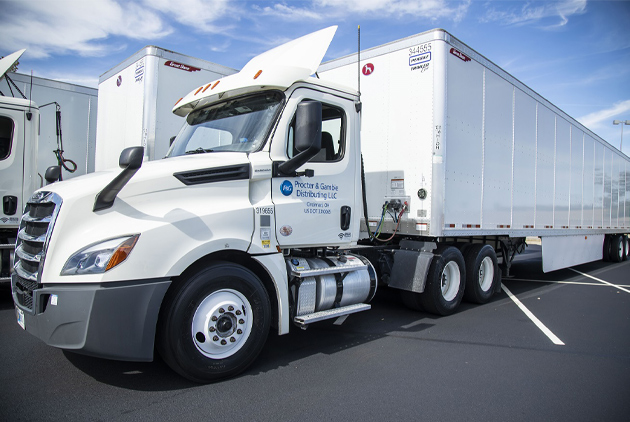
Source:Vanessa Chang
For international CPG companies, how can they drive supply chain sustainability? P&G Taiwan’s Supply Network Design (SND) may shed some light on this question.
Views
Achieving supply chain sustainability from supply network design
By Vanessa Changweb only
When talking about supply chain sustainability, people normally relate it to responsible material sourcing, resilience of suppliers, and reduction of carbon footprint in upstream manufacturing. For international CPG (Consumer packaged goods) companies operating in markets without any manufacturing sites, such as Taiwan, how can they drive supply chain sustainability? P&G Taiwan’s Supply Network Design (SND) may shed some light on this question.
In 2020, P&G made a bold commitment that its global operations would be carbon neutral by the end of the decade through the realization of Ambition 2030. It aims to enable and inspire positive impact on the environment and society through brands, the supply chain, partnership with society members, and employees, while creating value for the company and consumers.
 P&G will reduce its absolute greenhouse gas emissions across its operations and advance a portfolio of natural climate solutions to tackle climate change. (Source: Vanessa Chang)
In order to achieve a lower carbon supply chain, besides committing to 100% use of purchased renewable energy in global operations and eventually eliminating Scope 1 and Scope 2 emissions, P&G has committed to improve its global upstream finished product freight emissions efficiency by 50% by 2030 compared with 2020 baseline to cut Scope 3 emissions.
This groundbreaking Supply Network Design (SND) pioneered in Taiwan in a nutshell is to navigate the shortest routes to transport finished products from the manufacturing plants to the doorstep of consumers and reduce unnecessary local product repackaging. By doing so, it accelerates the transportation efficiency, saves operation cost, and massively reduces emissions at nearly 650 tons of CO2, or 1.2 times the amount of emissions absorbed annually by Da-An Forest Park in Taipei, in its first year of rollout.
This innovative supply network design was made possible with a thorough planning and integration of shipping operation, transportation and warehouse, data analytics and route planning. Vital components include:
1. Ship in Original Container (SIOC):
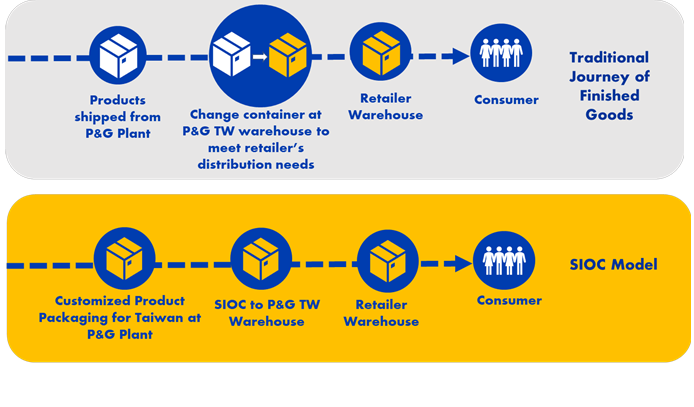
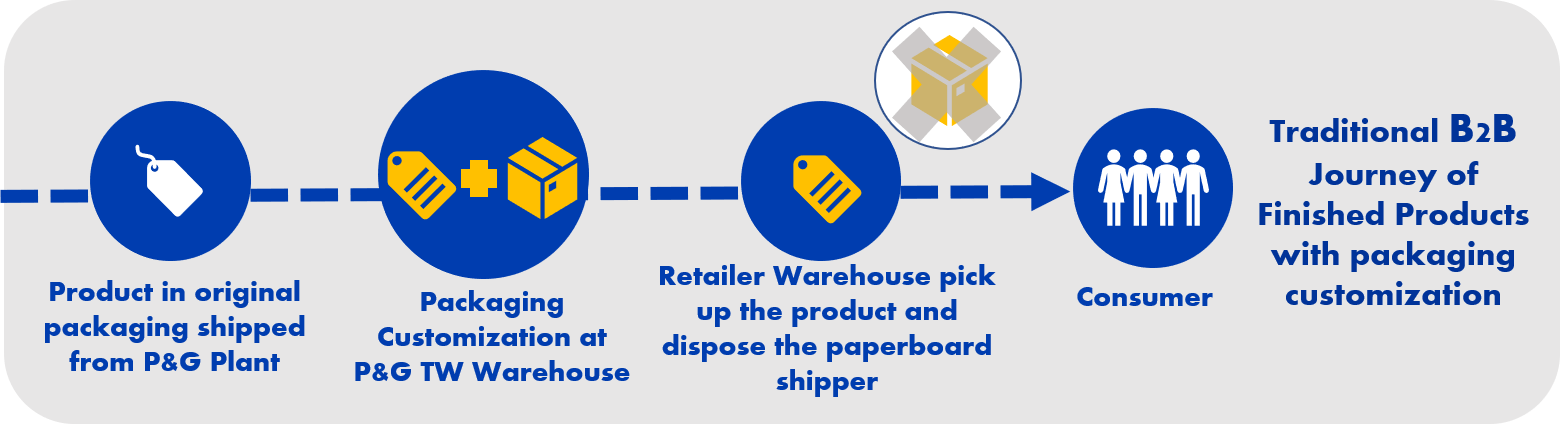
The design and production of product packaging has been tailored for the Taiwan market at manufacturing sites overseas, so that the finished products can be directly shipped to consumers in the original container (shipper) after arriving in Taiwan without repackaging. In traditional supply networks, imported finished products require customized repackaging due to local regulations and retailer distribution needs, which triggers a great amount of waste on packaging materials as well as manpower. With the fit-for-use packaging, P&G Taiwan’s warehouses are also able to ship the products to consumers without passing through the retailer’s warehouse, which then shortens the transportation route to consumers. Currently 50% of P&G Taiwan’s finished goods are in SIOC packaging.
 2. Advanced Order Visibility & Direct Plant Shipment (AOV & DPS):
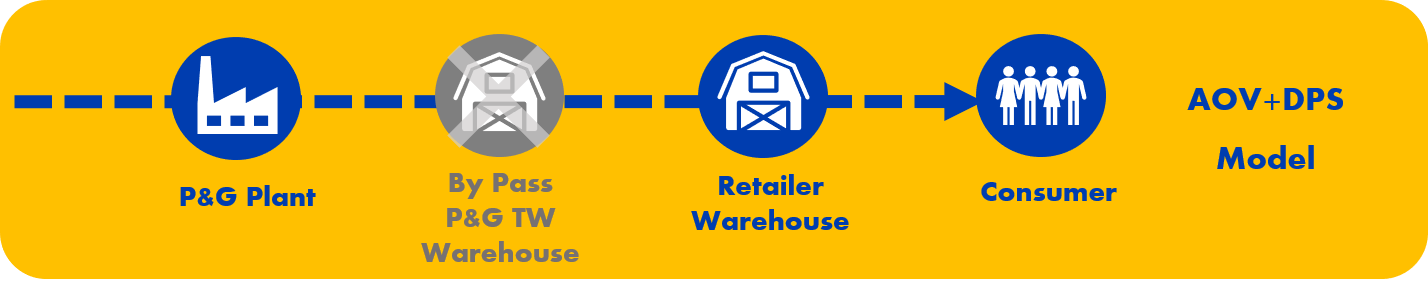
This unprecedented approach designed by P&G Taiwan local team is an optimization of SIOC and reflection of precise demand forecast data analysis in the supply network. The beauty of AOV & DPS is its elimination of supply nodes at P&G Taiwan warehouse so products are shipped directly to retailer’s warehouse, transportation efficiency hence increases. Besides, products in SIOC skip repackaging at retailer’s warehouses before being delivered to consumers, addressing operational efficiency, cost effectiveness from inventory reduction, and environmental sustainability.
The best demonstration of AOV & DPS is currently how P&G Taiwan collaborates with an e-commerce retailer – MOMO on the baby care brand, Pampers diaper. All of MOMO’s orders on Pampers are manufactured and packed in Pampers plant in Akashi, Japan and shipped all the way to Momo’s warehouse without stopping at any other P&G’s distribution center.

3. Circular Shipper:
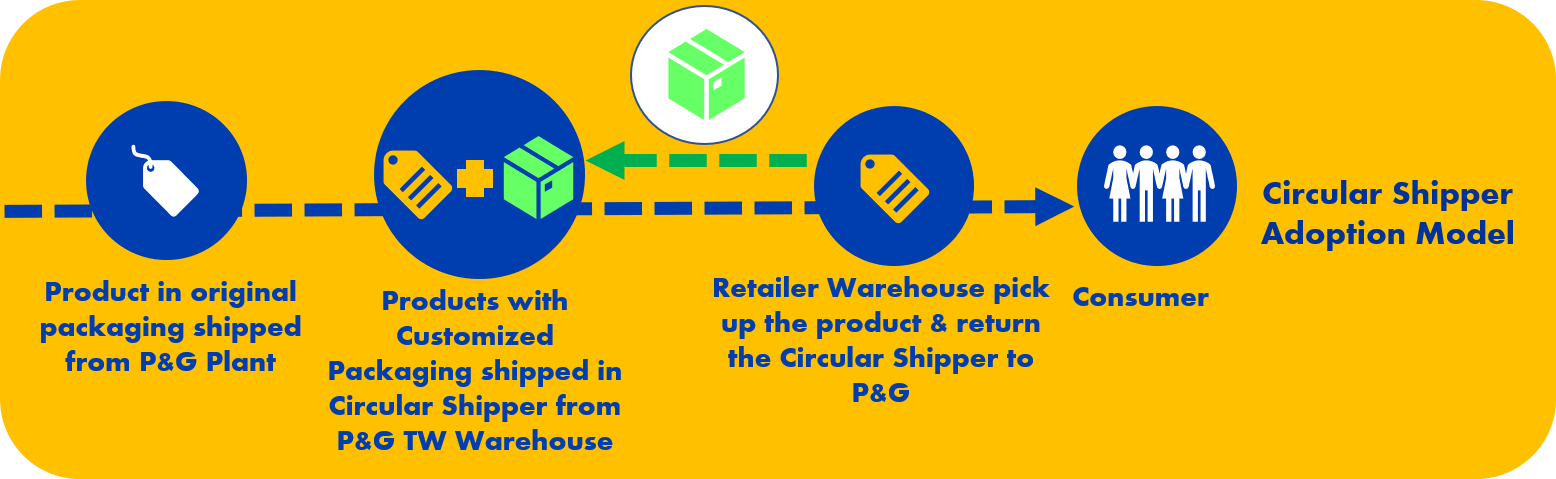
Optimizing the supply chain is not only critical for enhancing competitiveness and satisfying market demands, but also for building a circular and sustainable economy. To replace the traditional shipper of paperboard for products requiring local packaging customization when shipping from P&G to the retailer, P&G Taiwan are partnering with local startup Package+ (配客嘉) to experiment on the adoption of circular shipper, a foldable shipper made of recyclable material and reusable for approximately 50 times. The introduction of circular shippers tackles the single-use paperboard waste problem, an issue P&G Taiwan and retailers are facing.
To conclude, building a robust supply network with sustainability in mind lands the company plenty of rewards other than positive impact to the environment. It strengthens partnership with like-minded companies, optimizes operation efficiency (process and cost-wise), and most important of all, builds resilience and continuity of the supply network to respond to crises like COVID rapidly. Consumers nowadays also expect more from a company other than good products; they want to see brands and companies step forward to make meaningful differences in making the world a better place.
About the author:

Vanessa Chang is the head of Hong Kong/Taiwan Corporate Communications, P&G, currently located in Taiwan. She is also the head of Sustainability to lead step change to fulfill P&G Ambition 2030’s far-reaching goals through Brands, Supply Chain, Society and Employees.
Have you read?
♦ When will Taiwan go Carbon Neutral?
♦ APSIS 2021: Impact investment comes of age
♦ How can the Legislative Yuan accelerate SDGs in Taiwan?
Uploaded by Penny Chiang
Views

Subscribe to CWE Newsletter (every Thursday)
Stay abreast of what's happening in Taiwan with our weekly digest.
Keywords: