
Can Taiwan Learn From Japan’s Unmanned Service Industry?
Source:Pei-Yin Hsieh
Japan is looking for ways to alleviate manpower shortages caused by an aging population and a low fertility rate. While migrant workers, retirees, and women are encouraged to join the workforce, robots have become indispensable helpers, too. Can Taiwan—which has an even lower fertility rate and a faster-aging population—follow the Japanese model?
Views
Can Taiwan Learn From Japan’s Unmanned Service Industry?
By Yi-chih Wang, Chi-wei LinFrom CommonWealth Magazine (vol. 822 )
It is a cool, rainy day in springtime Tokyo. The crossing in front of Shibuya Station is no longer bustling with throngs of young people. The dearth of younger people and the resulting manpower shortage is obvious everywhere.
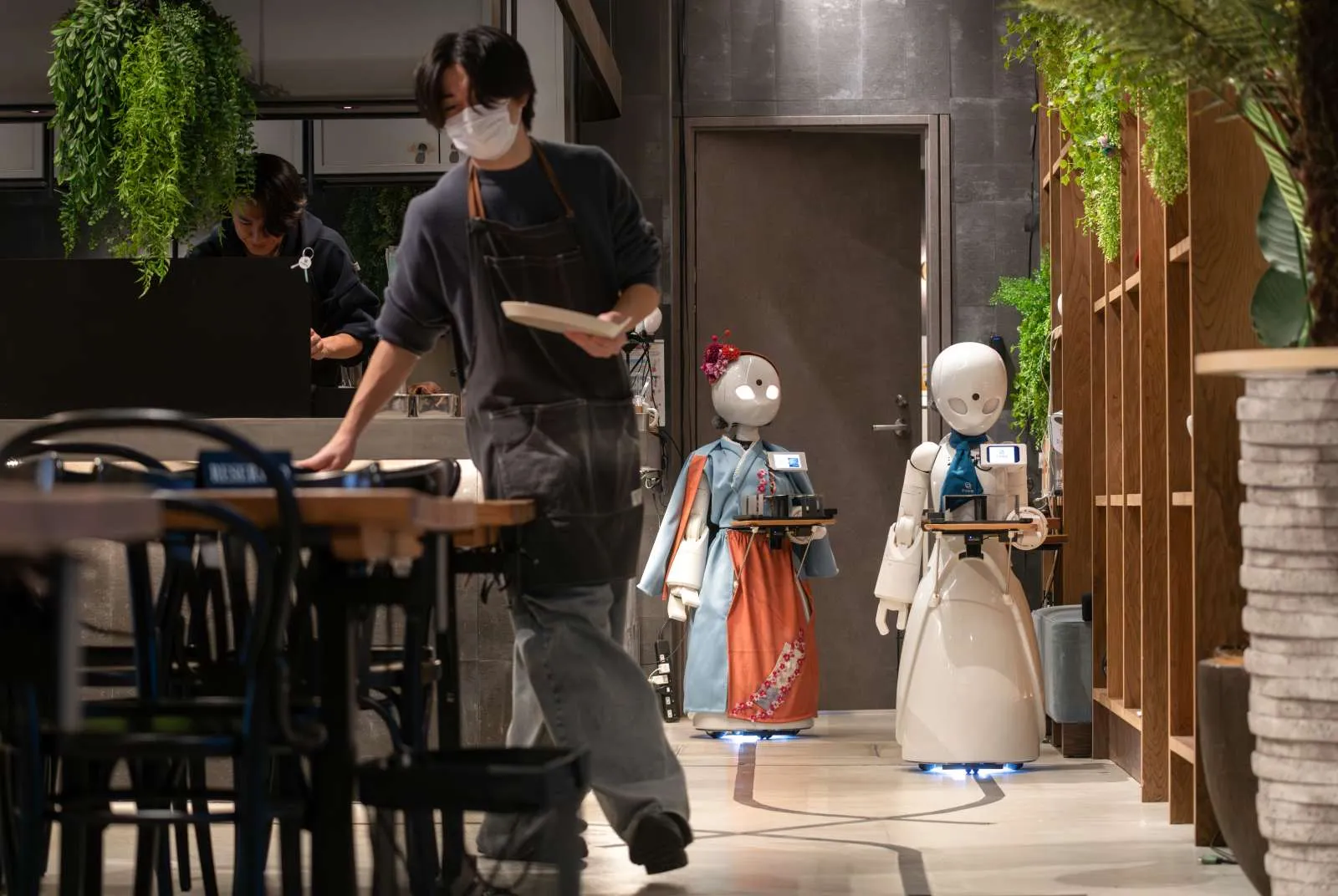
At Narita Airport, passport control is fully automated. Convenience stores are staffed by migrant workers. At chain hotels, automated check-in terminals have replaced reception staff. Clothing chain Uniqlo uses automated cashiers, and in restaurants, food is served by robots.
Japan’s trademark “omotenashi” hospitality culture is quickly making way for unmanned services and robot assistants as the workforce keeps shrinking.
Japan’s population has been declining for the past 15 years—and at an accelerating rate. In 2023, 342 companies closed due to a lack of workers, representing a 30 percent increase over the previous year. Overall, more than 10,000 companies went bankrupt.
Taiwan stands at the same starting line. This year, it officially became a super-aged society, aging even faster than Japan. It took Taiwan only seven years to transition from an aging society to a super-aged one.
The picture is even grimmer when it comes to fertility. Like Japan, Taiwan dropped below the “lowest-low fertility” threshold of 1.3 births per woman in 2003. But Taiwan’s total fertility rate is now even lower than Japan’s. This means Taiwan has an even more fragile foundation for its future labor market.
Japan invested more than US$440 billion over 30 years to encourage childbearing. Yet the decline persisted. Today, Japanese society is confronting the issue head-on: instead of relying solely on boosting birthrates, it's also restructuring work and lifestyle models.
From Resistance to Transformation: How Japan Tackles Manpower Shortages
Japanese society has undertaken reforms in six major areas, including measures to entice more women and retirees to rejoin the labor force. The government encourages companies to abolish mandatory retirement, promotes women to management positions, and introduces flexible work hours as well as consultant- and project-based roles.
As a result, Japan’s working population has remained close to 70 million over the past six years, with women and older adults playing a key role.
When female and retiree labor participation hit its limits, Japan began importing more foreign labor. In 2023, 3.769 million foreigners lived in Japan, accounting for 3.1 percent of the population. While this is still lower than Taiwan’s 7 percent or Singapore’s 25 percent, the trend is clearly upward.
Japan has relaxed residency requirements and expanded job categories for foreign workers. It is also improving their living conditions and Japanese language education to ease social integration and reduce friction.
Facing labor shortages, Japanese companies are also transforming: automating processes, shifting toward high-value industries, streamlining workforces, and boosting productivity per worker. From convenience stores to factories, businesses are seeking ways to operate with fewer people.
Rise of a New Work Pattern
To attract those who can and want to work, Japanese companies now offer more flexible arrangements. One example is “super-short” part-time jobs, which pay after just one hour—an appealing option for those who can only work briefly.
Remote work, four-day workweeks, improved hours, and higher wages have also become part of the corporate strategy—not just to ease labor shortages, but to prepare for a workplace transformation.
When work models are more flexible and hours shorter, groups traditionally considered unsuitable for employment—such as people with disabilities—can now participate, helping ease workforce shortages.
From Excessive to Limited Convenience
On the consumer side, the Japanese are adjusting to a life of limited convenience.
Over 6,400 convenience stores—roughly 12 percent of the total—have shortened their business hours due to staff shortages. More are expected to follow.
New labor laws are capping overtime hours, forcing society to rethink the expectations of instant delivery and on-demand services.
This isn’t a return to the inconvenient past—it’s a shift away from “excessive convenience” toward a lifestyle that values “moderate inconvenience.”
Blurring Lines Between Consumers and Workers: The New Normal of Man–Machine Coexistence
As self-checkout spreads in stores and supermarkets, consumers are also becoming part-time workers. In the future, service delivery will rely on human-machine collaboration.
Interacting with robots, avatar clerks, and AI agents has become a daily norm. Interestingly, consumers often feel more comfortable engaging with virtual representatives than real people.
“When discussing insurance needs, people often hesitate to disclose private matters to a real person, but they open up more to a virtual assistant,” notes Hiroshi Ishiguro, a professor at Osaka University and a pioneer in robotics. In insurance sales, AI agents have already outperformed humans.
While Japan has cautiously and gradually embraced automation, this iterative approach is breaking with its traditionally conservative culture and enabling breakthroughs in an era of labor scarcity.
Taiwan Faces Even Tougher Challenges
Japan took 30 years to reach its current state, but Taiwan is on a tighter clock. Its population is aging faster, and its fertility rate is even lower. Without early intervention, Taiwan’s labor market and social structure may unravel faster than Japan’s.
Taiwan must act now—by promoting new work models, accelerating automation, and reforming its migrant labor policies—if it hopes to survive this silent crisis through successful transformation
Have you read?
- Foxconn Medical Bots at Nvidia GTC Heralds the Dawn of Smart Healthcare
- Beyond the Chip: TSMC's Innovative Blueprint for Green Manufacturing at 2025 North America Technology Symposium
Translated by Susanne Ganz
Uploaded by Fiona Lin
Views

Subscribe to CWE Newsletter (every Thursday)
Stay abreast of what's happening in Taiwan with our weekly digest.
Keywords: