[Exclusive] NSC Secretary-General Joseph Wu: “What We Fear Most Is a Public Grown Numb to China's Pressure”
![[Exclusive] NSC Secretary-General Joseph Wu: “What We Fear Most Is a Public Grown Numb to China's Pressure”](https://cdn-cw-english.cwg.tw/article/202608/article-6a714cfac4b65.jpg)
Source:Chien-Ying Chiu
As China intensifies its gray-zone pressure across the Taiwan Strait and the first island chain, Taiwan's National Security Council Secretary-General Joseph Wu warns that the greatest risk is a public growing numb to Beijing's coercion. In this rare exclusive interview with *CommonWealth Magazine*, he explains Taiwan's response strategy—and asks a pressing question: Can Taiwan and its partners prevent coercion from becoming the new normal?
Views
[Exclusive] NSC Secretary-General Joseph Wu: “What We Fear Most Is a Public Grown Numb to China's Pressure”
By Kwangyin LiuCommonWealth Magazine
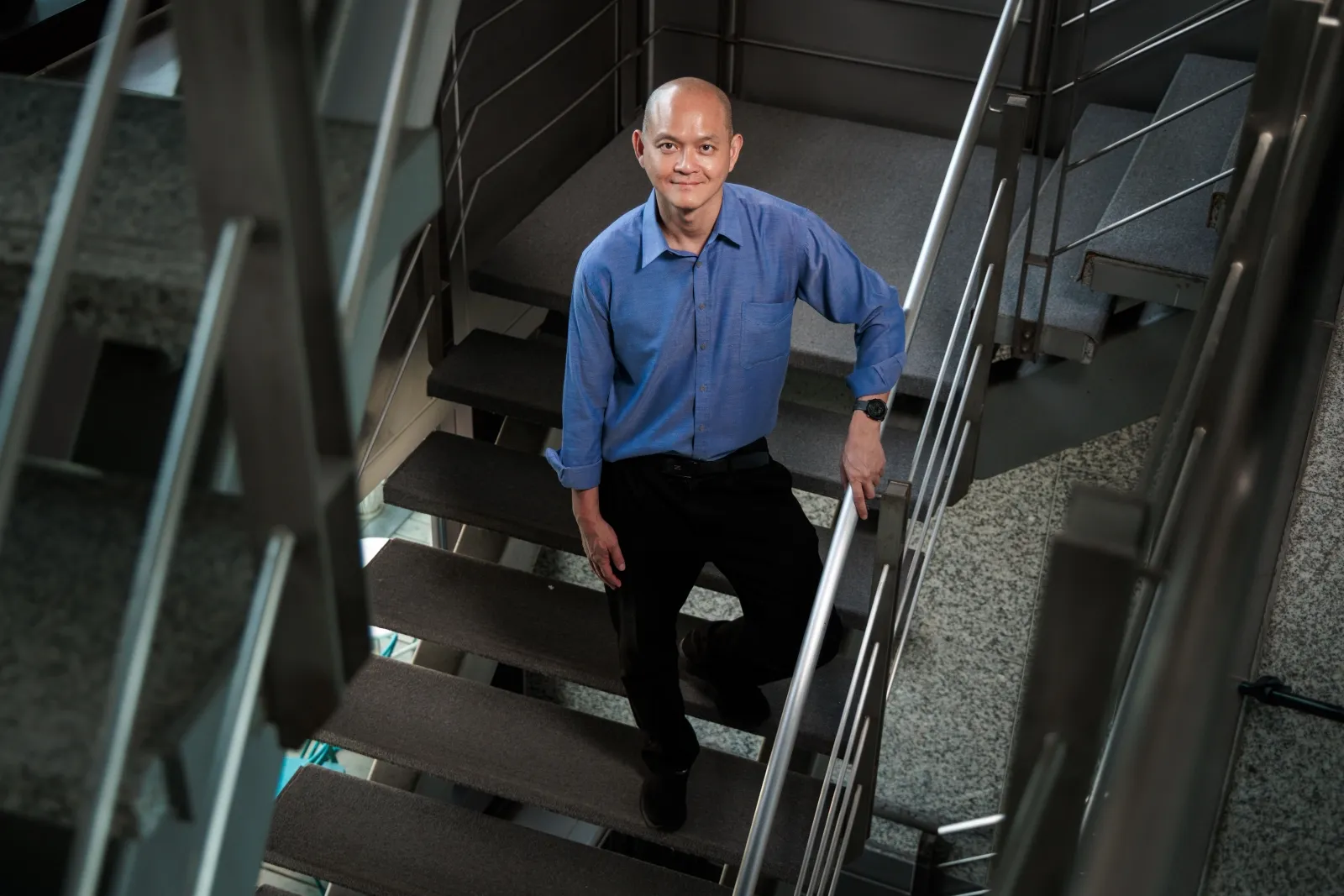
A sitting National Security Council secretary-general granting a media interview is almost unheard of. But Joseph Wu (吳釗燮) agreed to an exclusive interview with CommonWealth Magazine, driven by the escalating issue of Chinese coast guard incursions.
The timing may not be a coincidence. Taiwan and the broader first island chain are facing what officials describe as the most severe gray-zone pressure campaign in memory.
Since 2024, large-scale Chinese naval exercises twice a year have become routine, with their range now extending beyond the first island chain toward Guam. This June, amid Japan-Philippines negotiations over economic sea zone boundaries, China sent coast guard vessels into waters around Taiwan a record 263 times.
For the first time, one broadcast law-enforcement claims at commercial ships off Taiwan's east coast; for the first time, Chinese vessels entered restricted waters around Taiping Island (Itu Aba), Taiwan's largest holding in the South China Sea.
"What we fear most is a public that grows numb to this," Wu said repeatedly during the interview. "China wants to establish a fait accompli. Over time, people would start to think this is just how things are — that's the most dangerous outcome."
Edited excerpts of the interview follow.
Q: What trends are you seeing in China's gray-zone pressure on Taiwan and the first island chain?
A: Taiwan has long faced gray-zone pressure from China, including cognitive warfare. Late last year, Japanese Prime Minister Sanae Takaichi said that "a Taiwan contingency is a Japan contingency," and China's pressure on Japan increased in response. But this isn't just about Taiwan or Japan — China's pressure is expanding across the entire first island chain.
It started in 2012, when Chinese coast guard vessels were present near the Diaoyutai Islands more than 300 days a year. In 2013, China declared an air defense identification zone (ADIZ) over the East China Sea. In 2014, it announced the M503 international flight route. In the next year, Xi Jinping told Washington China would not militarize the South China Sea — yet afterward, China kept expanding its control of reefs and islands, dredging sand and building land, turning them into massive military bases.
In 2022, China's foreign ministry said there was no such thing as a median line in the Taiwan Strait; later it said the strait wasn't international waters. After then-U.S. House Speaker Nancy Pelosi visited Taiwan that August, Chinese fighter jets began crossing the median line without pause.
By late 2024, China mounted a massive naval mobilization, deploying vessels from the East China Sea around Taiwan to the South China Sea and western Pacific — nearly reaching Guam. China is expanding outward, step by step.
Q: Some maritime experts say China has already begun a "quarantine" of Taiwan's sea access. What's your assessment?
A: It's an obstruction of maritime traffic and trade. We're identifying possible scenarios and making the necessary preparations. If China's expansion isn't checked, its military and coast guard deployments around Taiwan will keep growing, and a future blockade will become easier to carry out.
What we fear most is public complacency. China wants to establish a fait accompli — over time, people start to think "this is just how it's always been" and stop reacting.
Countering this rising maritime coercion requires a whole-of-government response. The National Security Council has set up a platform involving the Ministry of National Defense, the Ministry of Foreign Affairs, the Maritime and Port Bureau under the Ministry of Transportation and Communications, the Coast Guard Administration, the Ministry of Economic Affairs, and the Fisheries Agency under the Ministry of Agriculture, all of which must establish clear response protocols.
Over the past year, the Ocean Affairs Council has adopted a transparency strategy, with the Coast Guard Administration publishing a dedicated "gray zone" section on its website disclosing the frequency of Chinese coast guard activity.
Since June, the Maritime and Port Bureau's maritime center has begun monitoring incursions and false law-enforcement actions by Chinese coast guard vessels, issuing alerts to fishing and commercial vessels.
We recognized as early as 2016 the potential future impact of China's coast guard on Taiwan. In 2018, we began building 141 coast guard vessels; after President Lai Ching-te took office, we invested in 46 more, with delivery of the full fleet expected by 2033. We want the international community to see that Taiwan has the resolve to resist.
Q: The "status quo" we once spoke of has been eroded gradually — like salami slicing. Based on past experience, what has effectively deterred China or slowed its pace?
A: Our basic principle is that we won’t do what China does. Dredging sand to build islands in the South China Sea, for instance, is illegal and violates international law — we absolutely cannot do the same. If Taiwan only pursued its own interests by mirroring China's actions, how would we be any different? Our bottom line is upholding a rules-based international order. We stand with international law, and to win the international community's support, we need to be firmer in that stance.
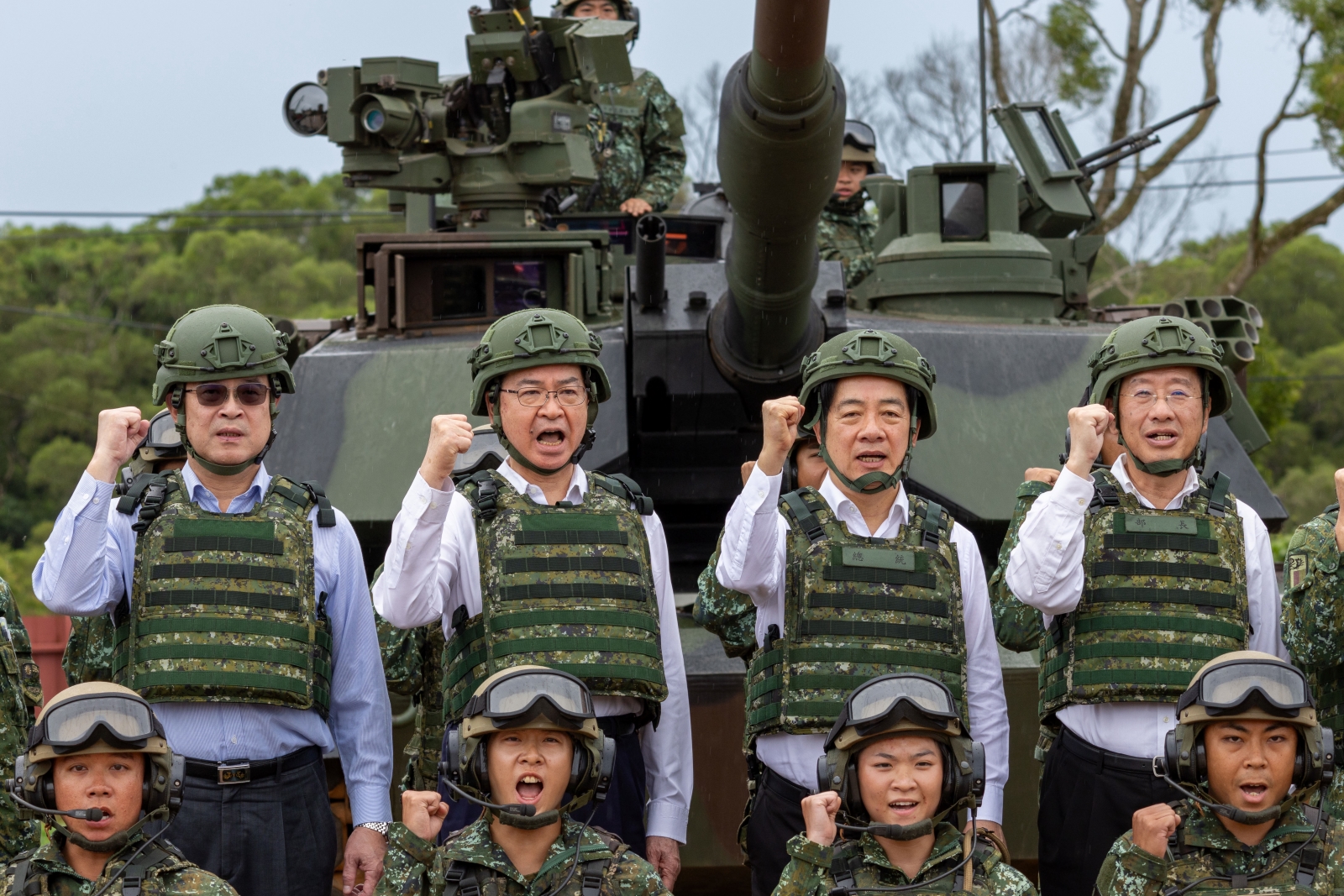 Taiwan continues to strengthen its self-defense capabilities. Pictured in 2025 are (from left, second row) National Security Council Secretary-General Joseph Wu, President Lai Ching-te, and Minister of National Defense Wellington Koo. (Photo: Chien-Tong Wang)
Past experience shows collective international deterrence works. In 2013, when China's Ministry of National Defense unilaterally declared an East China Sea ADIZ, it drew strong opposition and diplomatic protests from the U.S., Japan, South Korea, and others — damaging China's international standing and slowing its momentum, at least somewhat.
We maintain very close contact with foreign representative offices in Taiwan — there isn't a single day we don't communicate. The greater the mutual trust, the more willing they are to speak up when we need support.
We also keep communicating externally. The Philippines, for example, has faced Chinese incursions in the South China Sea and its coast guard has spoken out consistently, winning international response and support.
What we can do is pursue strategic communication so more countries understand the challenges Taiwan faces. We're open to cooperation with any country's coast guard willing to work with us.
Q: In early July, in a speech at an ocean forum dinner, you compared Taiwan to the Sudetenland before World War II. Why?
A: In 1938, European countries believed that ceding the Sudetenland to Germany would buy peace for everyone else. Similarly, some voices in the international community today say Taiwan has nothing to do with their national interests, and that letting China have Taiwan could buy peace.
But peace in the Taiwan Strait is inseparable from global security and prosperity. If Taiwan were taken, the pressure on neighboring countries would only intensify. If China seized Taiwan's semiconductor and ICT industries, that threat would be more serious than losing access to rare earths.
Q: The international community has often cited 2027 or 2032 as potential flashpoint years for a Chinese attack on Taiwan. Is China's intensifying pressure at sea and in the air preparation for a specific timeline?
A: China's goal is continued expansion. Our preparation is aimed at ensuring that if China ever makes an unfavorable decision, it cannot achieve its objective. Any failed war would be the greatest damage possible to China's leadership. If they see that we're prepared, I believe they'll hesitate regardless of the year.
China's military studies Sun Tzu's The Art of War closely — the principle of "attacking the enemy's strategy" first. Their highest standard should be "subduing the enemy without fighting." The pressure they apply on Taiwan is meant to break our will to defend ourselves, so they can take Taiwan without firing a shot. The government's responsibility is to ensure we have both the capability and the will for self-defense.
Q: The Republic of China's position — from the Diaoyutai Islands to the South China Sea to Taiping Island — holds that sovereignty over these areas belongs to us. How do we balance defending sovereignty with cooperating with Japan and the Philippines?
A: Our sovereignty claim over the Diaoyutai Islands is beyond doubt, but it should be discussed peacefully, which is why the Taiwan-Japan fisheries agreement exists. The same logic applies to the Taiwan-Philippines interactions in the South China Sea: our position is grounded in international law and the spirit of dispute resolution. Since the 2016 South China Sea arbitration ruling, the government's four principles and five approaches announced at the time remain unchanged.
Have you read?
- Taiwan Faces Uncertainty after Trump-Xi Summit
- After Xi Meets Taiwan Opposition Leader, Is Taiwan Being Recast as a “Domestic Affair”?
- KMT Chairperson Cheng Li-wun: Taiwan Should Not Take Sides
Uploaded by Ian Huang
Views

Subscribe to CWE Newsletter (every Thursday)
Stay abreast of what's happening in Taiwan with our weekly digest.
Keywords: