Taiwan Model
The Pandemic is a Reminder We Should Learn to Do Better with Less
Source:Shutterstock
Taiwanses are very lucky not to experience a lockdown. However, for many people, the lockdown was crucial to understand that our complex societies are actually fragile and could collapse. Although Taiwan has prevented the epidemic successfully, there are many challenges to face in the future.
Views
The Pandemic is a Reminder We Should Learn to Do Better with Less
By Sarah Oliveiraweb only
When my husband and I planned to come back to live in Taiwan this year, we did not imagine that it would be such a special year… And that Taiwan would be “another planet”, safe from Covid-19, while almost the whole world is suffering.
It was not easy to travel, we had to meet many requirements, it felt like being Mario Brothers in the video game of my childhood, overcoming challenges one by one. But everything went smoothly. Of course, the quarantine was not easy but Taiwanese friends kindly brought fruits to the hotel and we did not lack anything.
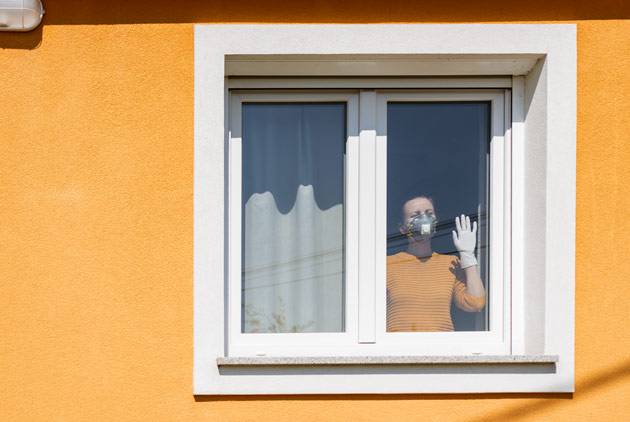
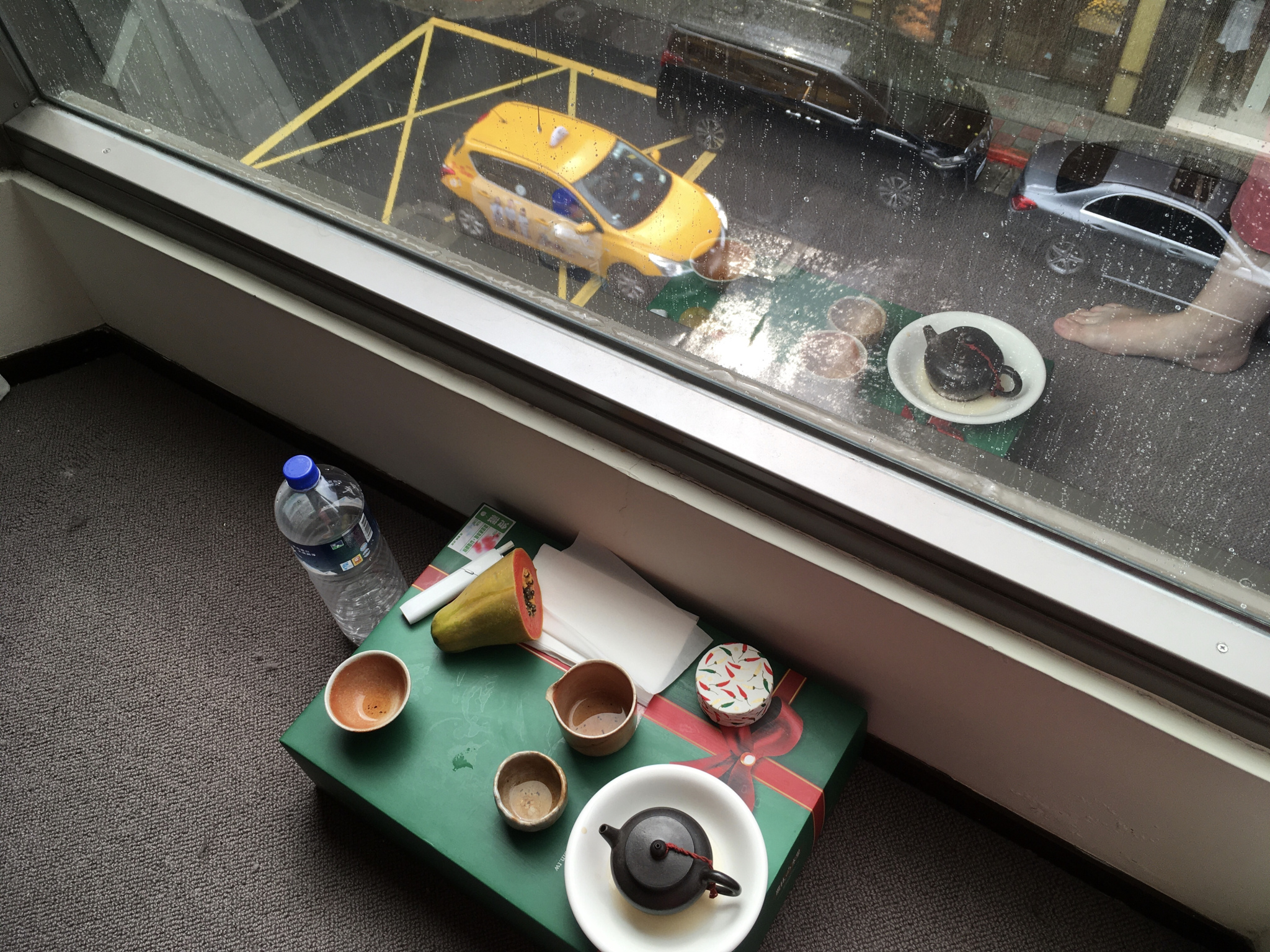 A picture from the window of the hotel during quarantine in Taipei. ( I really like this picture, because this window saved our life, by giving us a view on the world, during the 2 boring weeks of quarantine! we also brought our Taiwanese teapot to 泡茶 everyday!)
Taiwan is an inspiring model for its strategy: taking early measures to stop the epidemic, being innovative through digital technologies while also promoting low tech (how to re-use masks), and above all, upholding democracy and human rights as much as possible.
We should also thank Taiwan warmly for giving masks to many countries which needed them. It is a pity for the international community that Taiwan can not participate in WHO.
But there are still many challenges ahead.
Taiwanese people were very lucky not to experience a lockdown. However, for many people, the lockdown was crucial to understand that our complex societies are actually fragile and could collapse.
We experienced how vulnerable we are, and mutually dependent with other generations, other species and people from other countries.
We discovered in France that we did not have such simple things as masks, because the production was totally outsourced abroad. We became aware that the most important workers to keep us alive were paid low salaries, while the better-paid people who could work from home often felt that they had “bullshit jobs” (as described in David Graeber's book). We realized that we may wake up one day in a country where most of the restaurants closed down and all artists ended up unemployed.
We also asked ourselves, how can we survive in big cities if the supply chain for food, water or energy is broken? It is not a silly question, as we all know that climate change, the severe erosion of biodiversity, the exhaustion of resources, the widening economic inequalities will bring many difficulties in the near future. We are definitely not prepared.
More and more people are realizing that we took everything for granted and that it is now time to change our way of life. It is easier to say than to do it, but the new direction is clear: to engage in regenerating nature and social ties, to respect the limits of our planet, to get out of the over-consumption society and the dependence on fossil fuels, in order to reduce carbon emissions, to be more sustainable and resilient. As Navi Radjou puts forward, “Doing better with less” while giving more meaning to our lives can be an exciting prospect!
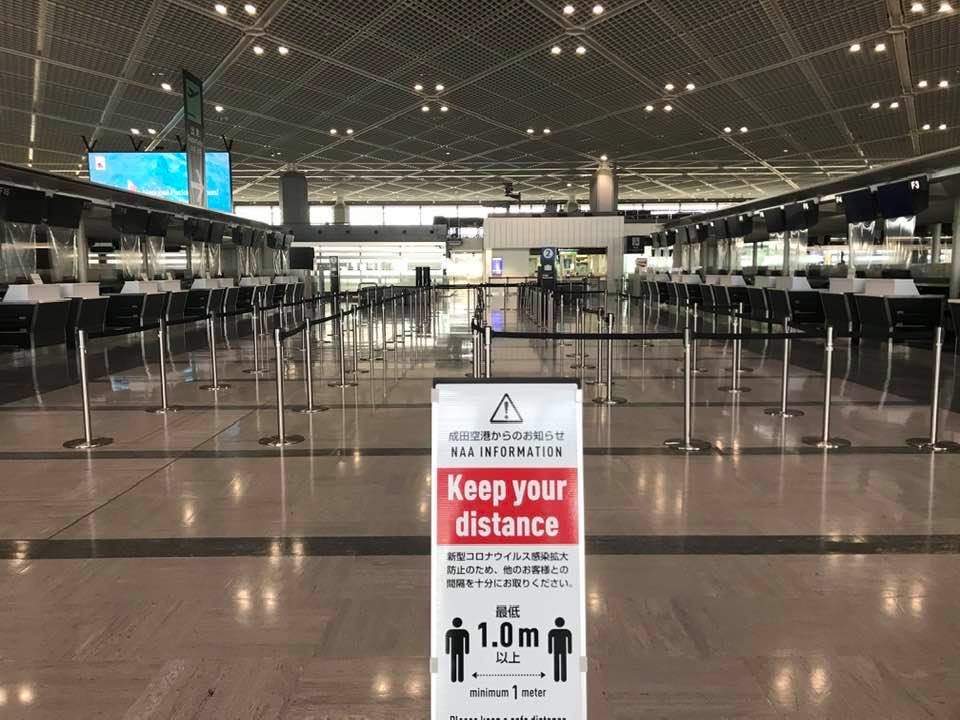 A picture of Narita Airport in Tokyo when we took the plane, as you can see it was not difficult to respect social distancing, as the airport was almost empty, most of the flights were cancelled, it was stunning.
Taiwanese people also probably asked themselves many existential questions during this epidemic, but they might not feel the same urgency, as the “business as usual” is still working here. As we all know, Taiwan will be affected very severely by the consequences of climate change. The most difficult has yet to come, beyond Covid-19.
The changing geopolitical situation is also bringing new challenges: Taiwan’s security partner, the US, appears weakened by this epidemic. Many countries worldwide, even in Europe, are facing an erosion of democracy, as security became the top priority of governments, at the expense of freedom. China is trying to take advantage of this crisis to promote its model.
The Covid-19 also raises a thorny issue: how to make proper use of digital technologies to efficiently prevent the virus from spreading while safeguarding human rights, privacy and democracy, and avoiding the collection of sensitive data which could be used for surveillance by States or big corporations. Taiwan, as a dynamic democracy, could contribute to the reflection, and maybe set an example for other democracies.
Last but not least, the travel restrictions due to Covid-19 are isolating Taiwan. Digital communication can not completely replace human interactions. There could be innovative ways to address this, such as inviting scholars, artists and civil society people from many countries for long-term residencies in universities or in partner organisations, to foster exchanges of experiences and co-creation. It would require an investment but strengthening human ties and becoming a major knowledge hub would considerably benefit Taiwan’s soft power.
Taiwanese people overcame many crises in the past, and I am confident that they will find creative ways to address the upcoming challenges. Their inventiveness is a source of inspiration.

About the author:
Sarah Oliveira, from France, works in media, cultural diplomacy and translation. She currently lives in Taiwan but also lived in Japan and Cambodia in the past.
Have you read?
♦ Pandemic in a Willingly Prepared Society
♦ Taiwan’s Health Tech success lies in Global South Collaboration
♦ Taiwan needs to build a brand image beyond COVID-19
Uploaded by Penny Chiang
Views

Subscribe to CWE Newsletter (every Thursday)
Stay abreast of what's happening in Taiwan with our weekly digest.
Keywords: