From the Margins into the Spotlight: Lessons from the Increase in International Media Coverage on Taiwan
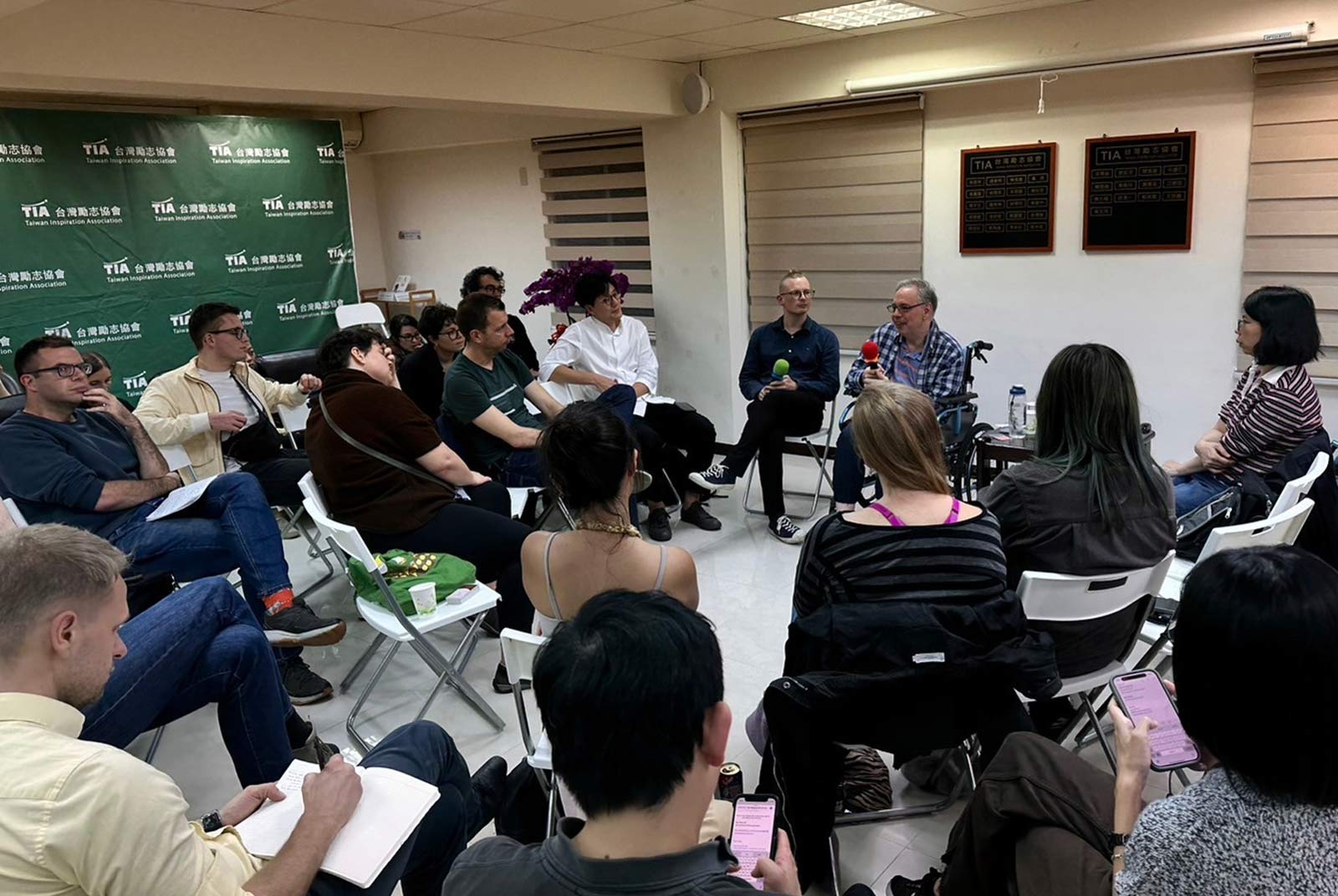
Source:TMWA
The surge in international media coverage on Taiwan comes at the risk of oversimplified narratives and political co-optation. But Taiwan also provides a hopeful example of how media attention can be built for a place that once was on the margins – and it could set a precedent for Western media to redefine some of their exploitative reporting practices worldwide.
Views
From the Margins into the Spotlight: Lessons from the Increase in International Media Coverage on Taiwan
By Leonardo Papeweb only
When I arrived in Taiwan in late August 2022, the dust had just settled after Nancy Pelosi’s visit. At the time, it felt strange to imagine the uproar during her stay and the menace of the Chinese military exercises that followed – as so often, things in Taiwan seemed calm and peaceful at first glance.
But more than anything, Taiwan seemed mysterious to me.
I had read an outline of the island’s history during my seven days of quarantine, and many things had left me puzzled. I had only then found out about the history of Japanese colonialism, about the different waves of settler colonialism in the Ming and Qing dynasties and the Chinese Civil War. Neither had I thought deeply about the conflicted political heritage of the Republic of China, about the fact that Taiwan had been exclusively inhabited by Indigenous groups until barely more than 400 years ago and had likely been the cradle of Austronesian civilizations in the Pacific.
Admittedly, I had initially decided to come to Taiwan because my path to China had been barred by the pandemic and by the sheer impossibility to just work there as a freelance journalist without formal accreditation. To a degree, my decision had been predetermined by external circumstances.
Fortunately, I would encounter many, many great companions in the time that was to come. I never regretted coming to Taiwan even one bit. And I met surprisingly many people who were a bit like me – at the early stages of their reporting careers, rather new to Taiwan, and sincerely curious to discover and understand. We could thrive in the media space because Taiwan had just started to draw more and more international attention, but not long enough for established media to fill up all the spaces. At the same time, the cost of living in Taipei was and is still more affordable than in other East Asian metropolises such as Tokyo, Seoul or Hong Kong.
So, it felt to me that most of us who met at Taiwan Foreign Correspondents Club happy hours and political press conferences still tried to make some sense of this place that we were supposed to explain to the world. There was something fluid and unsettled about the whole media landscape, and I found many people motivated to come up with new initiatives and ideas.
Grand narratives
Surely, the grand narratives about Taiwan had already emerged – the story of the vibrant democracy fending off Chinese aggression, the semiconductor economy crucial to global technological development, the positioning of Taiwan as a battleground of China-US geopolitical conflict. But those narratives always left and continue to leave a lot unexplained about Taiwan’s societal and political complexity.
During my time in Taiwan, I tried to develop my own style of reporting. This text is an attempt to reflect on my own practices and on questions that many foreign journalists in Taiwan face in different forms and degrees. Others have probably thought about these questions longer and harder, and may well have arrived at different conclusions.
The story of democracy vs. authoritarianism
One starting point for my reporting has been a certain unease with the overarching narrative of Taiwan at the forefront of the global battle between democracy and authoritarianism. It is not so easy to put the finger on where this unease came from exactly. After all, Taiwan really is a democratic society defending itself against a threat of takeover through an authoritarian state.
Very personally, some of the estrangement that I have felt about separating the world neatly into democracies and authoritarian states derives from the historical background of Western colonialism and its still largely unresolved heritage. I am very far away from simply subscribing to the statement that the so-called western world is on the right side of history.
But even though Taiwan has its own colonial history, it has not suffered from European colonialism in the same way as great parts of Southeast Asia, Africa and Latin America. And one might say that in the context of the very real threat from China, Taiwan is one of the places in the world where the narrative of democracy vs. authoritarianism actually does hold up most neatly.
The work of a journalist at home and abroad
A greater source of unease I have felt is about international media becoming a political proxy in geopolitical rivalries and serving government agendas.
The role that many foreign journalists play in political discourse is a bit curious if you contrast it with the traditional archetype of a journalist within their home society. Journalists are chiefly supposed to hold power to account, to give a balanced counterview against governmental PR, to enable the public to form informed opinions and thereby support vigilant democratic debate. That is the ideal, at least. But coming to Taiwan, I suddenly felt that instead of being busy holding power into account, I seemed to stand on the same side with Taiwan’s government in its resistance against the Chinese threat – and stories with such an angle made up the bulk of reporting that I did for German media.
Of course, one can rightly say that this reporting serves to hold the power of the Chinese government to account, but for me it still felt strange to find myself placed in the same ideological camp as the government of Taiwan, the country I worked in. In the end, every journalist needs to be aware of the risk of being co-opted for political agendas. One may incidentally agree with the agenda, but one needs to stay vigilant.
Can we tell a story of Taiwan without China?
To be sure, not all questions in Taiwan’s society and politics circle around the Chinese threat, and I found that it is part of the job of a reporter to do justice to the societal complexity and diversity of Taiwan.
In a lecture on Taiwan’s Indigenous heritage, a speaker phrased this challenge as a question: ‘Can we tell a story of Taiwan without China?’. This reminded me of an idea that had been very formative in my thinking about post-colonial societies in Africa and Latin America.
The Nigerian writer Chimamanda Ngozi Adichie had talked of ‘the danger of the single story’, the risk of looking at a person or society only with one lens. Adiche originally alluded to the ‘single story’ of certain societies being captivated in perpetual poverty. She warned that such a single story could reinforce racist stereotypes and diminish the complexity and agency of individuals and whole societies.
Taiwan’s single story of the strong and resilient democracy fighting off China sounds a lot more uplifting than many other narratives of post-colonial societies around the world, and it also ascribes a degree of agency. But it still produces an overly narrow view of a very complex society.
The approach of human-centered reporting
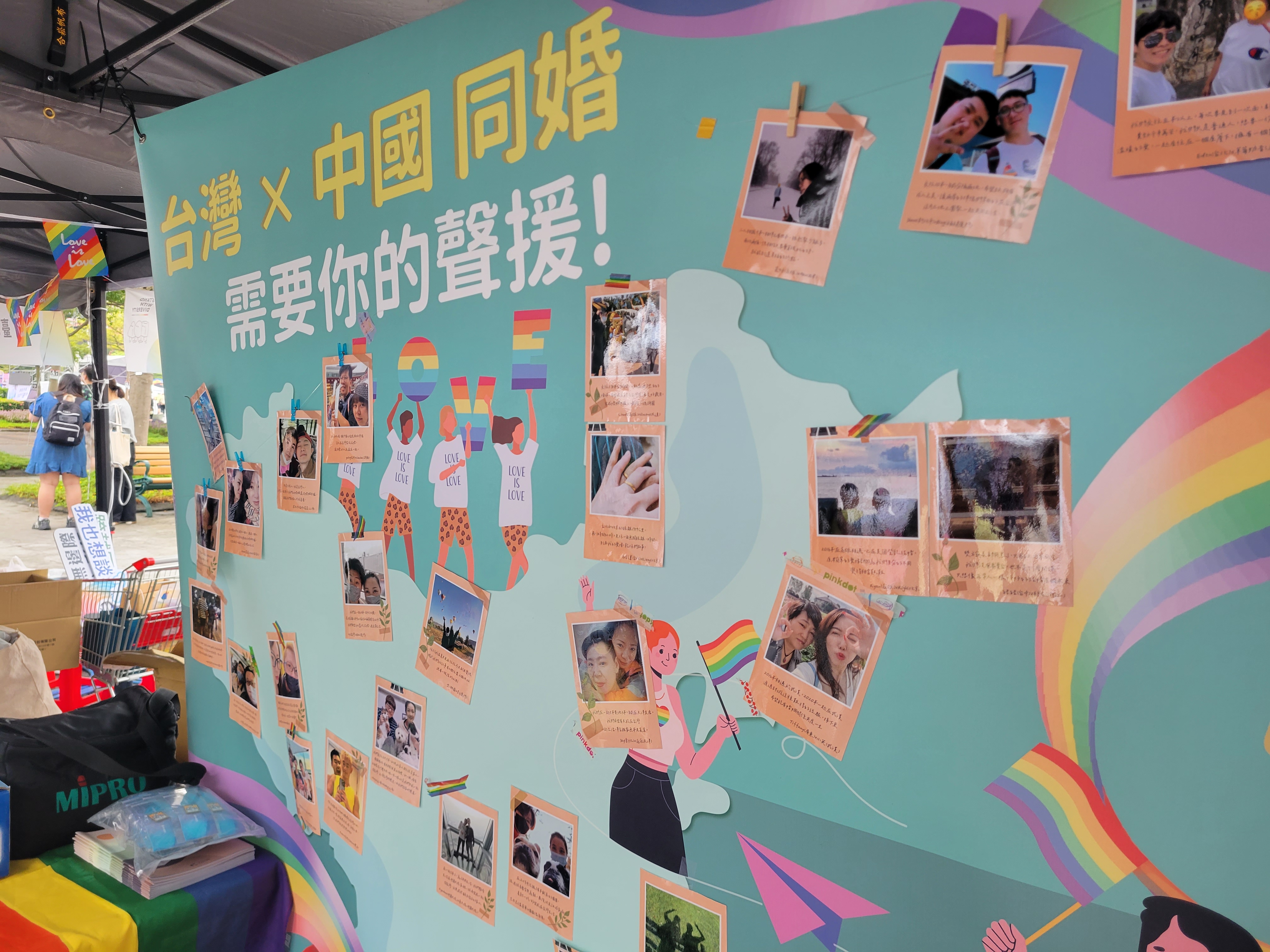 Taiwan and China's same-sex marriage advocacy. (Source: Leonardo Pape)
My personal way of dealing with the dilemmas of working in the politically charged environment in Taiwan is something that I would call human-centered reporting.
First, this means to me to trace back grand political and economic narratives to realities on the ground. Visiting different parts of Taiwan and trying to incorporate people of various social classes, ethnicities and political backgrounds into my reporting, has served to me as a reality check, a way of monitoring if the grand narratives were actually in touch with societal realities, and to give more nuance to them.
This attention to realities on the ground also means not to treat people as quote deliverers for the stories we would like to have. People tell their own stories, and whoever listens closely enough, will find that virtually no one tells the exact same story that we thought they would tell, or that we secretly hoped they would tell. Whoever has seriously talked to various people in Taiwan about their perception of China or about issues around cultural identity, will have found that answers are rarely as clear-cut as one might expect.
The majority of the population is indeed worried about the Chinese threat, but in other ways than external observers may assume: While international media attention on Taiwan spikes during Chinese military exercises, most Taiwanese remain rather unimpressed in these moments. Likewise, while the vast majority wants to preserve Taiwan’s open and democratic society and political system, how this goal can best be achieved is very much up for political debate.
And while around two thirds of the population have indeed moved away from the notion of having a Chinese cultural identity, the question of what being Taiwanese means exactly is still very much unresolved. In Taiwan’s open and increasingly diverse society, this kind of ambiguity is itself an essential part of social reality.
All these matters are open-ended, and the key to our understanding of Taiwan lies in listening closely to the diverse attitudes and opinions within its society.
Reflecting on my own interviewing practice, I found that it is very challenging to take people truly seriously. It requires patience, practice, dedication, often set against deadlines and specific expectations of editors and foreign audiences. I was lucky to work with editors back in Germany who gave me discretion to forge my own stories and put forward my own judgments.
But I did hear about a number of journalists (especially those parachuted into Taiwan) arriving with specific stories in mind and expecting interviewees – as well as local fixers – to deliver befitting statements, and about editors back in the West who expected very specific stories while being largely unaware of realities on the ground. The portrayal of the Kinmen islands in international media coverage is exemplary – reports often focus on their past military battles and their potential role in future conflict. The themes may be legit, but the perspectives of Kinmen people, who mostly hope to avoid open confrontation with China, have often been neglected.
Looking for the ‘bigger picture’
One of the most memorable stories I had the chance to report on in Taiwan was a feature on Taiwanese-Chinese transnational same-sex couples and their fight for legal recognition. As of now, Chinese citizens are still barred from entering into same-sex marriages with Taiwanese nationals, while the restrictions of transnational marriage of Taiwanese with citizens of all other countries have been lifted over the last years.
One could claim that such a story may not be invalid but still rather neglectable in relation to the overwhelming Chinese threat, the ‘bigger picture’. I also encountered this argument, though in a different context, while doing reporting on Taiwan’s #MeToo movement. At the time, I interviewed Chen Chien-Jou, a former DPP party worker and the first whistleblower that kicked off Taiwan’s #MeToo movement. She described how she was discouraged to speak out about her experience of sexual harassment within the DPP, and how in general victims are told to put their experience into relation with the ‘bigger picture’ – be it the reputation of a party or its success in upcoming elections. As it turned out, the claims of victims for gender equality and freedom from sexual violence did not block the view of some ‘bigger picture’. These claims were the bigger picture.
Famous for the wrong reasons
Likewise, a great deal of international contestation about Taiwan hinges on ‘bigger pictures’ of geopolitical rivalry and economic influence. National security hardliners in the US and proponents of unification in China may actually agree that there are bigger geopolitical objectives to be pursued than protecting the lives of Taiwanese people. If these hardliners prevail, the lives of Taiwanese people may well be put into jeopardy inmidst of the great-power rivalry between the US and China. And it is a responsibility of international journalists in Taiwan to constantly recenter debates on the livelihoods of the Taiwanese people, to expound their various perspectives to foreign audiences, to give them space to speak for themselves.
Humbling and uplifting lessons from Taiwan
Undoubtedly, the recent increase in media attention on Taiwan still largely derives from geopolitical constellations. Media companies and governments in the Western world have not suddenly decided to direct more attention to the lives of the Taiwanese because they concluded that this attention simply is what every society and human being deserves.
But no matter what, it is a blessing how many great and fascinating stories have been told about Taiwan in the last few years. Taiwan is a hopeful example of how international media attention can be built for a place that once was on the margins and how it gradually can be directed to human-centered concerns.
More than that, Taiwan may set a valuable precedent to fight against a number of bad practices of (especially Western) international media.
While some of Western reporting on Taiwan still suffers from a lack of diverse local perspectives and from a failure to give enough leverage and credit to local media personnel, structures are forming to counter these bad practices, with courageous and vocal local fixers and reporters standing up to make a difference. I hope that this spirit can also inspire more sensitive and less extractive reporting of Western media in relation to other parts of the world, especially in countries of the Global South. Overall, there is much potential for transnational media solidarity between Taiwan and these regions.
Ultimately, my personal ‘discovery’ of Taiwan revealed to me the value of exploring and understanding a place once unknown to me. During the last two years, I wondered how many other places are still hidden from my attention, just like Taiwan was before. My recent decision to leave Taiwan for the foreseeable future was driven by a wish to incorporate many more of these up to now unknown perspectives into my reporting, especially those from even more underreported places in the Global South, while staying connected to the perspectives I have got to know in my time here. In this sense, Taiwan stands to me for all the unseen places that are left to discover and understand. It sets a precedent for us to extend our understanding of the world, and to do justice in our reporting to the people who inhabit it – in Taiwan, and anywhere.
(This piece reflects the author's opinion, and does not represent the opinion of CommonWealth Magazine.)
About the Author:

Leonardo Pape is an independent journalist from Germany who was based in Taipei until February 2024. He has reported on political and societal issues in Taiwan for various German news media outlets, such as taz daily newspaper and China.Table. His reporting is now focused on the economic and political connections of China and Taiwan with Europe, the US and countries of the Global South. He is the co-founder of Taiwan Media Workers Association (formerly Taiwan Young Journalists Network), a group of local and international media workers aimed at fostering connections between Taiwanese and foreign media and promoting in-depth reporting with diverse perspectives from the Taiwanese society.
Views

Subscribe to CWE Newsletter (every Thursday)
Stay abreast of what's happening in Taiwan with our weekly digest.
Keywords: