Beyond the Headlines: A Conversation on Peace, Gaza, and Taiwan
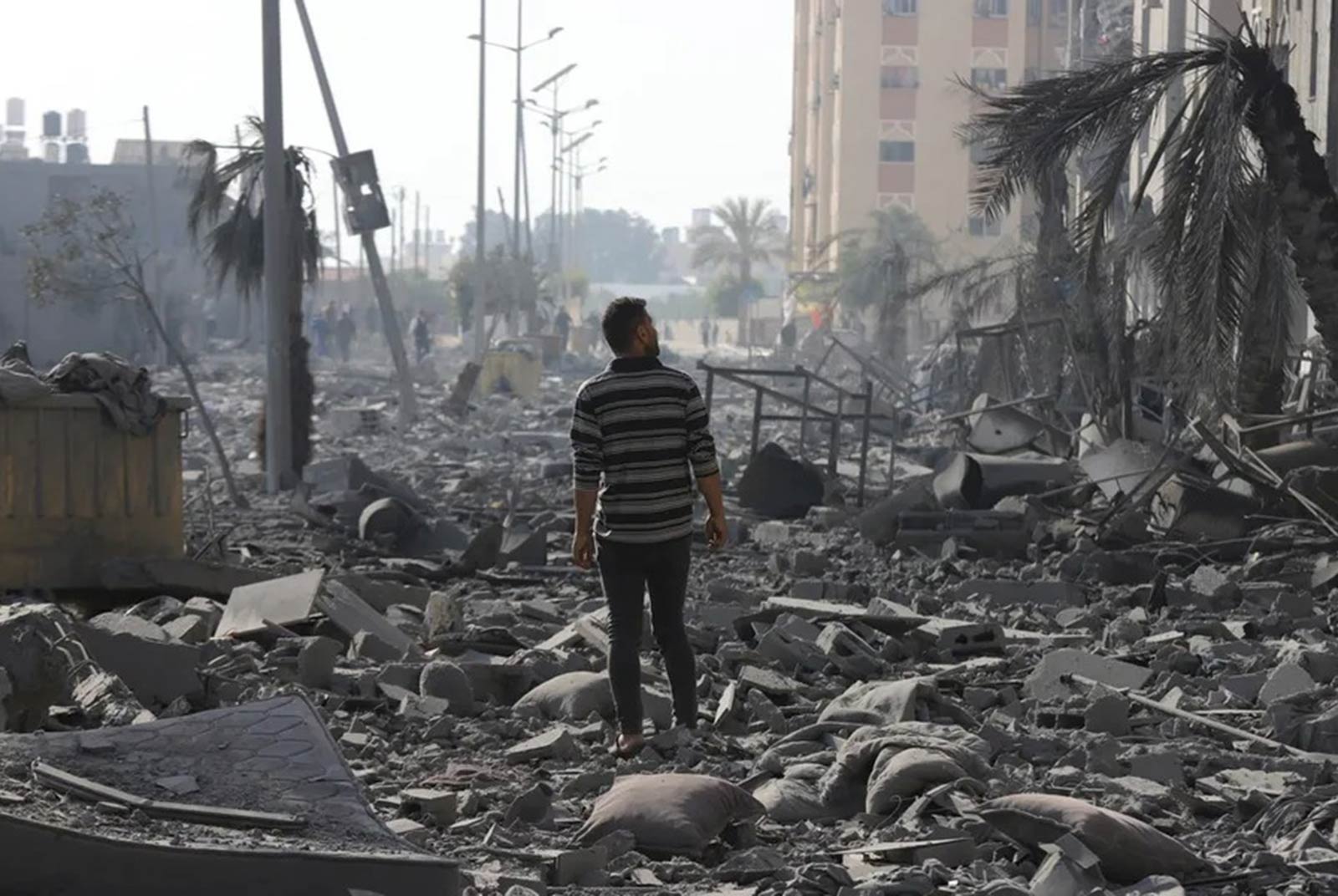
Source:shutterstock
In one of the most emotionally stirring episodes of the Taiwanology podcast, host Kwangyin Liu brings together two guests with profound connections to the ongoing Israeli-Palestinian conflict. Hazem Almassry, a Palestinian scholar currently based in Taiwan, and Roi Silberberg, an Israeli political educator, joined the program through the Taiwan Peace Fellowship to discuss the complexities of conflict, peacebuilding, and the role Taiwan can play as both witness and participant in global conversations about justice and reconciliation.
Views
Beyond the Headlines: A Conversation on Peace, Gaza, and Taiwan
By CommonWealth Magazineweb only
The following is the transcript of the 52nd episode of the Taiwanology podcast. It was produced by CommonWealth Magazine, hosted by Kwangyin Liu, and was first aired September 23, 2025. The guests were Hazem Almassry, Postdoctoral Research Fellow, Institute of European and American Studies, Academia Sinica, and Roi Silberberg, Political Educator. Director of School for Peace, Neve Shalom/Wahat al-Salam.
Listen to the episode: Seeking Peace in Taiwan: An Israeli and a Palestinian in Dialogue【Taiwanology Ep.52】
Growing Up in Conflict: Gaza and Israel
Kwangyin to Hazem: “Could you describe what daily life was like growing up in Gaza?”
Hazem Almassry: “Living and growing up in Gaza is a contradiction because you need to live two lives: the one the occupation wants you to live, and the one your family... wanted me to live. The first one... under hardship—checkpoints everywhere, sudden raids on homes, shooting people in the streets, closing the streets. And on the other side, my family and community... they try to give me the highest level of protection and the warmth that everyone needs to grow up without any problem.”
Kwangyin to Roi: “What was it like growing up in Israel?”
Roi Silberberg: “It was quite privileged, quite a pleasant childhood. I come from a normal family which holds Zionist ideology. I never met Palestinians until I was in university.”
Roi added that Israeli society is highly militarized: “You see people who are soldiers... in their uniform with their weapons—in a supermarket, on the beach, everywhere.”
Choosing a Path: From Biochemistry to Peacebuilding
Kwangyin to Roi: “How did you join the School for Peace?”
Roi Silberberg: “I had an opportunity to participate in a dialogue activity... and it changed my life. After that, I took a facilitator's course... and 15 years later, I became the director.”
Kwangyin to Hazem: “Why did you choose to study political science, and why in Korea?”
Hazem Almassry: “Even when we were children, we listened to news not just about Palestine, but about Bosnia, Congo, and Rwanda... I wanted to understand how politics shaped our lives. The chance I got in South Korea was really good—they announced a scholarship... and I got it.”
Hazem returned to Gaza after his master’s but was forced to leave again during Israeli attacks in 2014. “My plan A was to study in Australia. I got admission and scholarship. But they rejected my visa. They stated... the economic and political situation in Gaza will not encourage you to return after you finish your study.”
He added, “It was very disappointing. But I didn’t give up... I applied in Taiwan and got admission and scholarship at an international university in Hsinchu.”
Daily Realities and Loss of Loved Ones
Kwangyin to Hazem: “How is your family in Gaza doing after October 7th?”
Hazem spoke in heavy tones about the impossible situation facing his family and many others in Gaza. He described a life reduced to bare survival, with families enduring mass displacement, malnutrition, and widespread infrastructure collapse.
Hazem Almassry: “It’s beyond our ability to describe it... bombardment, starvation, tents with no basic needs. If you want to drink clean water, you need to carry it from far distance... If you want to cook something, you need to build a fire—if there is something to cook, of course.”
His most painful story was the death of his mother in December 2023. A nearby mosque, targeted by an Israeli airstrike, collapsed, causing the adjacent wall to fall on her as she was tending to the garden.
Hazem: “When my siblings went to her and found her under the wall, they found her okay—speaking—but she couldn’t walk. They rushed her to the hospital... but the hospital was overwhelmed. The doctor checked her and said, ‘It’s just a minor crack.’ She kept saying, ‘I’m fine, don’t worry.’”
Soon after, she began coughing up blood. “Her lungs were crashed. Internal bleeding. But it was too late. She died within 15 minutes.”
Due to the war zone conditions, there was no formal funeral. Hazem: “They buried her with her rings. We didn’t even have time to check her personal belongings. No family gathering, no public mourning—just a few siblings and nearby people.”
The story shed light on how daily tragedies in Gaza are often invisible to the outside world—not only due to physical distance, but also because of political filters that render such losses abstract. Hazem's voice quivered when he added, “Even talking about this here in Taiwan, sometimes people turn suspicious. They don’t see my grief. They see geopolitics.”
Taiwan as Refuge—and a Site of Tension
Kwangyin: “What has your experience in Taiwan been like?”
Hazem: “Taiwan offered me a lot. My kids go to school, they speak Chinese, they even act like Taiwanese... We customize our food to mix Taiwanese and Arab cuisines.”
But he also noted a shift in attitude: “When I talk about my losses in the context of the Israeli brutality, here sympathy stops and suspicion begins... Taiwanese people think Taiwan is on the same side with the US and Israel, and Palestine is on the same side with China.”
October 7th and Israeli Consciousness
Kwangyin to Roi: “What is this huge issue you mentioned? And how did October 7th change things?”
Roi Silberberg: “Before October 7th, we were in a long period of normalization... oppression and violence toward Palestinians, while Israeli society went on normally.”
He elaborated that Israeli society had developed mechanisms to isolate the consequences of occupation. “The entire structure of the state was built toward this goal: to keep things in control, while the economy and society continued as usual.”
The Hamas-led attacks on October 7th in 2023, which killed over 1,000 Israelis and involved hostage-taking, was a major rupture. Roi stressed that many Israelis were shocked—not only by the attack but by how unprepared they were emotionally to process the consequences of long-term oppression.
Roi: “People feel the war now. They feel the effort, the fear. They don’t think it’s normal anymore. But some want to bring back the ‘good old days’—when we were in control, but didn’t feel the burden of that control.”
He added that despite this massive shift, there is little evidence of political transformation. Host: “Is this opinion growing?” Roi: “Sadly, no.”
Roi: “The big lesson from October 7th is that Israeli people will never live in security while the others are almost not living. The only way there will be normal life is by having normal life for everyone.”
Kinmen Reflections and Taiwan’s Geopolitics
Kwangyin to Roi: “You visited Kinmen recently. What did you observe?”
Roi: “They have a meaningful history that’s not discussed enough. There’s a feeling that the people there are forgotten or left behind... They’re expected to be battle ready because it’s the front line.”
He added: “It is also how Israeli right politicians expect Israelis to be—like a modern Sparta.”
Kwangyin: “What can Taiwanese learn from peacebuilding?”
Roi: “Peace does not need to be communicated to Taiwanese people—they are strong enough to discuss it. But ignoring it is not the answer. Maybe we cannot have peace now\... But we must talk about who we want to be. Then peace will be part of it.”
Language, Accountability, and Agency
In the weeks following the October 7th attacks and Israel’s military response in Gaza, the School for Peace published an open letter signed by its leadership, including Roi Silberberg. The letter was addressed to their alumni, the broader peacebuilding community, and the international public. It condemned not only Hamas’ October 7th attack but also Israel’s escalating military campaign, which had already killed thousands of civilians, including women and children.
The letter stated: “We are being asked to return to normal life, but we refuse to accept such a normal life—one built on genocide, ethnic cleansing, occupation, repression, and the abandonment of citizens.”
Kwangyin: “You used the word ‘genocide’ in a letter. Why such strong language?”
Roi explained: “The choice of the word ‘genocide’ was not based on legal precision. It was moral. It was political. It was about urgency. If I use these strong words, it means everybody should do something in order for it to stop.”
He clarified that the letter served two core purposes. “First, that this must stop. Many bad things must stop. But when we use strong words like this, we are calling for the world to pay attention—not just condemn, but act.”
“Second, it means accountability,” he continued. “We would need to check: how could this happen? Who was to blame? Who didn’t do enough? Did I do enough?”
Roi added: “I know I would check myself. And I know people will check me. That’s the responsible thing to do.”
Writing the letter was not without risk. Roi acknowledged that within Israel, public opinion had hardened after the Hamas attack, and calls for de-escalation or acknowledgment of Palestinian suffering were met with anger or suspicion. “But we sent the letter anyway, because silence is worse. We have to talk about this—even if the words are hard to say.”
The Role of Dialogue and Peace Work
Kwangyin: “What is the hardest part of facilitating dialogue?”
Roi: “The hardest parts are the best parts. If people are in disagreement, that’s a good sign. But now, the hardest part is convincing people that they mean something. That we mean something in this moment. It’s very hard. But we do.”
He elaborated that the School for Peace does not structure its dialogues around political debates or fact-checking exercises. Instead, it focuses on identity: how people see themselves, and how they experience the conflict as members of their communities.
“We create a safe space—not just physically, but emotionally,” said Roi. “A space where it’s okay to say: ‘This is who I am. This is my fear. This is my grief.’” He emphasized that this space is particularly sacred in societies where polarization, fear, and misinformation dominate.
Roi said that while the participants in these dialogues often come in expecting persuasion or conversion, they leave with something more essential: the recognition of humanity. “They start to realize that even if they disagree on history or policy, they’re standing across from someone who also cries, who also lost a mother, who also wants safety for their kids.”
In the current moment, he said, the work is more emotionally taxing than ever. “People come hoping to find hope. But they leave realizing how deep the problem runs. And it’s our job to say: yes, the situation is devastating—but that does not mean your actions are meaningless.”
Kwangyin: “What can people do?”
Roi: “First, talk. Then talk louder.”
Dialogue, he insisted, is not about finding the right answer. It’s about sustaining moral awareness and emotional connection when systems are designed to separate us. “What we do now, even if small, builds the world we’ll live in tomorrow.”
Final Message to Taiwan
As the conversation came to a close, both guests were asked what message they would like to leave for Taiwanese listeners, especially given Taiwan’s own precarious geopolitical position.
Roi offered this: “Stay honest. Try to figure out who you are and act by who you are—not by expectations, international politics, or whatever. It’s hard. It is. But that’s the beginning of peace.”
He stressed that peace is not a static concept; it’s a practice. And it begins with self-awareness. “You don’t have to wait for a government, or a summit, or a ceasefire. You can start with your own heart, your own community, your own willingness to listen.”
Hazem added that Taiwan, despite being far from the Middle East, has a unique role to play as a society that values democracy, human rights, and regional stability. “If people here can see beyond geopolitics and see the human cost of war—any war—then perhaps they can also be a voice for peace where it matters.”
Views

Subscribe to CWE Newsletter (every Thursday)
Stay abreast of what's happening in Taiwan with our weekly digest.
Keywords: