Does Taiwan Have Leverage if Trump Asks for ‘Protection Fees’?
Source:AP
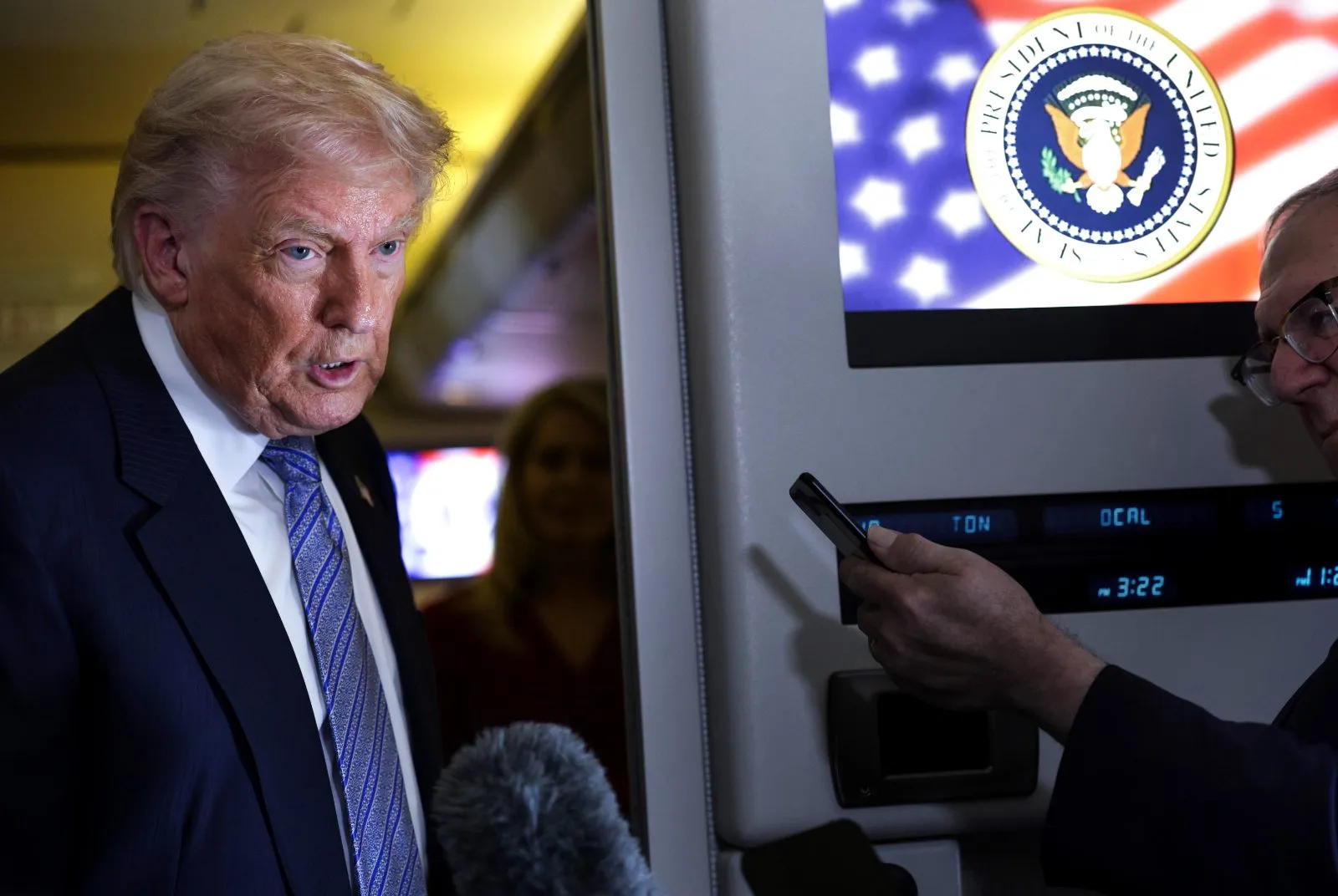
The election of Donald Trump underscored the American desire for change. Will U.S.-Taiwan relations be brokered through protection fees in the future, and, if so, how should Taiwan respond?
Views
Does Taiwan Have Leverage if Trump Asks for ‘Protection Fees’?
By Silva Shihweb only
“I voted for Trump,” said Alex, a 25-year-old native of Guatemala, the fourth person in a row to proclaim his support for the ex-president outside a polling station in Miami, usually a stronghold of the Democratic Party.
Alex, who had just finished a night shift at an airport logistics center,said, “Prices have increased so much that I might need to move back home.”
A year or two ago, he could afford to rent a one-person studio on his salary of US$1,000 a month, but today, for the same price, he can only afford to squeeze into a four-person room, he said. Similar circumstances have led many of his friends to move back in with their parents. “Kamala Harris said she would continue Biden’s policies,” said Alex, who voted for Biden in 2020 but changed his stance this time, arguing that Harris did not want to change the country.
Just a few days earlier, Alex had listened to Trump on the highly popular podcast The Joe Rogan Experience, where Trump reiterated his stance on Taiwan.
“Trump won’t allow World War III to happen and won’t let China take over,” Alex said, echoing nearly word-for-word the rhetoric Trump used at a rally in Wisconsin.
When asked if he remembered Trump mentioning that Taiwan should pay protection fees on Rogan’s show, Alex confirmed that he had and that it was fine with him.
Source of the Pain: A Broke Federal Government
Alex’s “pain points” reflect the main reason behind Trump’s electoral victory.
“What most people worry about are rent and living expenses, and there was a strong sense of anger over the economy before the election,” observed Jason Hsu (許毓仁), a visiting fellow at the Hudson Institute, a conservative think tank.
“So, when Trump talks about Taiwan needing to pay protection fees or stealing chip jobs, ordinary people can understand what he’s saying,” Hsu said.
Even more significantly, there is one number that has forced Trump to continue to emphasize “money” and even call for an “America First” policy — a national debt that exceeded US$35 trillion for the first time this year and that ironically Trump contributed more to in nominal terms (roughly US$8 trillion) during his previous term in office than any four-year U.S. president in history.
“There are many places in the United States that are in bad shape because there’s no money,” said Jaw-ling Joanne Chang (裘兆琳) , a former deputy representative to the U.S. and an adjunct research fellow at Academia Sinica’s Institute of European and American Studies.
According to the American Enterprise Institute, federal interest payments now exceed child welfare spending and are set to surpass defense spending this year as they continue to worsen.
Given these financial trends, it is easy to understand why Americans are increasingly inward-looking and rallying around the “America First” slogan.
Three Actions Taiwan Can Take
Though Trump will take office again on Jan. 20, 2025, Taiwan still has enough time and maneuverability to prepare. There are three actions Taiwan should consider.
First: Do not ignore the U.S. government’s political timetable.
Lai I-Chung (賴怡忠), president of the Prospect Foundation, a government-affiliated think tank, said the 2026 midterm elections mean that by the time Trump’s term begins in January and his Cabinet appointees get acclimated to their roles, “Trump will only have about a year to carry out the things he wants to do.” Because of that, “Trump’s real impact may be smaller than people expect,” Lai contended.
Another factor, Lai said, is that the U.S. Congress remains Taiwan’s strongest supporter across party lines. Over the past eight years, the number of Taiwan-friendly bills proposed has continued to set new highs.
In addition, if Trump pushes for an across-the-board 10-20 percent tariff on imported goods, as he advocated during his campaign, existing U.S. law would require a Section 301 investigation and congressional approval, meaning the process could last until 2026, Lai said.
Second: Taiwan should do a deep dive into its extensive defense budget.
Trump mentioned “protection fees” to be paid twice during his campaign. But how much could such fees be?
Former National Security Advisor Robert O’Brien, a potential member of Trump’s new team, suggested in a July interview that Taiwan’s defense spending should reach 5 percent of its GDP. This figure far exceeds the U.S.’ prior expectation of 3 percent and is double Taiwan’s current spending.
Taiwan’s defense spending, however, is dispersed across various departments under the concept of “whole-of-society defense resilience.” Therefore, actual defense expenditures could be close to Trump’s supposed target.
“We should take the initiative to assess our budget,” Lai suggested.
Yet, the new U.S. government may not limit the concept of protection fees to defense and could extend it to economic and trade matters.
“We have a bias in assuming U.S.-Taiwan relations focus solely on diplomatic issues and are limited to high-level visits and international participation. This view is incorrect,” said Vincent Chao (趙怡翔), the former head of the political division of Taiwan’s representative office in the U.S.
He said “America First” is an overarching policy that covers everything from technology and defense to trade and economic issues, all of which are bargaining chips in bilateral negotiations.
Because of that, opportunities to engage with different American government agencies should not be ignored, especially when it comes to semiconductors because of their economic importance.
Academia Sinica’s Chang observed that during his campaign, Trump repeatedly said Taiwan had stolen the U.S.’ chip business.
But it should not be forgotten, she said, that each time the Department of Commerce would reject that proposition and say the chip business is decided by American companies. Also, Deputy Secretary of State Kurt Campbell has warned that if there were a disruption in shipments of chips from Taiwan, it could lead to a global depression.
Given those high stakes, “Taiwan should be in constant communication with different agencies and say clearly that (semiconductors) were not stolen from the U.S. and that we have also aggressively invested in the U.S.,” Chang said.
Third: Taiwan holds new bargaining leverage.
While being pressured to increase its defense budget, Taiwan should not overlook new maneuvering room it could have in negotiations.
“It used to be that (the U.S.) wouldn’t sell weapons; now it can’t deliver,” Chang said.
Because the U.S. defense supply chain has not fully recovered since the pandemic, and the Russia-Ukraine and Middle East conflicts have taken their toll on the availability of U.S. arms, deliveries of weapons systems ordered by Taiwan, including missiles and F-16V fighters, have been delayed.
“We can make demands of the U.S.,” Lai argued.
Facing an increasingly inward-looking America and a deal-oriented Trump, these are the three areas Taiwan should focus on and be prepared for if it hopes to assert itself in the new global paradigm caused by a Trump presidency.
Have you read?
- What Impact Will Trump's Victory Have on Taiwan?
- Why is Trump Anti-China but not Taiwan-Friendly?
- Are imports bad? America’s Turn to Mercantilism
- After the Tsai-McCarthy meeting on 'tour of restraint': Three changes to US-Taiwan relations
Edited by Luke Sabatier
Uploaded by Ian Huang
Views

Subscribe to CWE Newsletter (every Thursday)
Stay abreast of what's happening in Taiwan with our weekly digest.
Keywords: