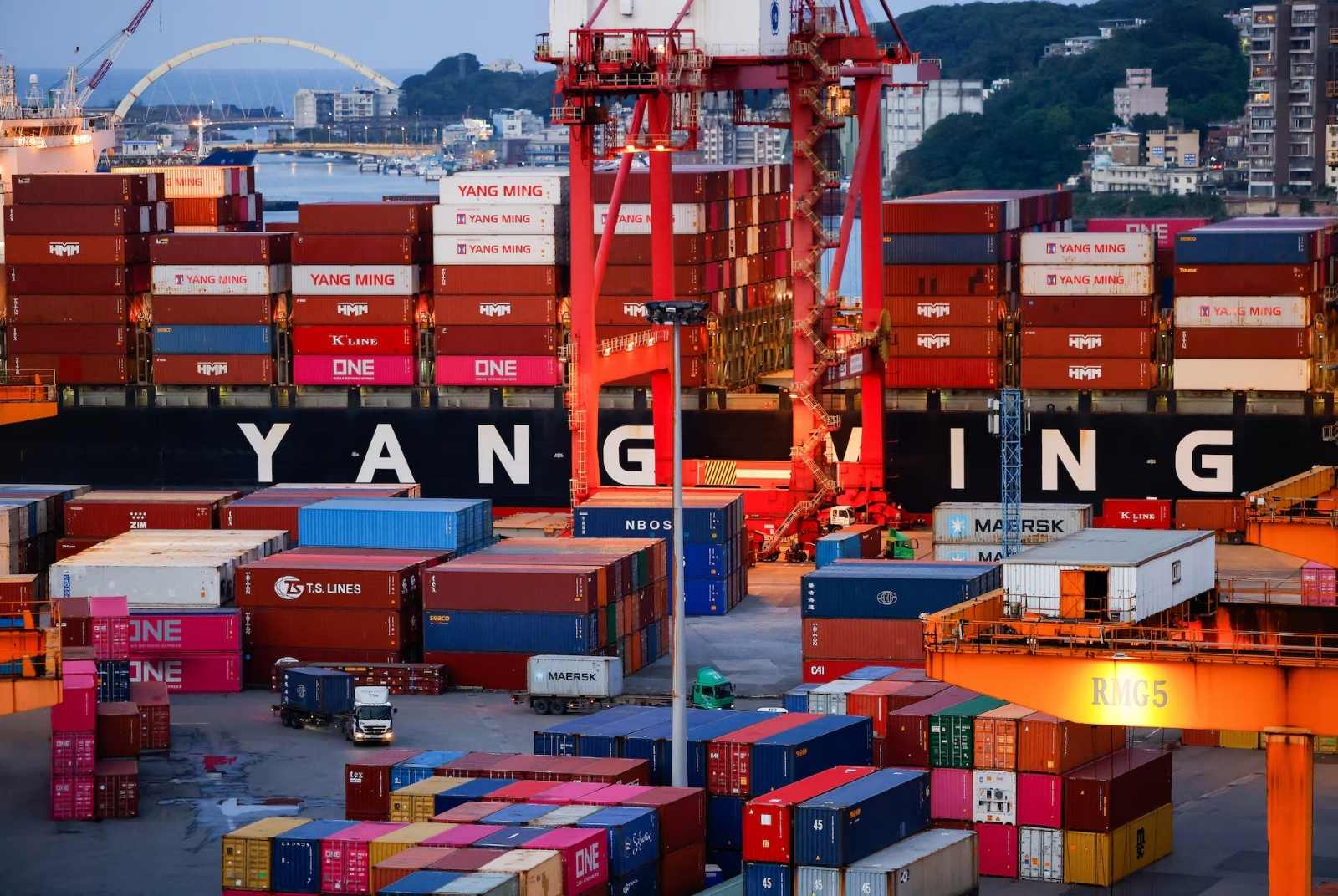
Taiwan Businesses Brace for 32% U.S. Tariff Shock
Source:Reuters
A tariff shock has hit Taiwan as the U.S., under Donald Trump’s second term, slaps a 32% duty on imports—higher than for Japan or South Korea. Taiwan businesses, from shoemakers to AI server manufacturers, are bracing for impact—even those not directly exporting to the U.S.
Views
Taiwan Businesses Brace for 32% U.S. Tariff Shock
By Pei-Hua Lu, Kwangyin Liu, Ching-Fang Wu, Janet Kang, Silva Shih, Elaine Huangweb only
For Taiwan, long a close economic partner of the U.S., the move came as a rude awakening.
Taiwan’s Executive Yuan swiftly issued a strong-worded statement, calling the tariffs “unfair and inconsistent with the reality of the U.S.-Taiwan trade.” Outside of semiconductors and steel and aluminum, almost no industry has been spared.
A Bombshell for Business Leaders
The tariff list released by the White House caught many off guard—including Diamond Group CEO Louis Chen, whose footwear business operates factories in Cambodia.
“Cambodia barely imports anything from the U.S., so we thought expanding production there was safe. Land had been purchased, and we were ready to double capacity,” Chen said, speaking from Cambodia. “But after the announcement, we had to reverse our plans overnight. Just yesterday we were meeting with the builder; now we’ve asked them to slow down construction.”
According to the White House’s reciprocal tariff table, Cambodia faces a 49% tariff—higher than Vietnam (46%), Thailand (36%), Indonesia and Taiwan (both 32%).
Trump’s policy targets imports from more than 180 countries. The minimum tariff is set at 10%, with implementation starting as early as April 9.
Fitch Ratings projects that the average U.S. tariff on imports will skyrocket from 2.5% in 2024 to roughly 22%, marking the steepest rise since the early 20th century. “If these tariffs remain in place for a prolonged period, you can throw all existing economic forecasts out the window,” said Olu Sonola, head of U.S. economic research at Fitch.
Taiwanese Government Sidelined
Within eight hours of the announcement, Taiwan’s Executive Yuan issued its protest.
But inside sources suggest the government was caught flat-footed. A senior official admitted that the tariff formula focused only on trade deficits—not previous customs duties—and that no advance warning was received.
Business leaders voiced frustration to CommonWealth: “The fact that the government didn’t preemptively alert companies or the public shows how disconnected we are from Trump’s inner circle.”
“We were shocked to see Taiwan hit with a 32% rate—worse than Japan or Korea,” said De-Hua Yang, Chairman of Goodway Machine Corp. “This will be devastating for our industry.”
One policy expert said Taiwan must now overhaul its entire trade negotiation strategy: “Whether U.S. demands are reasonable or not, Taiwan will need to make concessions to secure tariff reductions. The current rate is simply too painful.”
Two Survival Strategies for Taiwanese Firms
Outside of semiconductors and metals, nearly every major Taiwanese export sector—electronics, machinery, auto parts, bicycles, even AI servers—faces exposure. The Federation of Industries noted that once the separate 25% auto parts tariff takes effect in May, virtually all of Taiwan’s top-selling U.S. exports will be affected.
In response, Taiwanese manufacturers are coalescing around two strategic responses:
1. Move Production to the U.S.
Companies with heavy U.S. exposure and American clients are expected to accelerate their U.S. investments.
“This will push many previously hesitant tech firms to fully shift to the U.S.,” said Advantech co-founder Chaney Ho. “They’re realizing that moves to Vietnam or Mexico over the past few years have done little to help.”
Just one day before Trump’s announcement, PC maker Wistron revealed a plan to invest up to US$50 million to acquire U.S. land and facilities, preparing for the tariff war. Others, like Quanta and Foxconn, already have plants or land in place.
Even non-tech firms are following suit. Vietnam-based precision component maker VPIC, which manufactures for a major American motorcycle brand, recently leased warehouse space in the U.S. and shipped goods ahead of schedule. “We signed the lease at the end of March. The goods are already at sea,” said VPIC Vice President Peter Wu.
2. Shift Production to Lower-Tariff Countries
Some manufacturers—particularly traditional industries—are instead reevaluating comparative tariff advantages across countries, choosing to avoid the U.S. and instead shift production elsewhere.
“At Diamond Group, reactions varied by region. Teams in Indonesia and the Philippines breathed a sigh of relief, since their tariff rates are lower than Vietnam’s,” said CEO Louis Chen. “We’re now shifting more capacity to Indonesia.”
Textile giant Eclat Textile is also considering expansion in Indonesia. “We’re still in discussions with our brand partners,” said Vice President Fen-Ju Lin, “but future capacity expansion will factor in more than tariffs—labor costs, logistics, and supply chain stability all matter now.”
One senior textile executive added bluntly, “American buyers don’t want textile dyeing operations. They see us as a polluting industry. We don’t believe setting up in the U.S. is the right path.”
“Trump is like a wildfire, and Taiwanese companies are now scrambling globally,” said VPIC’s Wu.
Economic Growth Forecasts Take a Hit
Fubon Financial Holding’s Chief Economist Wei Lo has already downgraded Taiwan’s growth forecast: “We no longer believe Taiwan can maintain 3% growth this year.” The official projection is currently 3.14%.
Taishin Securities also anticipates economic headwinds, noting that the shock tariff rate exceeds expectations. While Trump has left the door open for negotiations, the outlook remains highly uncertain.
Wen-Ching Huang, Deputy General Manager of Taishin Securities Investment Advisory, warned that tariff pain cannot simply be passed to consumers. The burden will ripple from the end consumer back through brands to manufacturers. Even firms that don’t sell to the U.S. could see squeezed margins and weakened profitability.
Server manufacturers may fare better—able to pass on costs—but their ongoing U.S. factory expansions are raising operating costs, diluting profits. Foxconn’s server operations, for instance, are well-positioned, but its Apple business remains vulnerable.
The impact will vary within sectors. High-end PCB manufacturers for AI servers or network switches may see minimal disruption due to tight supply-demand dynamics. But mass-market PCBs face pricing pressure. In auto parts, companies like Excellence Opto and SUMEEKO with U.S. plants are better shielded, while others like Eson Precision—which supplies Tesla from Mexico—face steep tariffs.
What worries executives most is inflation triggered by tariffs. If global demand softens in response, a recession could follow.
“As contract manufacturers, there’s nowhere left to run. Brands will push costs onto us, and we’ll either absorb them or raise prices—both of which hurt demand,” one senior hardware analyst explained.
“Hopefully Trump is using tariffs as a bargaining chip, and won’t make this permanent. Otherwise, the global economy could come to a standstill,” Ho warned.
Views

Subscribe to CWE Newsletter (every Thursday)
Stay abreast of what's happening in Taiwan with our weekly digest.
Keywords: