Foxlink’s AI Robot Dog Leads Its AI Shift to North America
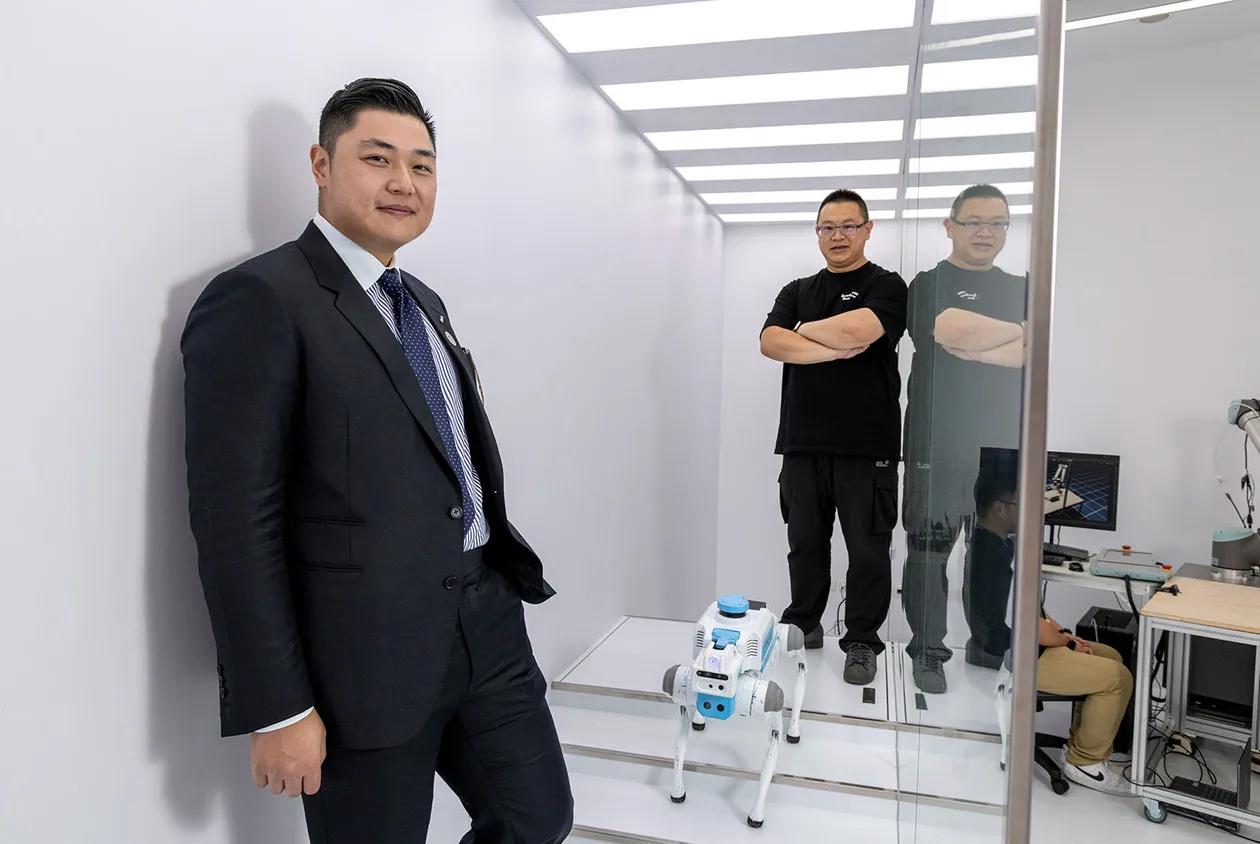
Source:Chien-Tong Wang
Taiwan’s Foxlink is no longer just a connector maker. Backed by in-house compute and a lean robotics team, the company is betting on Robot-as-a-Service to take its transformation global—starting with robot dogs in North America.
Views
Foxlink’s AI Robot Dog Leads Its AI Shift to North America
By Meng-Hsuan Yang, Kaiyuan Tengweb only
Foxlink, a longtime connector manufacturer, is pivoting from hardware to AI-enabled services. Its most visible—and mobile—symbol of that transformation is Jeff, a patrol robot dog now roaming the corridors of its headquarters. Every night, three of these autonomous quadrupeds take shifts, reducing the need for human security. They ride elevators, patrol all eight floors, and flag unfamiliar faces via facial recognition.
It’s a dramatic shift for a company once seen purely as a legacy OEM. In just over a year, Foxlink has become one of Taiwan’s fastest-moving AI players—launching its own AI supercomputing center and deploying a working robot dog in real-world environments.
The Making of Foxlink’s AI Strategy
The transformation began with Freddy Kuo (郭守富), special assistant to the chairman and son of Chairman TC Gou (郭台強). Trained in business management in Seattle and formerly involved in venture capital, Kuo returned to Foxlink to lead overseas factory planning. Observing idle capacity in Taiwan due to U.S.-China trade tensions, he proposed pivoting toward AI.
“Why stay on the sidelines when we can build it ourselves?” he recalls.
Foxlink partnered with Japanese cloud streaming firm UBidata and hardware providers like ASUS to construct a high-performance computing (HPC) center in just three months.
With compute secured, Kuo launched SYNC Robotics, a robotics-focused subsidiary aimed not at parts or contract manufacturing, but at building robot “brains.”
Software First, Hardware Collaborative
SYNC defines itself as a robotics platform company, focused on training software models that enable robots to sense, navigate, and interact. Whether two-legged, four-legged, or in the air, the goal is to enable adaptive machine behavior. The hardware, including cameras and sensors, draws from Foxlink’s own components and external robotics system partners.
The current robot dog, still in proof-of-concept, is being tested in Foxlink’s solar farms, factories, and offices. Using NVIDIA’s Omniverse platform, it learns to identify stairs, transparent floors, glass panels, and anomaly scenarios such as broken windows or intrusions. It’s also learning to interpret visual cues like substation light signals and relay alerts back to command centers.
SYNC has also built a multi-robot management system to oversee patrol routes, thermal and visual data, and environmental metrics—turning surveillance from task-based to system-based.
A Competition-Hardened Team
Behind the rapid progress is a tightly knit team. 90% of SYNC’s 14-member R&D team hails from a single lab at Tamkang University’s electrical engineering department, led by Professor Wong Ching-Chang (翁慶昌). The team has a long history in global robotics competitions such as FIRA, which gives them a shared technical language and fast development rhythm.
“We used to build robots that had to move the second a whistle blew. Now our customers expect that same reliability,” says CTO Hsiang-min Chan.
SYNC is also developing a robotic hand trained in virtual environments using Vision Pro to mimic grasping tasks, with real-world training augmented by sensor-equipped gloves worn by Foxlink employees. “The most valuable resource we have is the data to train our robots,” Kuo adds.
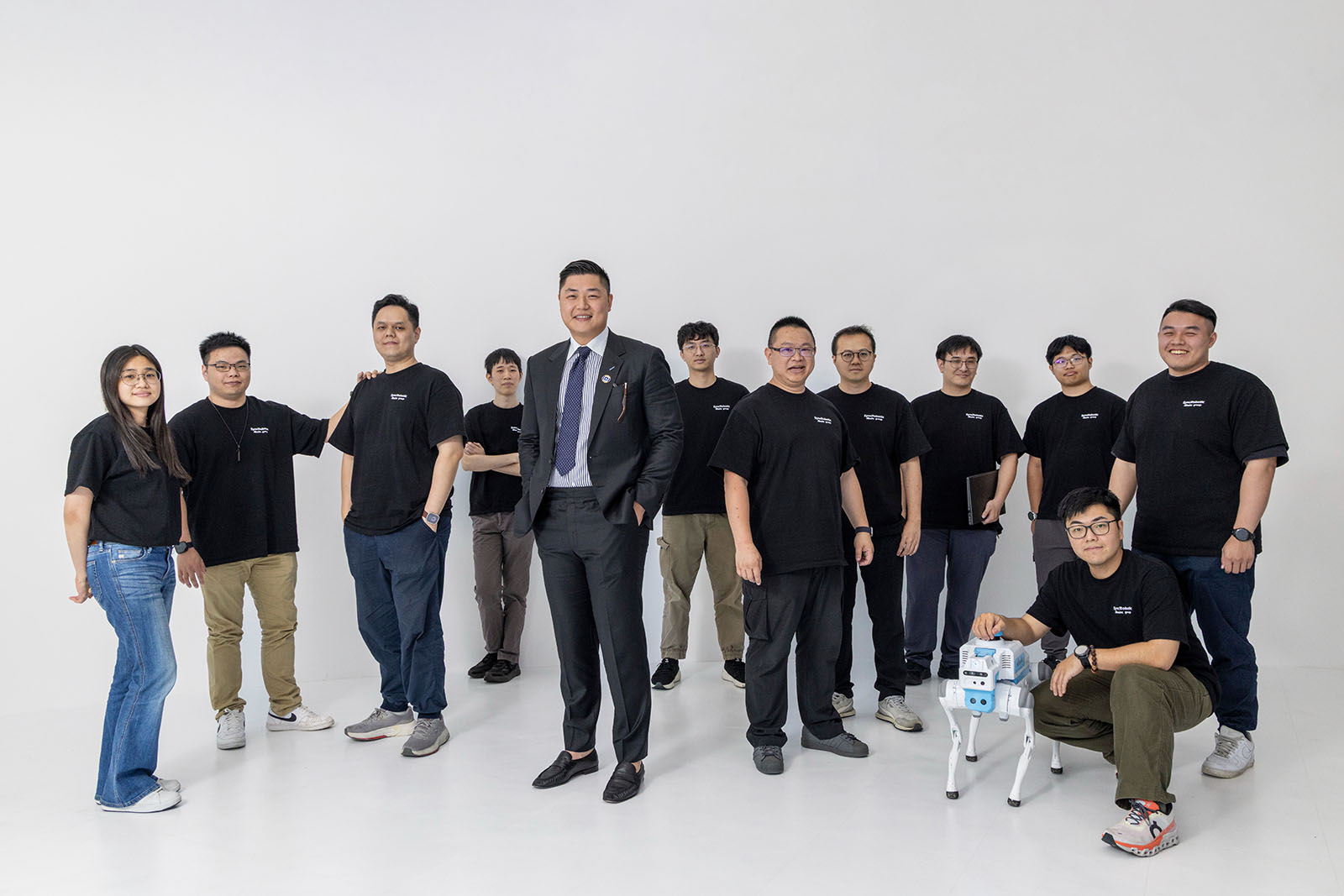 Most of the SYNC technical team members are from the Department of Electrical Engineering at Tamkang University. (Photo: Chien-Tong Wang)
A Service Model for Export
Crucially, SYNC is not selling just hardware—it’s selling services.
The business model is Robot-as-a-Service (RaaS), offering patrol robots to security firms and enterprises on a subscription basis. Two of Taiwan’s largest security companies are already in talks. For North America, Foxlink will leverage 2,000 dealers acquired through the purchase of Chinese surveillance equipment firm Dahua’s U.S. assets. Launch is expected as early as Q3.
“In contract manufacturing, brands always pressure you to lower prices. Only software creates high-margin growth,” Kuo explains.
With Taiwan’s robotics sector getting increasingly crowded, Kuo knows execution is everything. The goal: by next year or the year after, 120 robot dogs patrolling every month—real deployments in real terrain.
“We’re not just breaking from OEM,” he says. “We’re reinventing the business model.”
Have you read?
- How Giant’s Ultra-Light Carbon Fiber Bike Sparked a Comeback
- How TSMC’s AI Packaging Leap Pressures Delta and Infineon
- China’s Rare Earths Chokehold: Which Taiwan Industries Might Suffer?
Uploaded by Ian Huang
Views

Subscribe to CWE Newsletter (every Thursday)
Stay abreast of what's happening in Taiwan with our weekly digest.
Keywords: