Lisa Su: “We Are Still in the Third Inning” of AI
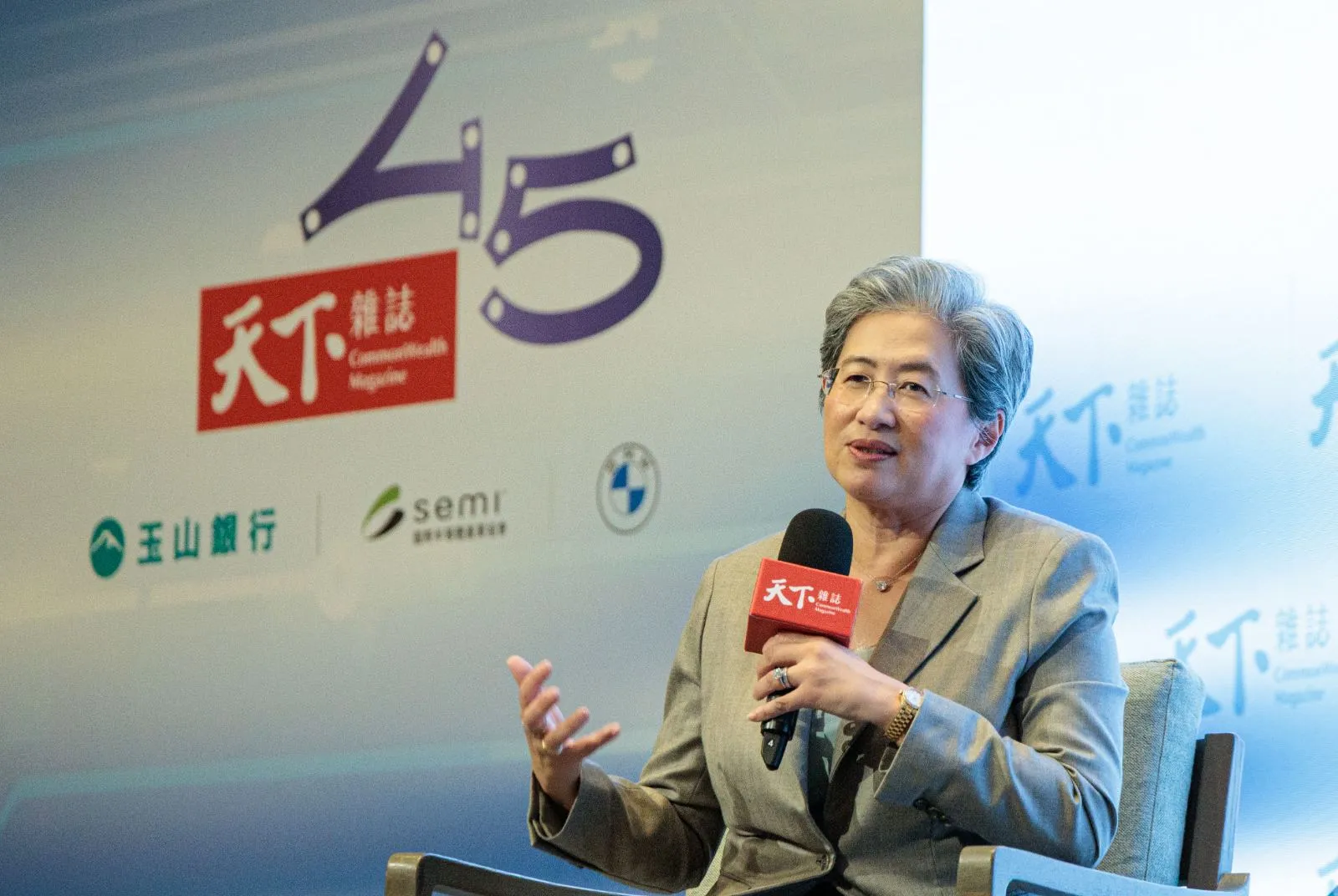
Source:Kai-Cheng Chuang
AMD’s Chair and CEO Lisa Su on a $10 billion Taiwan bet, the open AI ecosystem, chiplets, and what her mother taught her about entrepreneurship.
Views
Lisa Su: “We Are Still in the Third Inning” of AI
By Yishan Chenweb only
This is an edited transcript of a live conversation between AMD Chair and CEO Dr. Lisa Su and Commonwealth Magazine Editor-in-Chief Yishan Chen, recorded at the CommonWealth summit in Taipei in late May 2026. Dr. Su’s family roots trace back to Tainan. Topics range from AMD’s latest Taiwan investments and the trajectory of AI computing, to her philosophy of open ecosystems and what a mother’s entrepreneurship taught her about leadership.
Listen to the episode: Are We in an AI Bubble? AMD’s Lisa Su speaks out in Taiwan 【Taiwanology Ep.60】
Taiwan Investment
Q: You announced two major moves this week — a $10 billion commitment to advanced packaging partners in Taiwan, and the adoption of TSMC’s two-nanometer process. Can you elaborate?
It’s been a very exciting week. We’re in a time right now where the semiconductor and AI markets have never been growing faster. Every month, we’re surprised by how much growth there is. And every time we look at the usage of the technology, we’re convinced that this is the highest-growth moment the market has ever seen.
For AMD, our strategy is to lead in high-performance and AI computing. To do that, we must have a very strong supply chain and very strong partners. We’ve been working very closely with all of our partners here in Taiwan. Yesterday, we hosted a customer symposium with over 150 partners.
The first announcement is about our progress with TSMC. TSMC has been a tremendous partner for AMD — a very key reason we have been so successful. We wanted to be the first to really ramp 2-nanometer HPC technology. We’re happy to announce that our newest CPU chip, Venice, has started its production ramp in 2 nanometers.
The second piece is around the supply chain. AMD is co-investing with a number of companies in the Taiwan ecosystem — over $10 billion across advanced packaging, substrates, test capacity, and rack-scale integration. It’s a big vote of confidence that this is where the best technology lives, and it’s very important for AMD’s long-term growth.
Q: How exactly does AMD participate in advanced packaging — cost-sharing, joint R&D?
We have been very aggressive in 2.5D technology, CoWoS, EFB technology, and 3D stacking. For all of those technologies, we are very often the first user to adopt them at volume. We collaborate with the ecosystem and ensure we’re making investments upfront to have the capacity available as we ramp over the next several years. As we have seen, demand keeps going up. So we’re asking our partners to ramp faster — and we should absolutely share in that investment.
Q: What opportunity do you see in the Taiwan semiconductor ecosystem over the next five years?
What is so special about the Taiwan semiconductor ecosystem is that it has every part of the chain — from basic materials, all the way through advanced process technology, to backend technology, to systems, OEM and ODM partners, and now rack-scale manufacturing. All of those pieces need to work very closely together. The only place in the world that has all of it together is right here in Taiwan.
What’s different today is that, in addition to needing that end-to-end ecosystem, we’re also finding the need to have manufacturing capabilities around the world. Many Taiwan partners are now expanding outside of Taiwan. I think that’s a really good thing. Semiconductors are so important to the world that having geographic capability matters.
The only place in the world that has every part of the semiconductor ecosystem — from basic materials all the way to rack-scale manufacturing — is right here in Taiwan. — Lisa Su, Chair & CEO, AMD
AI Everywhere
Q: You predicted a 100× increase in compute capacity and AI user growth from one billion to five billion within five years. What’s driving that?
I believe AI is the most important technology that has occurred in the last 50 years. We’ve had other great technologies — the mobile phone, cloud computing — but AI is actually different. The reason AI is different is that we have found a technology that everybody can benefit from. Every single person, every single company, every single area can benefit from AI.
When I say AI everywhere, the vision is that over the next three, five, ten years, everything we do can be made better with AI. You should see AI in every device, in every application. And that type of proliferation is not just good for business — I think it’s really good for humanity. AI everywhere, for everyone — that should be our guiding principle.
Q: What about cloud versus edge compute, and training versus inferencing — where is the growth going?
Two or three years ago, it was really a few companies spending all the money on training large language models. But the truth is, nobody really makes money on training. Training is necessary, but that’s not where you see the return on investment.
Where you see the return is inference — people using the technology. And inference is evolving beyond simple questions. What we’re seeing now is AI entering the time when you can actually solve complex problems: changing the way you build products, run your companies, discover science. That’s the shift we’re witnessing. Usually technology doesn’t change this quickly. Now we’re seeing every couple of months that the capability is completely different — and models are getting so much better. It’s still very early in the cycle, but that’s what’s driving the demand.
Q: When will we see the GPU-to-CPU ratio normalize as AI moves beyond pure training clusters?
Actually pretty soon. When you’re trying to enable AI everywhere, you need every kind of computing. You’re starting to see CPUs grow alongside GPUs, and ASICs grow as well. Right now we’re seeing more and more agentic AI.
Think about it this way: you are a wonderful journalist, but you have to do your own research. If you had 10 agents, you can do all of that simultaneously. Apply that to chip design: a very advanced chip may take two or three years from start to finish. If we can cut that in half using AI agents, we can build many more products and satisfy much more market demand. That’s the power we’re looking for.
Supply Chain & Bottlenecks
Q: What’s the biggest bottleneck in the AI supply chain right now, and how do you address it?
We see bottlenecks everywhere — but they’re being solved quickly. That’s the thing about the semiconductor supply chain: it’s very aggressive and very capable. Once you see a bottleneck, you find a way to solve it.
Today, memory tends to be in a bit of a shortage, which is true. But there are ways to solve that. CPUs — we’re ramping capacity very much. Other bottlenecks include power. As we think about powering data centers in the various places we need them, that’s a real constraint. I don’t think there’s any one bottleneck. Together, we simply didn’t quite predict demand to go up this fast. The foundation is very positive: the world needs more AI computing, and we’re able to deliver that with the entire ecosystem together.
Q: You promoted AI PCs at Computex a few years ago, but adoption has taken longer than expected. What’s your forecast now?
I’m actually very optimistic about AIPCs. With new technology, it always takes a little bit of time. Early AIPCs — you couldn’t see the real application usage that easily. It was only for experts.
But today, the most interesting thing about AIPCs is that we all have a need for AI, but we also care a lot about privacy. We don’t want to always send data somewhere. We also want it to be local so we don’t always have to connect to the cloud — and frankly, the cloud can be very expensive. So I think AIPCs for developers, personal usage, and local enterprise usage will be a good growth vector over the next few years. And beyond PC, I think the next big wave is physical AI — robotics, and using all of that capability at the edge, whether in industrial and manufacturing environments or other local settings.
Open Ecosystems & AI Hardware Standards
Q: AMD is a strong advocate for open ecosystems — ROCm, UALink. Will AI hardware repeat the Wintel standardization story that helped Taiwan’s PC industry grow?
I’m a big believer in open ecosystems. Our philosophy is that there’s no one company that has all the best ideas — and no one product that’s the best product. The best way to provide all the technology the world requires is to have an open ecosystem where hardware is open, you can use different types for each application, and with that you need the right software capability and standards.
I do think you will have some open ecosystems and some closed ecosystems. But in the end, the open ecosystem is very, very powerful. Think even of the PC ecosystem today: you have the Apple ecosystem, which is more vertically integrated hardware and software. And then you have the PC ecosystem, which is more open. Both have their merits. But in this case, I think the open ecosystem will grow faster.
Q: In the Wintel era, the standard-setter and a few top brands captured most of the value. Who gains the most in the AI hardware value chain?
The way you should think about it is: this world is completely different from the Wintel model. The total semiconductor market is now over $1 trillion, and we can see very significant growth over the next five years. I don’t think there’s going to be one answer for all of that. There’s too many applications, too much work to do — which makes it a great place for all of us to find what we are going to be best at.
For AMD, we don’t claim to be the best at everything. Our focus is to be the best at high-performance computing and AI. If you think of a baseball game, maybe we’re in the third inning of nine. There is still a lot of innovation to happen and a lot of opportunity for all of us in the ecosystem.
Chiplets & Advanced Packaging
Q: Can you explain chiplets to a non-technical audience?
It’s actually not hard. Everyone has heard that Moore’s Law is slowing down. When you try to keep making things smaller, you actually can’t — you can’t yield it, it’s too expensive. So the idea of chiplets is: instead of building one big chip, you cut your chip into small chiplets and put them back together with advanced packaging.
Today, our most advanced chip — the MI450 — is just starting to go into production in the second half of this year. It’s over 300 billion transistors, and it has over 20 chiplets that we put together. When I was getting my PhD, I honestly thought this kind of technology could never work. But it’s amazing what the engineering capability of the entire industry ecosystem has been able to build.
Q: What’s the next breakthrough in chiplets?
Going forward, instead of talking about chips, we really need to talk about systems. The next frontier means integrating all of these capabilities together — all of the processing, some of the networking — and I think we are looking at how optics and photonic technologies come into the picture. The idea is how we keep putting more and more capability into a single system. That’s one very big reason behind the $10 billion investment announced yesterday.
When I was getting my PhD, I honestly thought chiplet technology could never work. It’s amazing what the industry ecosystem has been able to build.— Lisa Su
Leadership & AMD's Transformation
Q: You’ve been CEO for 12 years, growing AMD from $4 billion to $35 billion in revenue. How do you define leadership now?
The most interesting part of being CEO of AMD is how much, every few years, we’re actually running a different company. The technology is completely changing, the scale is completely changing. What I really enjoy is seeing the technology have an impact on the world. I like change. I don’t like to get bored.
Q: When you took over in 2014, AMD faced formidable competition. What made you believe you could succeed, and how did you get through the difficult years before Zen paid off?
When I took over as CEO, many people asked why I believed we could be successful. The reason I fundamentally believed we could succeed is that technology is a place where you have to see ahead of the curve. We were pretty sure that high-performance computing was going to be important. And there are very few companies that can actually build high-performance computing chips and capabilities.
We made two bets. The first bet was on TSMC — that’s turned out to be a really great bet, and we’re still making it. The second was that silicon technology was getting so complicated that you needed to break it up into pieces and rely on advanced packaging. Even though chiplets were still new, that was our bet. In the end, the entire industry is now using this technology.
What helped me through it was a very supportive board. I told them it was going to take five years. And we had a team that really believed in what we were doing. Those two things were very helpful.
Q: AMD now has over 1,800 people across 10 sites in Taiwan. What role does Taiwan play in AMD’s R&D?
Our staff here has grown very big. We have over 1,800 people in Taiwan right now across 10 sites — and in the last few years, we’ve added five additional sites. We do a lot of R&D here in Taiwan, particularly with our Taiwan ecosystem partners. Some of our most capable people in terms of bringing up our latest technologies are here in Taiwan.
AI & Society
Q: As AI moves into every corner of work and life, what should companies and employees do to prepare?
Some people think: is AI going to take away jobs? Should I worry on the employee side, or can I save money on the business side? That’s actually the small part of AI. The big part of AI is: how can I do something very differently? That means retraining your workforce.
At AMD, we are educating every single person about how to use AI tools and how to change the way we internally build products, do sales, do marketing. We’ve been doing this for the last 18 months, with a real training program at different levels — basic tracks, specialized tracks for engineers, and different tracks for sales and marketing. We’re all learning together. Of course, AI is not always right — many times it’s not right. So you still have to have the right checks in place. At the end of the day, the company is responsible for what type of information they put out.
Women in Tech & Personal
Q: Female leaders in the mainstream semiconductor industry are still quite rare. You once said your first encounter with a woman in business was your mother. What did you learn from her?
Let me start by saying that I think engineering is a great profession for women. The reason is that it doesn’t care whether you’re male or female. It only cares whether you have good ideas or bad ideas. And if you have really great ideas, you can make a real difference.
My parents were born in Tainan and immigrated to the United States when I was very young — I was also born in Tainan. My mother was, I would consider, a pretty amazing person. She immigrated to the United States with my father without speaking English well, and really didn’t know what she was getting into. My father went to graduate school and she brought up the kids.
Somehow, when I was maybe 10 or 12 years old, my mother decided she was going to start her own business — as an entrepreneur in the United States, without any background. She started from scratch and built it into a multi-million dollar business. She would often say, “Lisa, someday you have to come join me in the business.” Not to my brother — only to me. And even after I went to AMD, she would still say this. Finally, when I became CEO of AMD, she said, ‘Oh, maybe you won’t come back to my business.’
Role models are very important. If you have a dream, hard work, and vision, you can accomplish almost anything.
Engineering doesn’t care whether you’re male or female. It only cares whether you have good ideas or bad ideas. If you have really great ideas, you can really make a difference. — Lisa Su
Have you read?
- Lisa Su on why AMD Invests US$10B in Taiwan
- Can AMD capture Nvidia's AI chip market?
- As IBM Shows Quantum Computing Prowess, What’s Taiwan’s Edge?
Uploaded by Ian Huang
Views

Subscribe to CWE Newsletter (every Thursday)
Stay abreast of what's happening in Taiwan with our weekly digest.
Keywords: