How Celestica Became Google’s Secret Weapon Beyond Taiwan’s Supply Chain

Source:Shutterstock
As Google regains AI leadership with Gemini 3 and its powerful TPU infrastructure, Canadian manufacturer Celestica has quietly become a key player behind the scenes. Once part of IBM, the company now builds Google’s most advanced data center hardware, rivaling Taiwan’s top suppliers and fueling a tenfold stock surge. Could this under-the-radar partner be the secret to Google’s edge over Nvidia?
Views
How Celestica Became Google’s Secret Weapon Beyond Taiwan’s Supply Chain
By Liang-rong Chenweb only
The biggest storyline in tech right now is Google’s comeback. With Gemini 3 reclaiming the “most powerful AI” title, the question reverberating across Wall Street is simple: When will Alphabet’s market cap surpass Nvidia’s and take the global No. 1 spot?
In an interview with the BBC, Google CEO Sundar Pichai pointed to a crucial decision made years ago: if the company wanted to build the world’s most advanced AI, it needed to take all the parts of what it takes to build great AI technology.
In other words, Google’s full-stack approach, spanning everything from software to hardware, has now become the hottest phrase across the industry.
Analysts and tech influencers are fiercely debating whether Google’s in-house AI chip, the TPU, has now surpassed Nvidia in terms of cost-performance—or, to use the more precise metric, TCO (Total Cost of Ownership).
At the same time, many are now discovering that the liquid-cooling racks that overwhelmed Taiwan’s supply chain over the past year, as well as next-generation high-voltage DC power architectures expected to debut in 2027, have already been deployed inside Google’s data centers.
Google also leads Nvidia in cluster-level scale, with AI pods capable of training models using up to 9,216 TPUs simultaneously.
Google’s two key pillars: Broadcom and Celestica
Two major North American partners support Google in developing and manufacturing these cutting-edge technologies. Broadcom, the powerhouse behind Google’s TPU development, is now America’s sixth-most-valuable company.
Google’s primary data-center manufacturer, however, remains far less known—Celestica, a Toronto-based EMS giant whose stock price has surged more than tenfold over the past two years. Today, Celestica’s market cap stands at US$35.7 billion, slightly above that of Wiwynn(緯穎), Taiwan’s only pure cloud server ODM.
This makes it worth taking a closer look at this under-the-radar North American EMS titan—one of Google’s two indispensable partners.
Founded in 1994, Celestica originated as a wholly owned subsidiary carved out of IBM’s Canadian manufacturing division. The management team later partnered with private equity to buy out the company and take it public.
What followed was the classic American EMS growth arc: as major U.S. tech companies spun off their low-margin manufacturing operations, Celestica absorbed factories and orders from HP, Lucent, and IBM across the U.S. heartland and Mexico.
In the early 2000s, its top three customers were IBM, Cisco, and Lucent. Celestica later became the flagship manufacturer for BlackBerry—Canada’s national pride—until the smartphone pioneer collapsed under the weight of the iPhone. Only with the rise of AI and cloud computing did Celestica fully rebound.
A Tenfold Stock Surge: Who Exactly Is Celestica?
Normally low-profile, Celestica CEO Rob Mionis made a rare appearance on CNBC’s Mad Money during the company’s late-October earnings call. Host Jim Cramer wasted no time:
“You might be the company that understands manufacturing better than anyone!”
For Taiwanese tech reporters, that line stings a bit.
But Mionis’s reply was phrased in language deeply familiar to Taiwan’s manufacturing sector: “We moved early from commodity products into high-end design and manufacturing,” he said. “From components all the way up to full systems.”
The parallels with Foxconn founder Terry Gou’s(郭台銘) CMMS model (Components, Modules, Move, Services) are unmistakable.
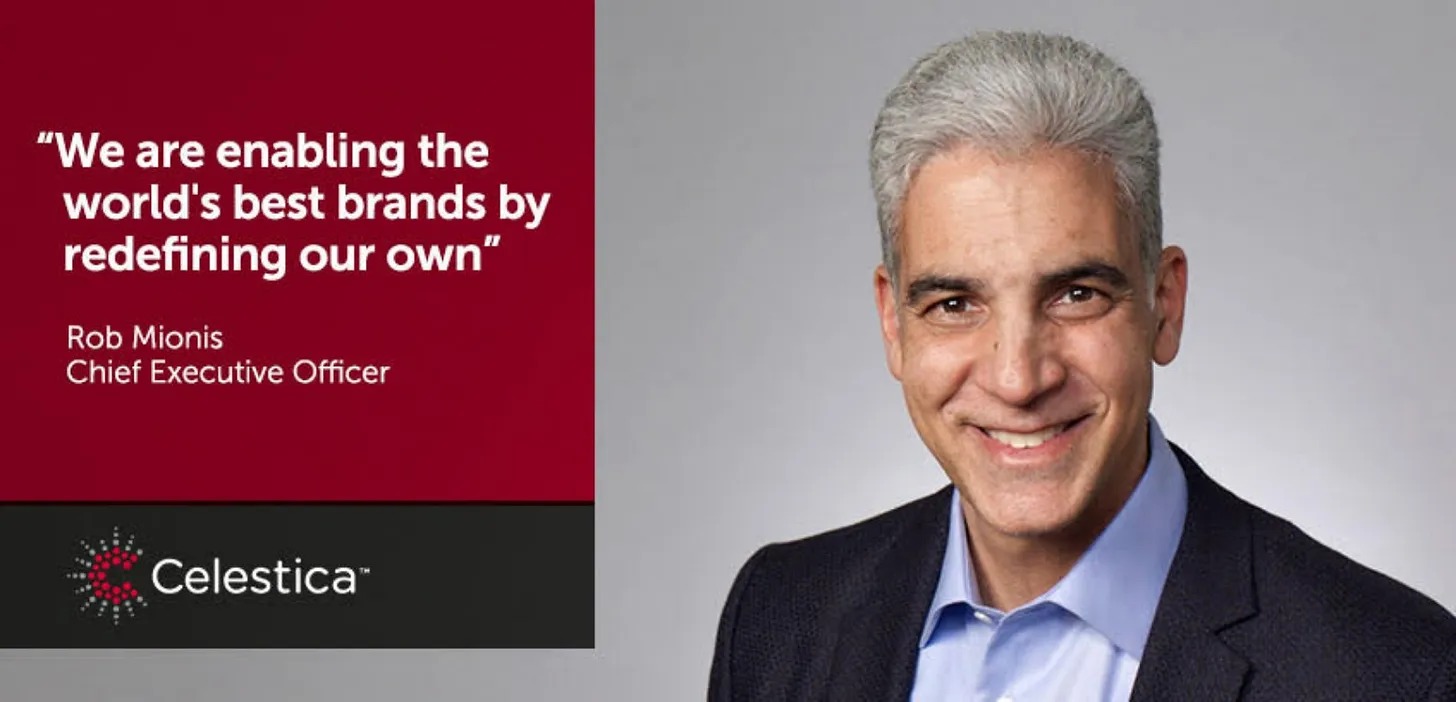
Mionis continued: traditionally, EMS firms simply build according to customer blueprints. Celestica’s speed comes from designing products itself—design for manufacturing.
“Forty percent of what we ship to cloud providers is our own design,” he said. This is essentially identical to Taiwan’s ODM-direct model.
Celestica isn’t the only dominant North American EMS heavyweight in the data-center and server integration business.
But unlike Supermicro—whose founder Charles Liang(梁見後) leads a team built on deeply Taiwanese engineering roots despite being branded as an American company—or ZT Systems, acquired by AMD and also built by a Chinese-American leadership team, Celestica stands out for its leadership team of almost entirely white male executives, with the lone exception of a Chinese-American chief human resources officer.
Both Mionis and Celestica’s CFO came out of GE, Honeywell Aerospace, and AlliedSignal—elite institutions in North American precision manufacturing.
Mionis is paid accordingly: US$16.97 million in 2023, making him Canada’s sixth-highest-paid CEO.
But has this group of elite executives truly excelled at the gritty business of contract manufacturing?
Financial results suggest: yes.
Celestica’s operating margin rose from 4.9% in 2022 to a projected 7.4% in 2025—on par with Wiwynn’s 7.3% in Q3 2024. Celestica expects US$12.2 billion in revenue in 2025—about one-third of Wiwynn’s size.
A Networking Titan Disguised as a Server Manufacturer
Why, then, does a company of this scale command such a high valuation?
The answer comes from one slide in Celestica’s earnings presentation: a market-share chart for high-end Ethernet switches.
(To see the chart and read the full story, please visit the Tech Taiwan Substack)
Have you read?
- Taiwan Indicts TEL in TSMC 2nm Leak: Implications for the Semiconductor Sector
- Foxconn’s Second Act: How Nvidia, Not Apple, Is Rewriting the Company’s Future
- Meet Chroma: The Quiet Taiwanese Giant Behind Nvidia’s Most Crucial Tests
Uploaded by Ian Huang
Views

Subscribe to CWE Newsletter (every Thursday)
Stay abreast of what's happening in Taiwan with our weekly digest.
Keywords: