How Taiwan firm Hu Lane utilizes international talents
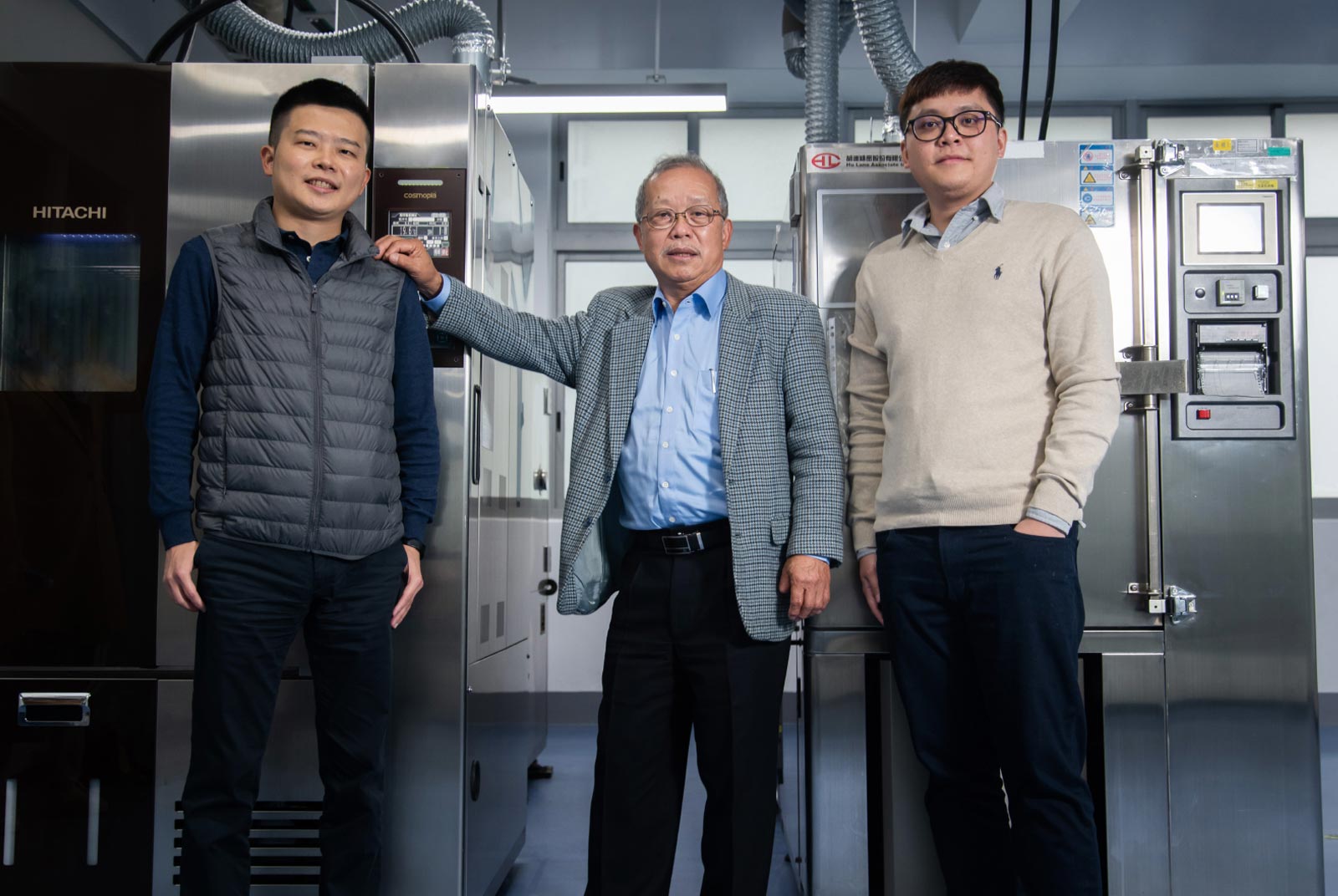
Source:Ming-Tang Huang
An Italian executive is paid more than the Taiwanese company’s CEO. Hu Lane Associate Inc., Taiwan’s largest automobile connector maker, has concentrated on markets outside of China. Three years on, it has reported record revenues. How did they do it?
Views
How Taiwan firm Hu Lane utilizes international talents
By Linden ChenFrom CommonWealth Magazine (vol. 742 )
“We’re not doing so well in the U.S. and European markets,” admits Oliver Chang, CEO of Hu Lane Associate Inc., Taiwan’s largest automobile connector manufacturer.
As of 2018, Hu Lane’s share of the European and American markets stood at just 10 percent. Yet over just the subsequent three years, the company set a new record of NT$4.95 billion in revenues, and “the European and American proportion was almost 20 percent,” relates Hu Lane COO, Chang Tzu-chieh.
Behind the company’s rapid growth in the European and American markets is a paradigm shift story of how a traditional industry transformed.
Back in 1977, Oliver Chang was working as a factory mold technician. He and two other more senior colleagues saw the industrial market taking off and came up with the idea to start a company. Chang, the youngest at the time, became the chairman.
For over 45 years, Hu Lane has enjoyed steady operation. The year 2018 was the company’s Waterloo. Once the trade war began between the U.S. and China, parts and components produced in Hu Lane’s Nanjing and Dongguan factories were subject to a 25-percent duty when imported to the United States. American customers responded by slashing orders, and along with poor conditions in the Chinese auto market, Hu Lane’s revenue dropped for the first time in company history.
At that time, China was the center of gravity for Hu Lane’s sales, accounting for 67 percent of sales. For Oliver Chang, a steady mover who is not well versed in English, in the past just crossing the strait to China was his choice of “internationalization”. But he could not be any clearer on the idea that in order to maintain sustainable operation, it was necessary to spread market risks by investing in the European, American, and Southeast Asian markets.
Three second-generation Chang family members with degrees from the UK and U.S. have honed their skills at the company for a decade, taking on the hefty task of transformation. These individuals include vice president of production operations Chang Ping-chun, vice president of global sales Chang Shao-chien, and human resources director Chang Chung-yi.
Enticing EU clients with Italian director
Chang Shao-chien knows many colleagues in the industry after many years of cultivating the European and American markets. Facing mounting pressure for Hu Lane to undergo transformation, in 2019 he sought out Luca Cammisa, an Italian national with a quarter century of experience working in the trenches of the automobile market, to serve as sales director to help Hu Lane open up the U.S. and European markets.
Hu Lane offered very generous terms to attract such talent. “His salary alone would be enough to hire 15 people at the same level in Taiwan. It’s even higher than mine,” marvels Oliver Chang.
Industry insiders explain, saying that the automobile industry is relatively insular. The certification process can take up to a year or two, and many cooperative relations can routinely take a decade to cultivate. By hiring Cammisa for his extensive network of business connections, Hu Lane believes it can at least cut its time investment in half.
For Cammisa, Hu Lane not only pays him a nice salary, but affords him a stage upon which to put his strengths to work.
A veteran of over 15 years with auto parts supplier Delphi, Cammisa felt limited to doing as he was told, and rarely had the chance to stretch out. With Chang Shao-chien lobbying, Hu Lane granted Cammisa the autonomy to do his own thing, with orders from Oliver Chang for production and R&D units to give him their full support.
 (Source: Hu Lane)
Setting out with full authorization to establish a career milestone, Cammisa brought extra gusto as he went about visiting with potential clients around Europe and the U.S. introducing them to Hu Lane. Thanks to the diversity and breadth of its product line and high degree of customization, Hu Lane was able to gain entry to the supply lines of such major industry names as Maserati and FIAT.
However, this was not enough for Hu Lane. “We should have a 40-percent share of the European and American markets,” asserts Oliver Chang, noting that if the company continues to grow its U.S. and European markets it will expand its team, and not even rule out setting up local production.
Vietnamese workers repatriated as managers
As for the rapidly growing Southeast Asian market, Hu Lane adopted a similar strategy of engaging local professionals to manage local staff. This is an outgrowth of Taiwan’s current difficulties with recruitment. As Chang Chung-yi relates, in 2019 Hu Lane’s Taipei plant had fewer than 10 job openings, which has since expanded to 30. Yet the company cannot find people to fill the positions, largely because of young people’s reluctance to take on labor-intensive work.
Still, opportunities can be found in crises, and Hu Lane went about sinking local roots, establishing cooperative arrangements with Taipei Municipal Nangang Vocational High School, as well as the Department of Mechanical Engineering and related mold-making departments at Taipei Tech, while at the same time introducing guest workers from Vietnam and the Philippines.
After three to five years of training at Hu Lane, five Vietnamese guest workers who had distinguished themselves especially well, having accumulated sufficient technical skills, returned to the Vietnam plant to serve as reserve managers.
The Vietnam plant is actually the brainchild of Oliver Chang, intended as a hedge against the impact of the U.S.-China trade war. Chang made the decision to establish the facility in 2018, and the production line began operation in 2020. And although it was chiefly staffed by Taiwanese expatriate managers at first, now one-half of the mid-level management consists of locals.
In addition, Hu Lane looks to make appropriate use of overseas Chinese student manpower, participating in an employment matchmaking fair for overseas Chinese students sponsored by the Taiwan External Trade Development Council (TAITRA) five years in a row. To date, this has resulted in the hiring of five overseas Chinese students to positions at Hu Lane.
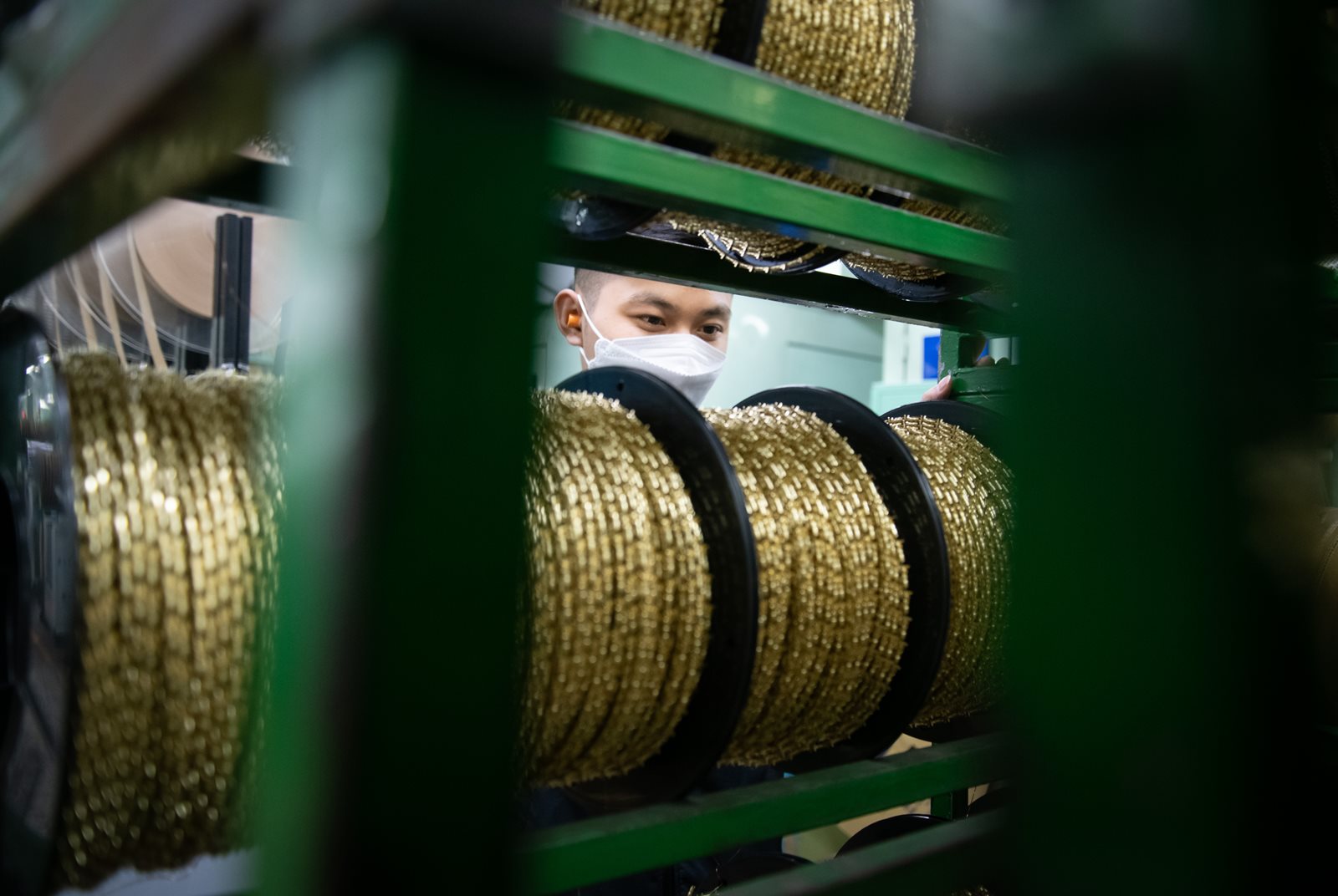 (Source: Ming-Tang Huang)
Chang Chung-yi relates that overseas Chinese students from Southeast Asia are well versed in Chinese and local languages. After completing university in Taiwan and undergoing six months to a year of training to become familiar with the company’s management methods, they are ready for assignments overseas. Typically they are dispatched to Vietnam and Indonesia for management positions in factory operations, quality control, and accounting.
Taking a three-pronged approach to cultivating talent consisting of locals, foreign guest workers, and overseas Chinese students, Hu Lane’s ultimate goal is for local executives to handle management directly. And after 27 years of operating in the Chinese market, today the company is approaching that goal, as just one or two Taiwanese executives remain at the Nanjing and Dongguan plants, and most operations are handled by local managers.
Hu Lane’s strategy of using locals to run local markets has helped the company mature into the multinational enterprise it is today.
Have you read?
♦ How GlobalWafers got ready for merger failure
♦ As Peloton loses steam, Taiwan suppliers drown in inventory
♦ Taiwan’s talent drought may raise salaries
Translated by David Toman
Edited by TC Lin
Uploaded by Penny Chiang
Views

Subscribe to CWE Newsletter (every Thursday)
Stay abreast of what's happening in Taiwan with our weekly digest.
Keywords: