A Year After "Liberation Day," China Rerouted Its Exports and Taiwan Expanded Its Tech Footprint
Source:Shutterstock
One year after Donald Trump's "Liberation Day" tariffs upended global trade, the data tells a story of adaptation rather than disruption: China rerouted its exports, transshipment hubs absorbed the overflow, and Taiwan expanded its semiconductor footprint. Did Washington succeed in rewiring global trade, or simply hand Beijing a roadmap for working around it?
Views
A Year After "Liberation Day," China Rerouted Its Exports and Taiwan Expanded Its Tech Footprint
By Judy Linweb only
Taiwan’s Central Bank revisited trade data last week to mark the first anniversary of U.S. President Donald Trump’s “Liberation Day” tariff announcement. In supplementary materials distributed to reporters following its quarterly press conference, the Bank highlighted several noteworthy trends triggered by the reciprocal tariffs, and the ripple effect continues.
The global economic landscape shifted dramatically on April 2, 2025—a date President Trump dubbed “Liberation Day.” Speaking in the White House Rose Garden, Trump declared a national emergency over the U.S. trade deficit and fentanyl trafficking. Invoking the International Emergency Economic Powers Act (IEEPA), he unveiled a sweeping package of “reciprocal tariffs,” including a universal 10% baseline tariff on imports and country-specific duties that in some cases exceeded 50%. Promoted as the beginning of an American industrial revival and a step toward greater economic independence, the move represented the most significant unilateral escalation in U.S. trade policy since 1930.
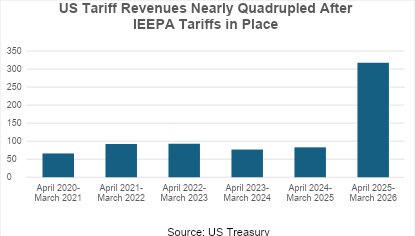
The impact was immediately visible in the data. For years, U.S. tariff revenues had remained relatively stable, ranging between US$66 billion and US$92.6 billion annually. In the fiscal year following the announcement (April 2025–March 2026), however, customs duty collections soared to a record US$317.8 billion, a 283% increase from the previous year. The unprecedented jump in revenue highlighted the arrival of a new era of protectionism—one that rapidly reshaped global supply chains and redirected billions of dollars in trade flows.
This sudden, massive tariff wall forced foreign exporters, particularly in Beijing, to completely rewrite their trade strategies.
Faced with a heavily penalized US market, China did not stop exporting; instead, it rapidly re-engineered its global supply chains to bypass the United States.
1. The Sudden Pivot in Chinese Exports (Sheet B)
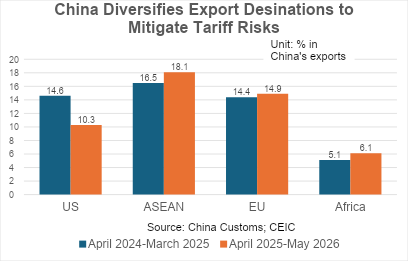
Sheet B tracks the percentage of China's total exports allocated to its major trading partners before and after Liberation Day, revealing a deliberate and massive diversion:
- The US Market Evaporates: In the year leading up to the tariffs (April 2024–March 2025), the US swallowed 14.6% of all Chinese exports. In the year following Liberation Day, that figure plunged to 10.3%, as the high cost of Trump's tariffs squeezed Chinese goods out of American ports.
- The Rush to ASEAN and Africa: To compensate for the American shortfall, Beijing flooded alternative markets. China’s exports to the ASEAN bloc climbed from 16.5% to 18.1% of its total export pie. Exports to Africa also expanded, rising from 5.1% to 6.1%.
- Stability in Europe: The EU held relatively steady, moving marginally from 14.4% to 14.9%, serving as a baseline consumer while China pivoted heavily toward developing economies.
2. The Multi-Year Shift in Global Market Shares (Sheet C)
When viewing this shift through a broader lens (Sheet C, tracking overall global market share), we see the long-term dismantling of the old Sino-American trade axis.
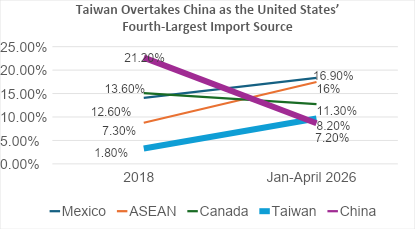
- Back in 2018, China commanded a dominant 21.2% share of the US imports. By early 2026, under the weight of escalating trade wars, its direct footprint sat at 7.2%.
- However, the data reveals that third-party hubs caught the overflow. ASEAN's share nearly doubled from 7.3% in 2018 to 16% by 2026, and Mexico climbed to 16.9%. This indicates a massive "transshipment" or nearshoring reality: Chinese components were increasingly routed through places like Southeast Asia and Mexico to be finished and safely shipped into the US under lower tariff rates. Meanwhile, Taiwan expanded its tech footprint from 1.8% to 8.2% to secure isolated semiconductor supply lines.
As trade flows physically shifted, international currency markets (Sheet D) experienced a volatile two-phase reaction over the 12 months following Liberation Day.
Phase 1: The Post-Liberation Currency Surge
Immediately following the April 2025 announcement, global markets reacted with alarm over potential US inflation and a desire to diversify away from the dollar. Capital fled the greenback, causing foreign currencies to surge:
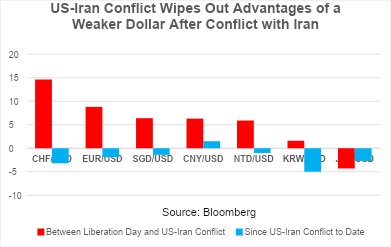
- The Swiss Franc (CHF) gained a massive 14.6% against the USD, while the Euro (EUR) rallied 8.8%.
- Crucially, despite the new tariff pressures, the Chinese Yuan (CNY) actually strengthened by 6.3% against the dollar, alongside the Singapore Dollar (SGD, +6.4%) and New Taiwan Dollar (NTD, +5.5%), as regional trade networks adapted.
Phase 2: The US-Iran Conflict and the SCOTUS Bombshell
The narrative flipped entirely later in the year. The outbreak of the US-Iran conflict triggered a classic geopolitical panic, sending investors rushing back to the safety of the US Dollar and erasing most of the post-Liberation currency gains (e.g., the South Korean Won plunged 5%).
Then came the February 2026 Supreme Court ruling, which struck down the IEEPA tariffs and triggered absolute legal whiplash for corporations worldwide. While the ruling technically rendered the Liberation Day tariffs unlawful, it opened up a chaotic battleground:
- The Tariff Pivot: Rather than backing down, the Trump administration immediately pivoted, invoking Section 122 of the Trade Act of 1974 to slap a temporary 10% global import surcharge to keep protectionist walls intact while bypassing the ruling.
- The Refund Mess: The data in Sheet A shows customs collections peaking at $317.8 billion through March 2026. Because the Supreme Court did not outline a mechanism for remedial actions, international corporations are now locked in fierce legal battles trying to claw back billions of dollars in unconstitutionally collected duties.
Conclusion: A Fragmented New World
One year after the Rose Garden declaration, the global economy has fractured into distinct regional trade blocs. While the US Treasury successfully collected historic tariff windfalls, it did not stop Chinese manufacturing. Instead, the data proves that China successfully adapted—withdrawing from direct US trade and pivoting its massive export engine toward ASEAN, Africa, and nearshoring partners, leaving a global market defined by high tariff walls and highly strategic supply routes.
Have you read?
- Taiwan Boasts Stellar GDP Figures, but Wealth Reaches Few
- Navigating Asia’s New Strategic Playbook: Resilience, Innovation, and the Green Transition
- Former U.S. Intel Chief Studeman: Taiwan Faces a 'Boiling Frog' Threat That Goes Beyond Military Invasion
Uploaded by Ian Huang
Views

Subscribe to CWE Newsletter (every Thursday)
Stay abreast of what's happening in Taiwan with our weekly digest.
Keywords: