A Institutional Reform Is Transforming the Global Manufacturing Landscape
As Global Supply Chains Reshape, Taiwanese Businesses Cannot Ignore India
Source:Shutterstock
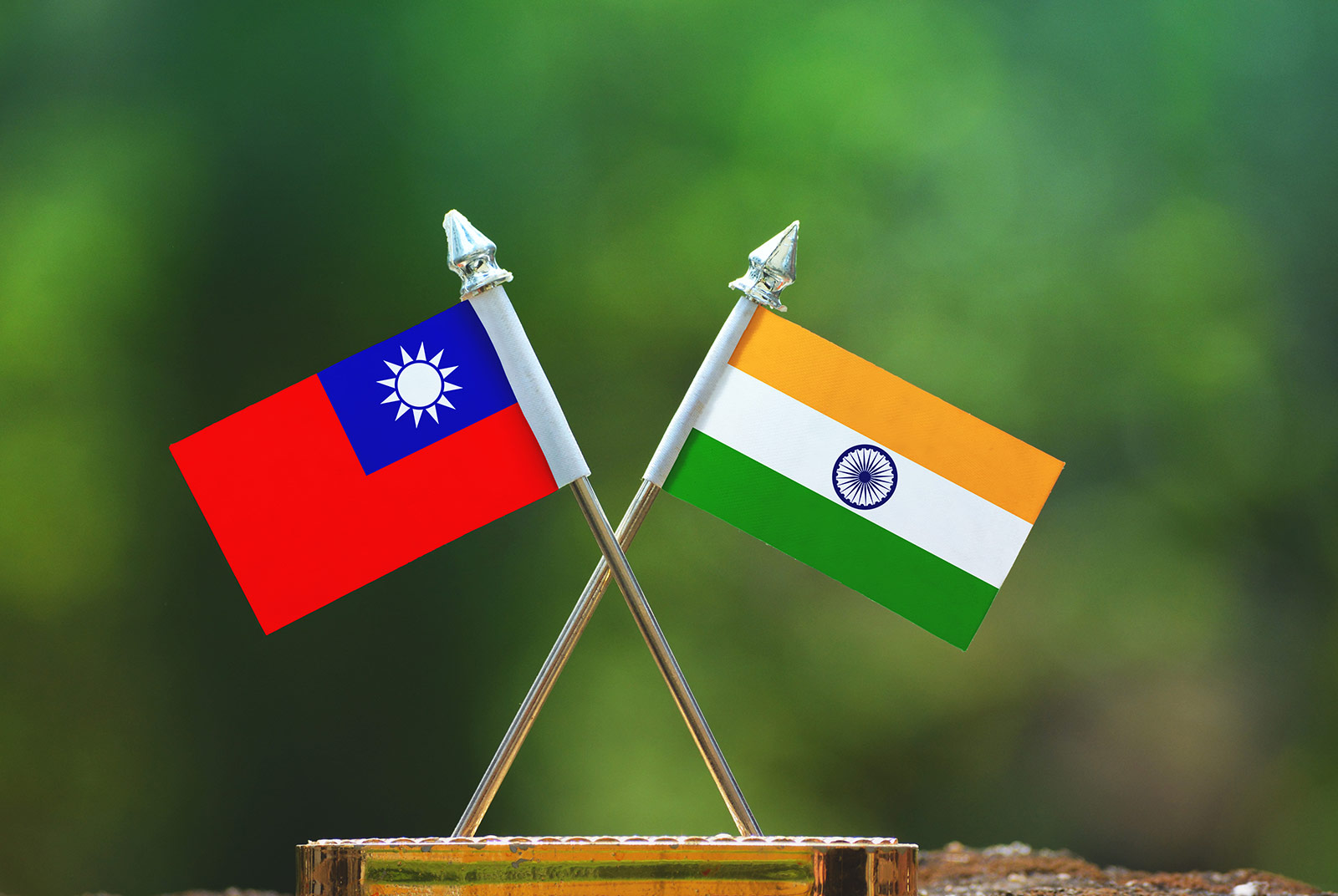
As global supply chains continue to evolve, India is emerging as a compelling manufacturing destination for Taiwanese businesses. In this op-ed, Ninad Deshpande, Director General of the India Taipei Association, explains how a decade of institutional reforms has made India’s business environment more transparent, efficient, and predictable—and why leading Taiwanese manufacturers are already expanding there. As the next phase of global manufacturing takes shape, is it time for Taiwanese companies to take a fresh look at India?
Views
As Global Supply Chains Reshape, Taiwanese Businesses Cannot Ignore India
By Ninad Deshpandeweb only
The global supply chain is undergoing its most significant restructuring in decades. Driven by the geopolitical shifts, and corporate reevaluations, supply chain resilience is no longer just a strategic discussion—it has increasingly become concrete action for many multinational corporations. For Taiwanese enterprises, the question worth considering is no longer whether India is ready to become the next long-term manufacturing hub, but how much is the readiness on the ground.
Many Taiwanese businesses still reflexively point to administrative, regulatory, policy, and prolonged timeline. These concerns are not unfounded. Precisely for this reason, the Indian government has reinvigorated a comprehensive reform programs that began a decade ago to further enhance Ease of Doing Business (EoDB). The goal now is to make laws and administrative procedures even more transparent, efficient, and predictable to attract high tech sector investment and stimulate ongoing traditional business industries. This is a thorough systemic undertaking spanning taxation, finance, labor, trade, and investment. The underlying governance philosophy still remains what the Indian government frequently summarized as: "Minimum Government, Maximum Governance."
The impact of these reforms is evident in key metrics. Over the past five years, the number of registered companies in India grew by roughly 27%. Furthermore, the 2026–27 Budget introduces measures such as digital trade facilitation, tax certainty, reduced compliance and litigation burdens, and trust-based customs systems. Notably, long-term tax exemptions extended through FY2040-41 for overseas electronics component suppliers and bonded warehouses offer unprecedented tax certainty. This demonstrates that the reform is not a one-off policy announcement, but an ongoing, multi-year structural transformation.
As India celebrates 80th anniversary of India's independence this month, this shift is far more worthy of corporate attention: the government is moving beyond short-term fiscal incentives to lower the cost of doing business through long-term policy predictability. For enterprises, institutional efficiency is often more critical than subsidies. When evaluating overseas investments, a manufacturing firm cares about more than just population or market size—it asks: How long does it take to build a factory? Can components pass through customs on time? Are regulations transparent? Can capital move in and out safely? These seemingly administrative issues often dictate whether an investment project is truly competitive.
Consequently, recent Indian reforms have focused not on launching more incentive policies, but on improving the daily operating environment for businesses. A decade ago, if a Taiwanese electronics EMS firm set up a factory in India, obtaining approvals required going through six separate committees. Setting up plants across two states meant undergoing labor registration and licensing applications independently in each jurisdiction—a time-consuming and labor-intensive process. When importing goods, customs duties had to be paid before cargo release, trapping working capital at customs for weeks. Furthermore, procedural oversights or documentation errors could subject executives to criminal investigations. These are precisely the friction points recent institutional reforms aim to resolve.
- Approval Phase: The six separate committees have been consolidated into a single national tripartite committee. Approval timelines for factory construction or expansion have been cut from 90 days to 30 days—allowing electronics contract manufacturers, PCB, and component suppliers to enter production significantly earlier.
- Registration & Licensing: Companies now perform a single digital registration, yielding a nationwide license. For companies planning simultaneous setups across multiple states, project teams can focus fully on engineering and production lines rather than state-level administrative red tape.
- Customs Clearance & Capital: A "clear first, pay later" mechanism allows certified companies to move imported goods directly to factories for production, with customs duties payable within 30 days. For assembly plants relying heavily on Just-in-Time (JIT) operations, this releases cash flow and boosts working capital.
- Compliance Risk: In the past, procedural errors—such as late filings or minor documentation mistakes—could be treated as criminal offenses. The 2023 Jan Vishwas (Trust Act) and its 2025 amendments reclassified procedural oversights from criminal liabilities to civil fines. Companies correcting minor mistakes now pay fines or rectify records without facing litigation, allowing resources to be spent on business operations rather than risk management.
In short, this wave of reform dismantles four major pain points long cited by Taiwanese manufacturers in India: slow approvals, cross-state duplicate procedures, capital trapped in customs, and criminal liability for procedural errors. While the institutional system is not yet perfect, a comparison of operations before and after these reforms demonstrates a clear shift toward greater predictability and manageability.
These improvements are increasingly reflected in industrial investments. Bilateral trade between Taiwan and India recently crossed the $12 billion milestone, setting a record high. Foxconn’s workforce in India has surpassed 50,000 as it expands its manufacturing footprint. PSMC’s $13 billion semiconductor fabrication joint venture with the Tata Group further underscores that the global semiconductor industry is incorporating India into its long-term strategic layout.
Investments by these major companies look beyond current market demand to position for the supply chains of the next decade. For Taiwanese small and medium-sized enterprises (SMEs), the cluster effect created by these large investments is particularly notable. As electronics manufacturing, semiconductor, and assembly capacities take shape, demand for PCBs, passive components, precision molds, automation machinery, testing equipment, and various parts will surge in tandem. In the past, Taiwanese businesses entering India often had to operate in isolation; today, as the supply chain matures, SMEs have greater opportunities to follow existing clients and co-create new industrial ecosystems.
This leads to an observation I wish to share with Taiwanese enterprises: re-evaluating India today should not be driven solely by its market size, but by its shifting industrial fundamentals. Taiwan possesses world-leading precision manufacturing capabilities, complete supply chain management experience, and a highly agile SME network. India offers rapidly growing talent, digital capability, and an expanding manufacturing ecosystem. Cooperation between both sides should go beyond "Made in India with Taiwanese Investment" to jointly build a more resilient global supply chain.
No enterprise can remain isolated from global supply chain restructuring. Every company adopts a distinct strategy, and no single market fits all. However, for Taiwanese businesses considering their next overseas manufacturing base, now is an ideal time to rediscover India. India brings not only vast opportunities, but also trustworthiness—an increasingly critical ingredient in today’s corporate decision-making that addresses not just the 'just in time' operational need, but also the 'just in case' risk management dilemma.
Demonstrating this shared momentum, India and Taiwan are working at bilateral deputy ministerial levels to highlight the potential of the India-Taiwan partnership and its enabling factors in India, as officials meet by the end of this month for the 19th India-Taiwan Economic Consultations (ITEC) in India.
What truly deserves to be seized is not merely India’s 80-year development journey, but the new opportunities emerging from the global manufacturing landscape reshuffle over the next decade. As institutional reforms, market demand, and industrial clusters intersect, the investments made today will define an enterprise's position in the next supply chain era.
About the author:

Ninad Deshpande is the Director General of the India Taipei Association.
Have you read?
- China’s Tech Stocks Are Falling Despite Their Own Breakthroughs
- Trump Arrives in Beijing With No Cards up His Sleeve
- After a Strong 2025, Taiwan’s Economy Faces Pressure in 2026
Uploaded by Ian Huang
Views

Subscribe to CWE Newsletter (every Thursday)
Stay abreast of what's happening in Taiwan with our weekly digest.
Keywords: