Exclusive Interview: Uber CEO Bullish on Taiwan Market, Supports New Labor Regulation
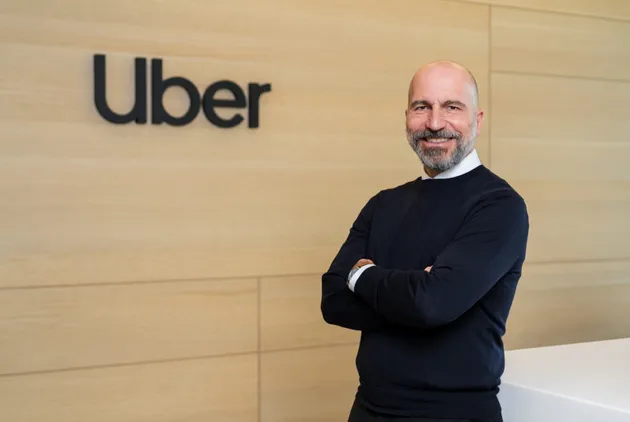
Source:Kuan Hsieh
Uber CEO's visit to Taiwan coincides with the initial approval of the food delivery law, and Bolt's entry into Taiwan in September to compete with Uber for drivers and customers. Faced with AI disrupting the world, how will Uber, the last game-changer, respond?
Views
Exclusive Interview: Uber CEO Bullish on Taiwan Market, Supports New Labor Regulation
By Yi-chih Wangweb only
Dara Khosrowshahi, CEO of Uber, has always been a supporter of open dialogue with regulatory agencies and labor unions. His visit to Asia in December was primarily focused on deepening Uber’s partnership with Japan’s Rakuten and its plan to invest US$2 billion in the Japanese market over the next five years. Along the way, he stopped by Uber’s branch offices in Hong Kong, Korea, and Taiwan. He stayed in Taiwan for 16 hours.
This was his first visit to Taiwan since taking the wheel at Uber in 2017. He says, “This is the first time I've come to Taiwan. It's long overdue.” He goes on to add, “We've been in business here for over 10 years, and it's one of our most successful countries in which we operate, especially in both mobility and delivery.”
His visit coincided with Taiwan’s passing of draft legislation to improve labor conditions for food delivery workers.
At the same time, Uber competitor Bolt’s entry into Taiwan means that the ride-hailing giant is facing challenges on both the regulatory and business fronts.
To Khosrowshahi, Taiwan is a textbook example of an ideal market, where Uber’s penetration rate is 98% and one out of every two accounts is an Uber One account. He observes, “The people of Taiwan, they love convenience, reliability and excellent service.”
Commenting on Taiwan’s population density and highly cost-effective delivery services, he says, “If the world looked like Taiwan, our business would be five times bigger.” Because of this, despite the Taiwanese government’s blocking of Uber’s NT$30.8 billion bid to acquire rivaling food delivery service Foodpanda, he stresses that “Respecting the regulatory decision, we're continuing to look at all kinds of investment opportunities.” Uber has also bought Taiwan’s local taxi company Crown Taxi to show its commitment to Taiwan.
Regarding the projected rise in operating costs brought on by the new regulations, which are estimated to reach NT$5 billion annually, Khosrowshahi has adopted a proactive approach to engaging in dialogue with regulators. He supports efforts to protect the rights of delivery workers, but he draws the line at a ban on “order stacking”.
Stacking orders (i.e., having couriers complete multiple orders in one trip) is a major source of profit for the platform. This practice must be allowed, he insists, lest the cost-savings made possible by the algorithm be erased and service fees be forced to increase.
Khosrowshahi’s management style centers around “rational communication”. He took the reins at Uber amidst financial setbacks and controversy, and he managed to turn things around in just six years.
 (Photo: Kuan Hsieh)
Unlike the previous manager’s combative stance, Khosrowshahi asks, “Why can't I bring taxi drivers more business and build a partnership that way?” He reminds his team: “We can't always demand that society or regulators change their ways; we have to change our ways first.”
His secret to success is “supply-driven”. During internal meetings on recruiting drivers and suppliers, managers told him, “If we have drivers, then we will have consumers. The consumers come.” But Khosrowshahi wanted to redefine Uber’s core value, as he felt that Uber’s competitive edge came from its ability to help customers save time. “The value of time in life is that it's the only thing I think that if you lose, you can never have it back.” He concludes, “The integration of supply is one of the biggest lessons I learned at Uber.”
In the future, Uber will work on promoting cross-platform personalized services. For example, “If you're going to go to work, we can give you your Starbucks on the way.”
As for the autonomous vehicle revolution, Khosrowshahi favors platform integration strategies over capital investment, saying, “No one company can build the future alone.” Although he opines that “The transition will be slow, and we need to verify the safety of autonomy,” he is optimistic about the impact of AI, saying that “A chatbot can be a window into the experience.”
Ultimately, his goal is to make Uber services ubiquitous.
Have you read?
- Will Amazon’s Bazaar Win Taiwan’s Budget Battle?
- Can Student Interns Keep Taiwan’s Hotels Running?
- Why Korean Tourists Are Going Crazy for Taiwan
Translated by Jack Chou
Edited by TC Lin
Uploaded by Ian Huang
Views

Subscribe to CWE Newsletter (every Thursday)
Stay abreast of what's happening in Taiwan with our weekly digest.
Keywords: