Can Taiwan's AI Initiative Produce More than a Heap of Reports?
Source:Richard deVries
Since last October Taipei has been paying for AI diagnosis before it pays for AI. The sequencing is right, and it puts Taiwan ahead of most of the world on a question the AI industry spent more than US$5 billion answering this year. The program is also moving faster than planned. That is the part to worry about.
Views
Can Taiwan's AI Initiative Produce More than a Heap of Reports?
By Richard deVriesweb only
Since last October the Ministry of Economic Affairs has been running the Industrial Competitiveness Guidance Corps, a program that pays for AI diagnosis before it pays for AI. The company puts up NT$10,000 (US$317). The government puts up NT$190,000 (US$6,032), and a consultant comes into the plant to work out what the actual problem is. Tool subsidies and training vouchers follow at NT$100,000 (US$3,175) and NT$120,000 (US$3,810), and only on the back of what the diagnosis found.
In July the ministry published the count. Nine months in, the guidance teams had been through 9,249 companies, 93 percent of them small and medium enterprises. The original target was 14,000 by 2028. The agency now expects to pass 20,000, against a two-year budget of NT$23 billion (US$730 million).
Most owners I speak with have not heard of it. That is a shame, because the design is better than the ones that came before it. Previous programs handed out money for tools. This one pays someone to work out what the problem is before anyone buys anything.
That ordering is not obvious. The AI industry put more than US$5 billion behind the same idea seven months later.
What the Labs Paid to Learn
In May, Anthropic announced a US$1.5 billion venture with Blackstone and Goldman Sachs to put its own engineers inside customer organizations. OpenAI raised more than US$4 billion for a similar effort valued at US$10 billion. In July the Anthropic venture launched under the name Ode, built on an AI services firm it had bought in May and staffed with around a hundred engineers. OpenAI did the same thing, acquiring a consultancy called Tomoro.
Two of the most valuable companies on the planet decided that selling the technology was not enough. They needed people in the room who understand how a business actually runs. And rather than build that capability, they bought it.
Both moves quietly admit something the industry has been dancing around for two years. The hard part of AI is not the technology. The hard part is the organization.
The evidence had been piling up. Microsoft's Work Trend Index found that organizational factors, meaning culture, manager behavior, and talent practices, account for more than twice the real-world impact of AI compared with individual mindset and behavior, 67 percent against 32 percent. Only 19 percent of the AI users it surveyed sit in what Microsoft calls the 'frontier', where individual fluency and organizational readiness both run high.
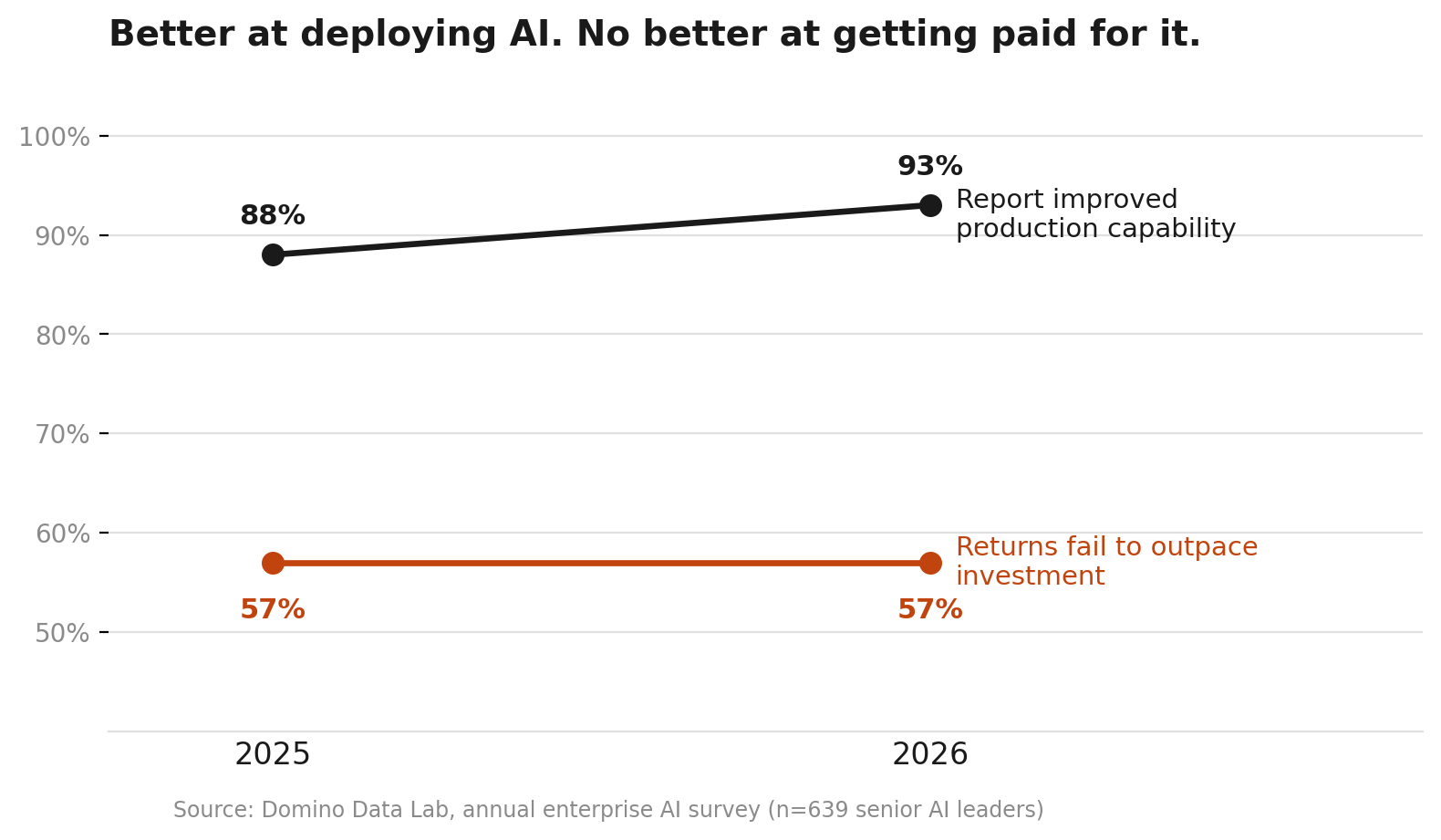
In late July Domino Data Lab published its annual survey of 639 senior enterprise AI leaders. The share of companies whose returns fail to outpace their investment held at 57 percent, unchanged from last year. Over the same period, the share reporting improved production capability climbed from 88 percent to 93 percent. Read those two numbers next to each other. Companies are getting better at putting AI into production and no better at getting paid for it. Two years of that is not a technology problem.
So Taipei and Silicon Valley have reached the same conclusion by different routes. Diagnosis before deployment. Where they part company is on what happens next.
Three Assumptions That Do Not Travel
Ode's model is straightforward. A small team works with the customer to find where the technology can do the most good. Engineers then sit alongside the customer's own engineering team, building tools and supporting them over the long term. It is the model Silicon Valley has settled on for hard deployments, and it works.
Three assumptions hold it up:
The first is that the client has an engineering organization mature enough to pair with visiting AI engineers. The whole arrangement runs engineer to engineer.
The second is that the engagement is long. Diagnosis exists to open the door to a permanent embedded relationship.
The third is the one nobody has written about. Ode was conceived by Blackstone, which noticed the gap while trying to push AI across the companies it owns, and its first clients are the portfolio companies of its investors. That presumes an owner sitting above the operating company who wants transformation and has the authority to insist on it.
In my experience none of the three describes a Taiwanese mid-sized manufacturer.
Engineering here means process and manufacturing engineering, not the kind of internal software organization that can absorb a visiting AI engineer. In the machinery firms I sit in, the IT department is often one person who also administers the ERP licence and makes sure the wifi and servers are working.
Then there is the Laoban. Pragmatic, capital-disciplined, and rightly skeptical of long agency commitments, he does not buy multi-year 'transformation' on faith. For a while I read that resistance as generational, the older owner who had simply not caught up. That was lazy of me. What these owners understood better than I did was that everyone walking through the door with an AI pitch was selling something, and not one of them could say where the money would come from. They were not behind. They were waiting for a straight answer.
And in a family-owned firm there is nobody upstairs. No sponsor pressing for change, no board demanding a roadmap. The Laoban is the owner. If he is not persuaded, nothing happens.
Of course none of this is a flaw in Ode's design. Its model suits American mid-sized firms with software-adjacent operations and institutional owners, which is exactly where it has launched. Anthropic was deliberate about that. Its existing partners (Accenture, Deloitte, PwC) handle the global enterprises, while Ode goes after community banks, regional health systems, and mid-sized manufacturers. Even Anthropic treats the mid-market as a different problem needing a different model. Taiwan should extend that logic one step further.
What the Local Version Needs
If diagnosis before deployment is the right idea, and it is, the local version has to start somewhere else.
It cannot run engineer to engineer, because most clients have no engineering counterpart. It has to run operations to operations, with the people who know where decisions get stuck, where the promise made in the catalogue comes apart at the seams, and where nobody quite owns the workflow.
It also cannot be designed to maximize engagement length. Taiwanese B2B owners do not want to be embedded with. They want a clear diagnosis, a tangible quick win, and a roadmap they can act on. Whether they act on it with an outside partner or in-house is their call, not their consultant's.
Which brings the question back to Taipei, and to the pace.
Nine thousand companies in nine months is about a thousand a month, delivered through 22 research institutes, 42 sub-industry teams and 424 local trade associations. As throughput that is a real achievement. As diagnosis it is the thing to watch. Operational diagnosis is not a survey instrument. Its value comes from someone standing in one particular factory looking at one particular bottleneck, and that does not template well.
The composition is worth reading too. Around 60 percent of the companies guided so far are in services, mostly wholesale, retail and food and beverage, where the questions repeat from one business to the next and a working answer travels. Manufacturing is the other 40 percent, concentrated in metal products and machinery. That is the harder half, and the half where a generic answer is worth nothing.
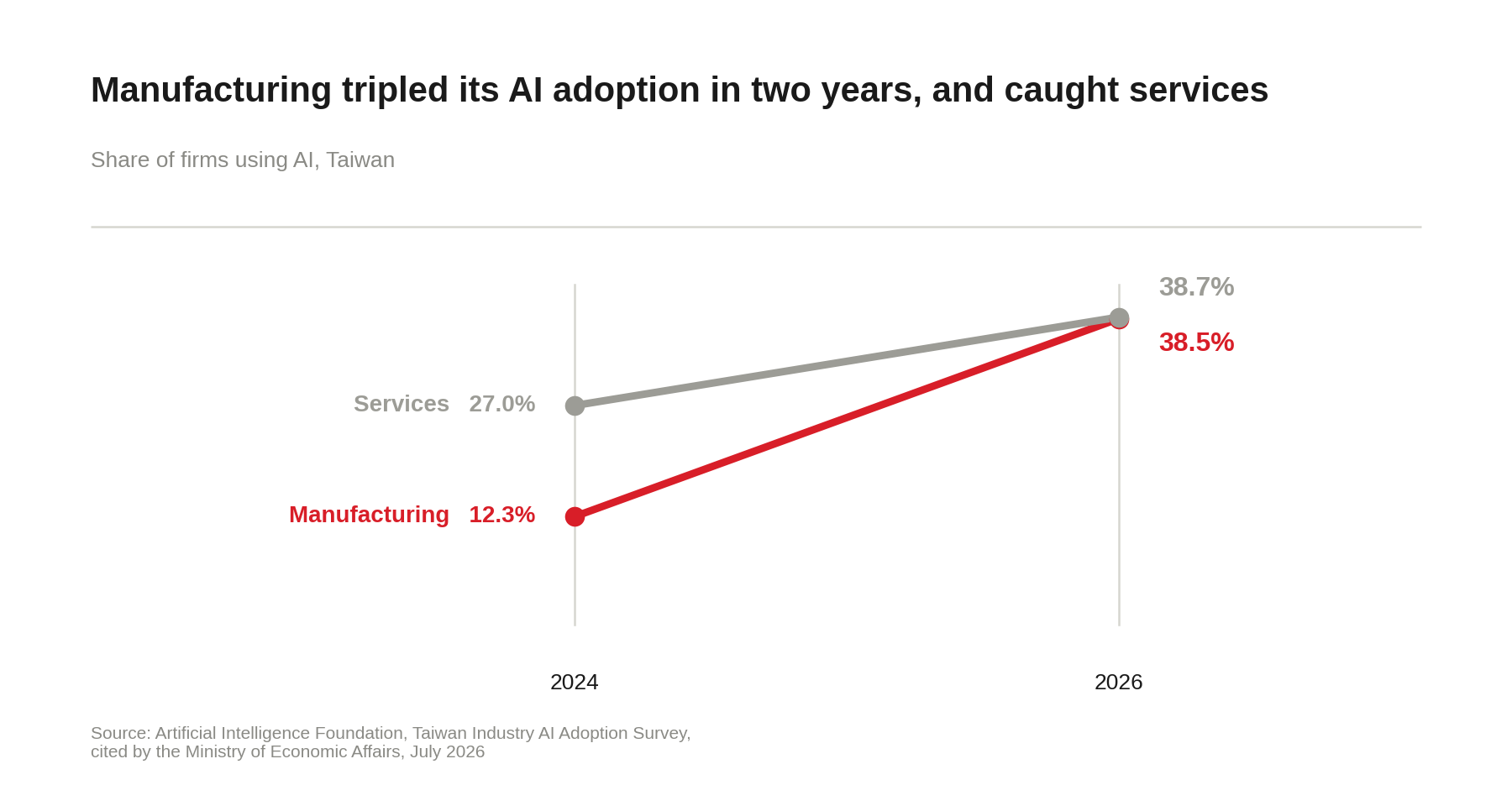
So the target will be met. It may well be beaten, and the wider picture is moving with it. An industry survey the ministry cites puts manufacturing AI adoption at 38.5 percent this year, against 12.3 percent two years ago, which closes almost all of the gap on services. The breadth is real. What the count cannot tell anyone is whether the consultant who walked into the ten-thousandth machine shop had the room to find something, or whether the visit produced a document. Run at speed as a form-filling exercise, the program will have funded a very large number of reports. Run properly, it will have funded the only stage that determines whether the other two are worth anything. The firms furthest behind are precisely the ones least able to do anything with a generic answer.
The Bigger Pattern
The labs getting into implementation is not a small story. It is the strongest signal yet that AI value will be won at the level of organizational design rather than technology selection. Microsoft's data, the partner networks, the acquisitions, the flat returns against rising capability in the Domino numbers, all of it points one way. Implementation is the bottleneck, and more than US$5 billion has now been placed behind that conclusion.
Their answer, though, was built for their customers, and their customers are not here. For Taiwan's mid-sized manufacturers the work has to look different. Less embedded engineering, more operational intelligence. Less long-term lock-in, more portable roadmaps. Less faith in what the technology could theoretically do, more attention to the everyday workflows where it meets an actual decision.
The Laobans who get this right will not be the ones who hire the biggest name. They will be the ones who insist on diagnosis first, results fast, and a roadmap they own.
(This piece reflects the author's opinion, and does not represent the opinion of CommonWealth Magazine.)
CommonWealth Magazine welcomes op-ed submissions. Please send your article proposals to [email protected]
About the author:

Richard deVries is the founder and CEO of Geber, a brand strategy and marketing consultancy with offices in Taipei, Tampa and Toronto. For more than 25 years, he has helped B2B companies, many of them Taiwanese manufacturers, clarify what makes them valuable and turn it into brands that compete internationally. Geber's work has been recognized with a Red Dot Award in 2025 and an iF Design Award in 2026.
Contact: [email protected] , or connect on LinkedIn
Have you read?
- Taiwan Builds World-Class Products. It Forgets to Tell Anyone
- How Taiwan Can Build Global Brands Without Losing Itself
- Line Logic: Why Trust in Taiwan is Earned Not Announced
Uploaded by Ian Huang
Views

Subscribe to CWE Newsletter (every Thursday)
Stay abreast of what's happening in Taiwan with our weekly digest.
Keywords: