China Treats AI as Comprehensive Strategy and That Makes a Big Difference

Source:Shutterstock
Europe sees it only as a risky but needed lever on competitiveness, and this is not enough.
Views
China Treats AI as Comprehensive Strategy and That Makes a Big Difference
By Alicia Garcia Herreroweb only
When Xi Jinping arrives at the White House on 24 September, artificial intelligence will be at the top of the agenda. Trump has said as much himself, and the two governments spent the summer preparing an intergovernmental dialogue on frontier models. Europe will not be in the room, and that absence is a symptom rather than an accident.
Almost four years after US export controls were meant to keep it out of the race, China is close to the American frontier in artificial intelligence, and getting closer. Europe is not close, and is not closing. The usual explanation is money. It is the wrong one: China has converged on the United States while spending a fraction of what American firms spend.
What distinguishes its effort is not the size of the cheque but the scope of the objectives behind it.
In its 15th Five-Year Plan, for 2026 to 2030, China pursues AI as three things at once — a source of productivity growth, an instrument of technological sovereignty and a military capability — and coordinates policy across every layer of the stack, from fabrication to applications. Europe pursues AI as one file within an industrial competitiveness agenda. That difference in scope, not in budget lines, is what should worry European policymakers.
Start with the economics of AI. China needs productivity growth to offset a structural deceleration: an investment-driven model that has run its course, a property sector that will not recover its old role, and an ageing population. The plan lists AI among the “new quality productive forces” and names artificial general intelligence as a national ambition. China’s AI strategy when it comes to competitiveness is called “AI+”. This strategy drives adoption into services, reaching into healthcare and education. Beijing is betting AI can at least mitigate structural deceleration. This is the objective that Europe is working on although with much less impetus. Adoption is much slower and the regulatory constraints are much larger for Europe.
The second objective has no European equivalent in practice. US export controls on advanced semiconductors, imposed in October 2022, pushed Chinese policymakers to reduce their dependence on US AI infrastructure. In April 2025, Xi Jinping himself demanded “self-reliance and self-strengthening” and the creation of an “independent and controllable” ecosystem built on domestic hardware and software. Europe talks about digital sovereignty but has not built infrastructure that reduces its own dependencies on American cloud providers and foundation models, and on Taiwan and South Korea for advanced fabrication and memory chips.
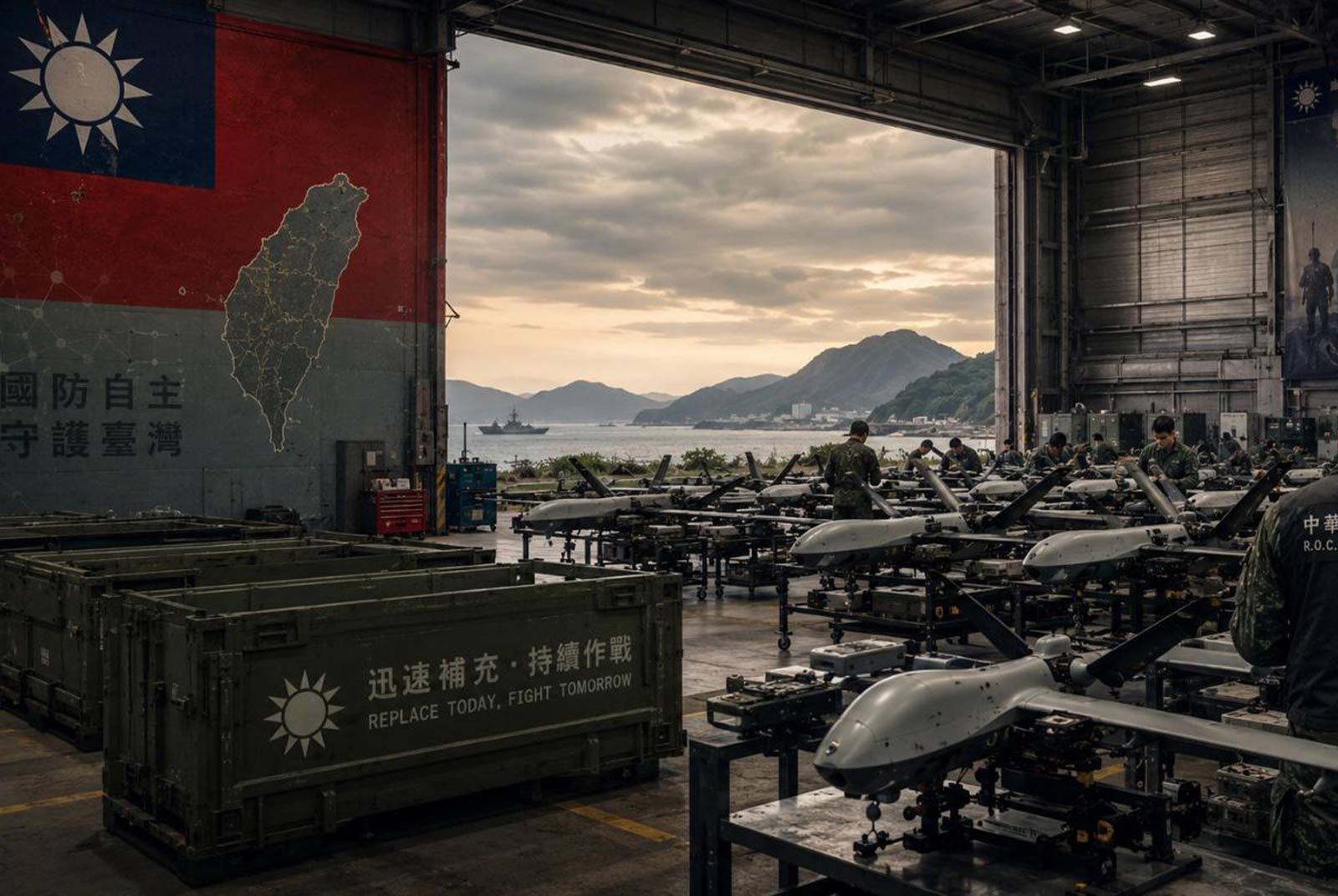
The third objective is the one Europe barely addresses at all, namely defence. AI is already embedded in autonomous systems, intelligence analysis, logistics and battlefield decision support in both armed forces. Washington holds the world’s largest military-AI investment, largely through the Defense Advanced Research Projects Agency (DARPA). Beijing is fusing civilian technological and industrial capacity with military research, procurement and production, and has a doctrinal concept for it. Europe’s military-AI capabilities remain fragmented across member states, even as rearmament since Russia’s invasion of Ukraine has begun to stimulate defence-related investment.
What binds the three objectives together in China’s case is state support, not only in the form of funding but also of the overall strategy. The heaviest direct money goes to capital-intensive semiconductors, where import dependence bites hardest due to US export controls. Higher up, the state enables rather than directs, through compute vouchers and guidance funds that steer private capital instead of replacing it.
The protected home market — foreign providers find it close to impossible to sell generative-AI services in China — allows domestic platforms to accumulate the users, data and revenue that fund model development.
The fact that China is a full single market for AI deployment clearly helps and should draw important lessons for Europe. And abroad, open-weight models help the diffusion of Chinese AI, competing with the US on price and on control.
This is putting China in pole position as standard-setter, which should clearly worry Europe. In fact, Xi Jinping institutionalised China’s global role in AI at the World AI Conference in Shanghai in July, launching the World Artificial Intelligence Cooperation Organization.
The American model is less coordinated but with a bigger ticket in terms of funding. One could argue that extreme competition among large private companies cannot produce a comprehensive plan like China’s. In reality US objectives are also very large in scope, certainly larger than Europe’s. The US administration plays a relevant role in shaping innovation and deployment of AI through procurement, basic research and export controls. The difference, though, comes from the nature of the funding. Private investors are less patient than a state, and they may not be able to tackle market failures. In the US this is increasingly visible on the energy front, where the build-out is outrunning the electricity grid.
All in all, both China and the US have an overall strategy which includes the innovation space and defence, beyond competitiveness. Europe lacks this.
As for constraints, China’s binding one is AI hardware and America’s are energy and the patience of capital. Europe has them all, plus the framing: no strategy except regulation.
The AI Act is the world’s most comprehensive governance framework, yet regulatory leadership has produced neither a surge in innovation nor faster adoption, with compliance manageable for large firms and costly for small ones.
For European firms seeking a capable model they can host, inspect and adapt, the most accessible frontier-adjacent options are increasingly Chinese. Local hosting answers some concerns about foreign control; it does not answer the risk of exchanging one dependence for another. On 24 September, two governments will discuss the terms of a technology on which Europe depends and to which it contributes little.
The question is not whether Europe has the ambition to lead in AI. It is whether European institutions can treat AI as China and the United States do — as an economic, sovereignty and security question at once — and act on it at the speed the technology demands.
(This piece reflects the author's opinion, and does not represent the opinion of CommonWealth Magazine.)
CommonWealth Magazine welcomes op-ed submissions. Please send your article proposals to [email protected]
About the author:

Alicia Garcia Herrero is the chief economist for Asia Pacific at French investment bank, Natixis, based in Hong Kong. And she is also a Senior Fellow at Bruegel.
Views

Subscribe to CWE Newsletter (every Thursday)
Stay abreast of what's happening in Taiwan with our weekly digest.
Keywords: