When Did We Stop Waiting for Answers?
Source:Joshua Roberts
From library card catalogs and microfilm to smartphones and AI, finding answers has become almost effortless. That’s an extraordinary thing, but I sometimes wonder whether getting used to immediate answers has made us less comfortable with questions that need a little more time.
Views
When Did We Stop Waiting for Answers?
By Joshua Robertsweb only
When Finding Out Took Time
I spent a lot of time in libraries when I was younger. I remember the Dewey Decimal System, looking things up in encyclopedias, searching old newspapers and magazines on microfilm, then photocopying whatever I found so I could take it home and highlight the useful parts.
Even when I first became interested in close-up magic, I learned mostly from books. There was no video showing exactly where to put your fingers or how a move should look. You read the explanation, studied the illustrations, and tried to figure it out.
Finding answers took time.
I don’t say that with much nostalgia for the inconvenience. I’m quite happy not to spend an afternoon searching through microfilm. But I’m glad I experienced it, because I’ve also been fortunate enough to watch most of that friction disappear.
 Finding an answer once meant knowing where to look, then taking the time to find it.
A Few Clicks Away
I remember when Encyclopedia Britannica became available on CD-ROM. Suddenly, all those volumes were searchable and interactive. Looking something up often led to looking up something else, and I remember enjoying the exploration as much as finding whatever I was originally looking for.
I also had access to computers fairly early. My high school in the Seattle area was an early Microsoft test school, with a computer lab they helped fund. It was there in the early 1990s that I started learning about website design and built my first website using Netscape Navigator Gold. Then came Windows 95 and the flourishing internet. The amount of information available seemed to explode, and suddenly there was an enormous new world to explore.
Years later, the smartphone removed another bit of friction. When I got my first iPhone in 2007, I no longer had to wait until I was sitting in front of a computer to look something up. If I suddenly wondered how many days it takes to hike the Annapurna Circuit in Nepal, I could find out while I was still wondering about it. If two people disagreed about some obscure fact over dinner, somebody could pull out a phone and settle it before dessert arrived.
Not knowing something, even temporarily, started becoming optional.
Now We Just Ask
AI feels like another step in that progression, except this one is a little different. Search engines made information much easier to find. AI increasingly gives us the answer itself.
I use it constantly, and I’ve noticed that I don’t treat every answer the same way. How tall is Mount Everest? I don’t check. What’s the IMDb rating of a Star Wars movie? I’m probably not checking that either. I’ll photograph something I’m eating and ask AI to estimate the macronutrients. I know it isn’t perfectly accurate, but it’s good enough for what I need.
Recently, I asked for help making a traditional marinara and meatball dish for a potluck. The recipe looked reasonable, so I started cooking. There wasn’t much at stake. If I’m asking about my health, finances, or something else with real consequences, however, I behave quite differently. I ask more questions, look at other sources, and become much less willing to accept the first answer.
Same technology. Same immediate response. The difference is how much I care about getting it wrong.
Some Questions Need More Questions
We’ve spent decades making information progressively easier to access, and I think that has also conditioned us to expect immediacy. Most of the time, that’s wonderful. But not every question works that way.
If I walked into a doctor’s office and said my stomach hurt, I’d be concerned if the doctor immediately prescribed treatment. I’d expect questions. Where does it hurt? How long has it hurt? What did I eat? What medication am I taking? Has this happened before?
Those questions aren’t getting in the way of the answer. They’re part of how the doctor gets there.
There are facts we can retrieve almost instantly. Other problems require context, judgment, experience, or simply more questions. Sometimes we don’t know which kind we’re dealing with until we slow down enough to find out.
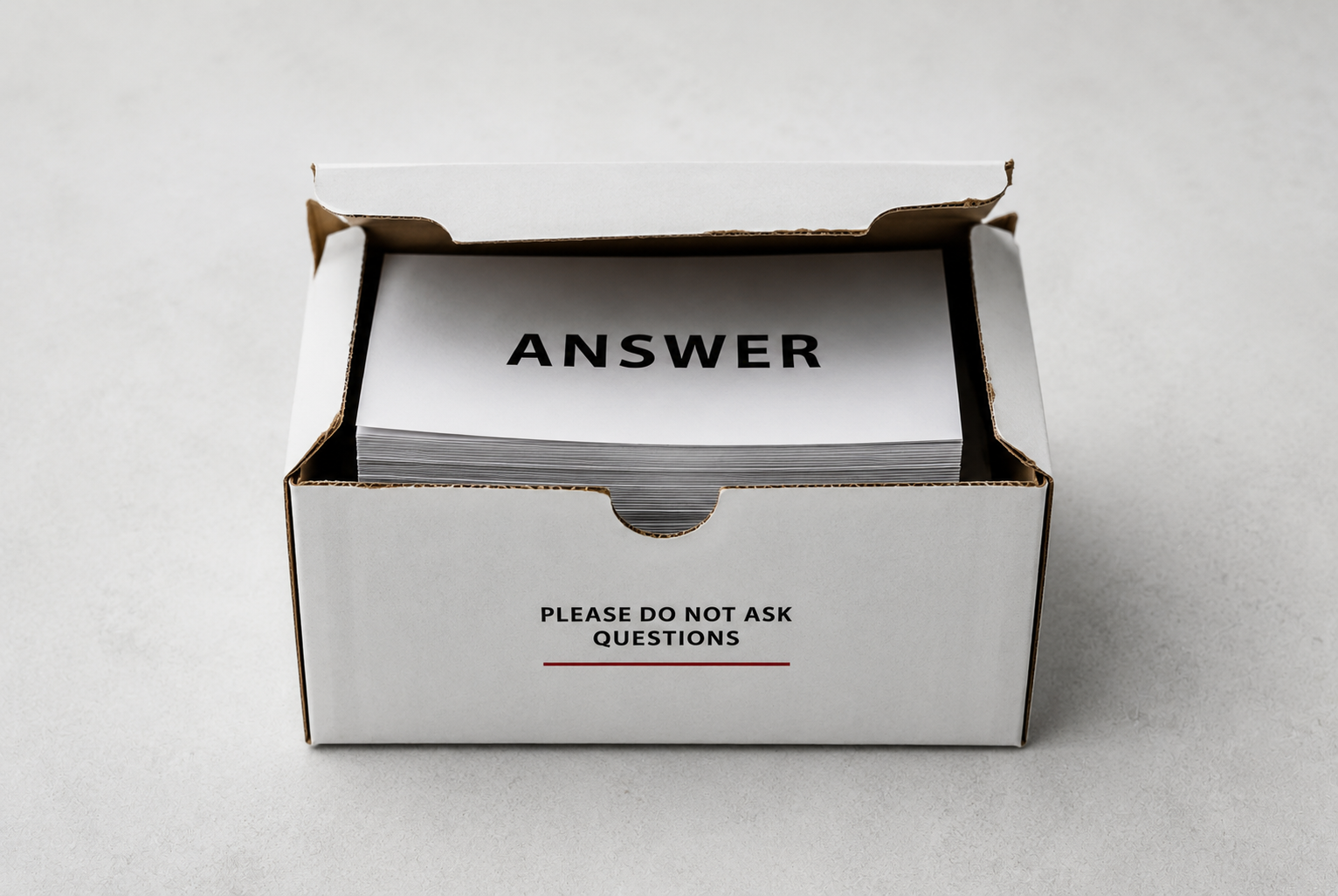 The fastest answer isn’t always the right one, especially when we haven’t asked enough questions.
Thinking We Already Know
I run into this in my own work too, and I’m certainly not immune. As a consultant, asking questions is a large part of what I do, but experience can sometimes create its own shortcut. You see something that looks familiar and think you understand the problem because you’ve seen it before.
An OEM manufacturer we work with once asked us to redesign some of its product documents. We’d dealt with similar situations before and thought there was a better solution. Instead of maintaining separate PDFs, why not keep the information on the website and generate documents from there? One source of truth, always current, searchable, and less duplicated work.
It made perfect sense to us.
Except we’d missed something.
The company had document-control requirements behind the scenes, including maintaining historical versions for accounting and legal purposes. We’d recognized something familiar and started thinking about the solution before fully understanding the problem.
I’m still not entirely convinced there wasn’t a better way to solve it, but that’s another story.
Experience is useful because it helps us recognize patterns, and most of the time that’s a good thing. But sometimes something that looks familiar has a completely different constraint hiding underneath it. Even when asking questions is part of your job, it’s surprisingly easy to think you already know the answer.
I certainly don’t want to trade AI for microfilm. Being able to sit at my desk and simply talk to a computer still feels remarkable when I think about where I started. But as answers become easier and faster to get, I’m finding myself thinking more about the ones that shouldn’t come quite so quickly.
We’ve spent decades removing friction from the way we find information, and most of that has been extraordinary progress. But perhaps some friction isn’t something we should eliminate.
Sometimes it’s a critical part of getting to the right answer.
The thoughts above come from my own experience watching the way we search for information, use technology, and approach problems in my work. This piece reflects my own opinion, and not that of CommonWealth Magazine.
(This piece reflects the author's opinion, and does not represent the opinion of CommonWealth Magazine.)
CommonWealth Magazine welcomes op-ed submissions. Please send your article proposals to [email protected]
About the Author:

Joshua Roberts is the Founder of Level Interactive™, a Taipei-based brand strategy and design consultancy helping B2B and technology companies get clear on their story and communicate it well. A former Global Creative Director at Acer, he has worked across agency and in-house roles over more than 20 years in Taiwan. Outside of client work, he spends his time hiking, traveling, and practicing close-up magic, a habit that goes back further than his design career does.
Contact: [email protected] or connect on LinkedIn.
Have you read?
- How Taiwan Can Build Global Brands Without Losing Itself
- Line Logic: Why Trust in Taiwan is Earned Not Announced
- What Hiring Reveals About a Company’s Brand
Uploaded by Ian Huang
Views

Subscribe to CWE Newsletter (every Thursday)
Stay abreast of what's happening in Taiwan with our weekly digest.
Keywords: