Taiwan's Drone Problem Is Replenishment, Not Production
Source:Meng Kit Tang
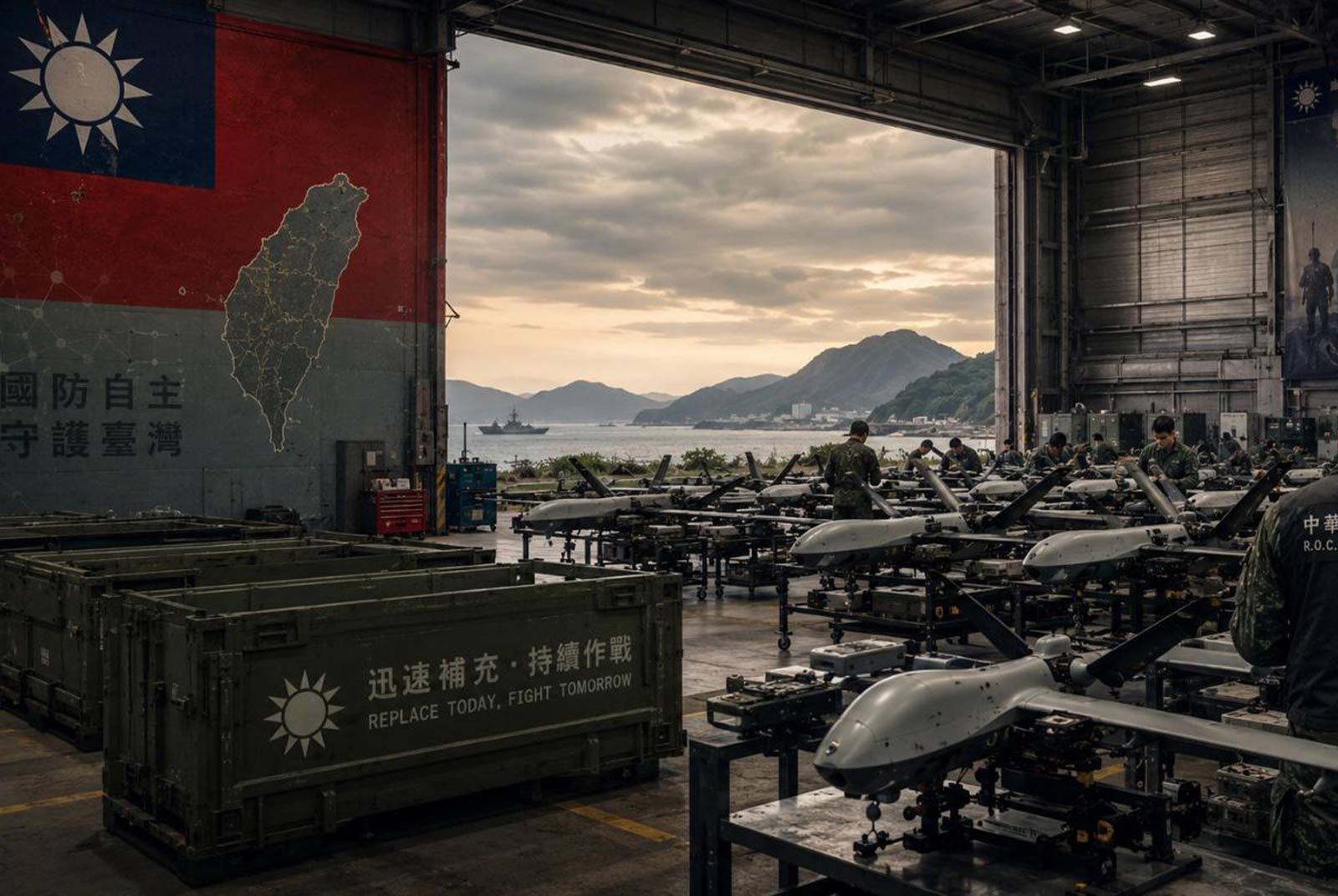
Taiwan has proven it can manufacture drones at scale. The bigger challenge is whether it can sustain wartime replenishment through reliable procurement, secure supply chains, and continuous military orders.
Views
Taiwan's Drone Problem Is Replenishment, Not Production
By Meng Kit Tangweb only
A Late Boat and a Consumable Problem
Taiwan's first indigenous submarine missed its contracted delivery date in November 2025, and the navy has fined the builder, CSBC Corporation, roughly NT$190,000 a day since. When Defense Minister Wellington Koo addressed the legislature on July 20, he declined to confirm reports that the vessel, the Hai Kun, would be delivered by the end of August or early September, saying the ministry was setting no deadline.
Safety and quality would decide the date, not a calendar. The delay is not scandalous: a first-of-class submarine is a scarce platform, and Taiwan had never built one before the Hai Kun.
However, drones follow a different logic. Their value comes partly from being replaceable. A fleet has to absorb losses by putting another aircraft into the field after the first is gone. The question for the Hai Kun is whether Taiwan can build the thing at all. For drones, it is whether Taiwan can keep building them after combat starts consuming them.
The Factories Are No Longer the Scarce Fact
Drone output reached NT$12.9 billion in 2025, up from about NT$5 billion in 2024, according to the Ministry of Economic Affairs (MOEA). Research Institute for Democracy, Society and Emerging Technology (DSET) reports that exports to Europe rose from 2,574 units in 2024 to 107,433 in 2025, then to 136,010 in the first quarter of 2026 alone. Monthly capacity was about 15,000 units in May; MOEA’s 2030 target is 100,000 a month. On August 14, the legislature kept NT$63.4 billion in 2026 drone funding after the Kuomintang (KMT) had threatened 70 percent cuts.
Those figures show Taiwan can expand production. But production capacity, military inventory and replenishment capacity are three different things. A factory can make 100,000 drones a month without the military holding 100,000 replacement systems or being able to buy them at that rate.
Between output and replenishment sit contracts, inventories, components, testing, logistics and a buyer willing to keep ordering. Taiwan's industrial base is expanding faster than its ability to show how those pieces fit together. The question is whether procurement can turn that capacity into replacements when fighting begins.
The Wrong Mountain
Chips derive strategic value from scarcity. A fabrication plant takes years and tens of billions of dollars to build, which helps explain why Taiwan has spent two decades calling Taiwan Semiconductor Manufacturing Company Limited (TSMC) its silicon shield.
Drones are different: their value depends on replacing losses quickly and cheaply.
The guardian-mountain framing says little about what a drone industry needs. The immediate question is who will buy the output and on what terms, a dispute already visible in the fight over which ministry controls the program.
Taiwan's industrial base resembles electronics manufacturing services, with high-volume assembly, distributed suppliers and rapid iteration, much like the model Foxconn and Pegatron built around other companies' designs. But that model needs predictable demand. Taiwan can build the factories; it has yet to show that its military will sustain the orders needed to keep them running.
Taiwan has adjusted indigenous programs when procurement conditions changed. The Air Force cut its Ching-kuo fighter order from 250 to 130 in 1991 after Washington approved F-16 sales.
The lesson for drones is straightforward: an indigenous production line needs a sustained reason for the military to keep buying. That requirement becomes harder to manage when the systems are expected to be consumed.
A Number Passed, Not Settled
The budget fight began in May, when the opposition-controlled legislature passed a NT$780 billion special defense budget instead of President Lai Ching-te's. The cut removed all funding for domestically produced uncrewed systems. Fourteen bill variants seeking to restore the money then moved through committee without agreement for three months.
On August 14, the legislature restored NT$63.4 billion, but the figure covers two different purposes. NT$44.2 billion funds industry development over six years, with equal annual allocations intended to give manufacturers predictable orders.
The remaining NT$19.2 billion covers one year of procurement and, MND Comptroller Bureau head Hsieh Chi-hsien said, applies to unarmed drones and industry subsidies rather than weapon systems.
The larger dispute came to a vote on August 27. The legislature rejected Lai's NT$210 billion special-budget bill, which would have run through 2031 under the Ministry of National Defense (MND) and funded about 210,000 systems, including 208,200 littoral attack drones.
Instead, lawmakers approved the KMT-TPP alternative: NT$240 billion over six years through the annual budget, with an annual ceiling of NT$40 billion in principle. The MOEA will oversee the program except for military procurement, which remains with MND.
Koo had already told the legislature that MND planned to spend NT$42.1 billion on the covered categories in 2027, above the new annual ceiling. If that requirement holds, MND will need legislative approval for the additional money each year.
Premier Cho Jung-tai declined to say whether he would sign the bill. Taiwan now has funding for both its drone industry and military procurement, but the mechanism does not yet clearly match projected demand.
It has committed money to making drones without settling how much the military can buy each year as replacement needs rise.
Three Tests, One Passing Grade
For now, Taiwan has passed the production test; but it has not yet answered three other questions: will orders continue, will the drones work under wartime conditions, and can the supply chain be trusted when demand surges?
On demand, the funding that survived the August 27 vote is annual and capped in principle, though adjustable, after the legislature had voted in May to strip it. That leaves replenishment exposed to annual political decisions.
On performance, the Industrial Technology Research Institute (ITRI) became the first evaluation body outside the United States for Association for Uncrewed Vehicle Systems International's (AUVSI) Green Unmanned Aircraft System (UAS) program, strengthening cybersecurity and supply-chain standards but not proving battlefield resilience.
An August Audit Office finding found that the military's NT$3.55 billion fixed-site counter-drone system cannot detect or jam PLA drones using the newer 5.1 GHz band. It does not establish that Taiwan's own drones will fail under electronic attack, but it exposes a wider gap between the threat and Taiwan's defenses.
On supply chain, vice-president Hsiao Bi-khim told CNA that foreign buyers value Taiwan as a trusted, non-red supply-chain source.
Three days earlier, Kaohsiung prosecutors detained a supplier to the Army's 8th Field Army, alleging it concealed Chinese-made chips and flight-control boards in training drones and falsified their origins. Ciaotou prosecutors called it the first national-security case involving a military drone contract.
Taiwan can produce more drones; but it has yet to prove that it can replace them securely, predictably, and at wartime speed.
A Small Number Inside a Large One
Taiwan's Cabinet approved a fiscal 2027 defense budget of NT$1.1225 trillion on August 20, its first above NT$1 trillion and 3.01 percent of GDP. A week later, the legislature gave the drone program roughly NT$2 billion less annual headroom than MND says it needs for 2027.
The sum is small beside the defense budget. The dispute is therefore less about affordability than about design. Taiwan is spending more on defense, but it has not settled how a class of weapons expected to suffer heavy losses should be funded.
Taiwan has built the factories. The harder test is whether it can keep money, components and orders moving fast enough from those factories to the battlefield. A drone fleet is not a stockpile. It is a flow, and Taiwan has yet to prove it can sustain that flow under fire.
(This piece reflects the author's opinion, and does not represent the opinion of CommonWealth Magazine.)
CommonWealth Magazine welcomes op-ed submissions. Please send your article proposals to [email protected]
About the author:

Tang Meng Kit is a Singaporean and works as an aerospace engineer. He graduated from the S. Rajaratnam School of International Studies (RSIS), Nanyang Technological University (NTU), Singapore. His research interests include cross-Straits relations, Taiwan politics, policy issues and aerospace technology.
Have you read?
- When the Homeland Changed: Waishengren, Memory, and Taiwan
- I Fear the Compatriots Even When Bearing Gifts
- Harmony or Autonomy? The KMT’s China Visit and the Search for Openings Across the Strait
Uploaded by Ian Huang
Views

Subscribe to CWE Newsletter (every Thursday)
Stay abreast of what's happening in Taiwan with our weekly digest.
Keywords: