Taiwan's Next AI Winners: QIC Sees 500 Smaller Companies Worth US$2.66 Trillion by 2030
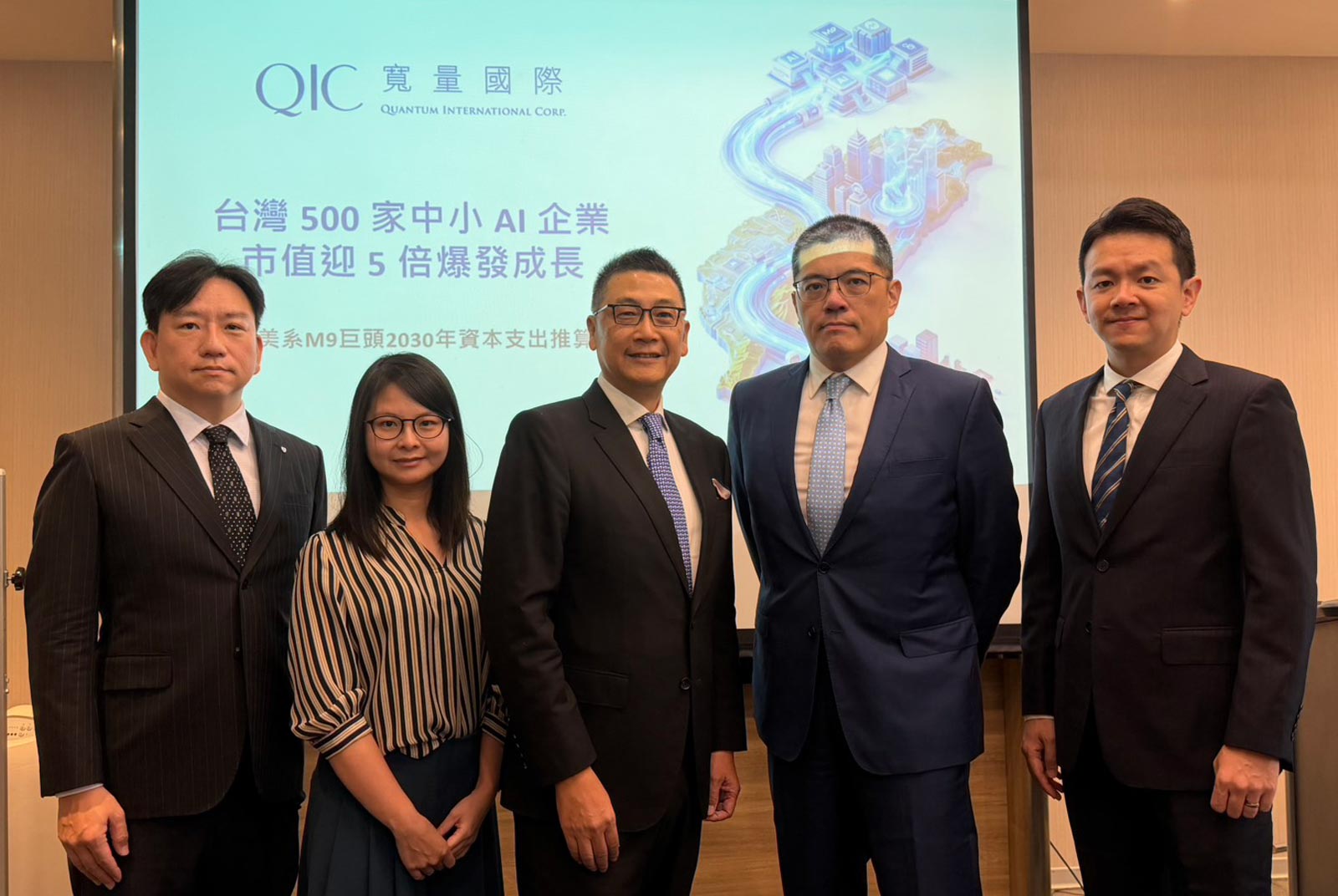
Source:QIC
Fueled by US$6.5 trillion in projected AI capital spending and supply chain localization, Taiwan's emerging AI players could see their combined market value increase fivefold.
Views
Taiwan's Next AI Winners: QIC Sees 500 Smaller Companies Worth US$2.66 Trillion by 2030
By Judy Linweb only
Taiwan's next wave of AI investment winners may emerge from beyond its established technology giants, as massive global AI infrastructure spending and accelerating supply chain localization create new opportunities for smaller companies.
According to estimates by Quantum International Corp. (QIC), a Taiwan-based boutique investment bank, the M9—Microsoft, Amazon, Google, Meta, Oracle, SpaceX, Tesla, NVIDIA, and Apple—along with independent AI infrastructure providers, will invest as much as US$6.5 trillion in AI capital expenditures between 2026 and 2030, representing a compound annual growth rate (CAGR) of 35%.
QIC is bullish on 500 Taiwanese small- and mid-sized AI companies, collectively known as the “QIC AI 500,” which are poised to benefit from two major growth drivers: massive capital expenditures by the U.S. M9 tech giants and independent AI infrastructure providers through 2030, and supply chain localization initiatives led by Taiwan’s top 50 AI companies (T50), which boast the strongest net cash position among the world’s major AI powers.
Alex Lee, CEO of QIC, stated in a press conference on Monday, "Since 2023, widely regarded as the beginning of the AI era, 20 Taiwanese small-cap companies have successfully risen into the ranks of the T50 industry leaders. We believe the 500 rising stars within the QIC AI 500 universe represent the most promising source of alpha for global investors over the next five years.”
Under its proprietary QIC AI 500 research framework, QIC conducted an in-depth analysis of 2,289 small- and mid-cap companies listed on Taiwan's stock exchanges and Emerging Stock Market, excluding the top 50 companies ranked by market cap (T50). The research team reviewed publicly available financial statements, investor conference materials, and corporate disclosures covering the past 12 quarters. From this universe, QIC selected 500 promising companies positioned to benefit substantially from the AI boom, collectively designated the "QIC AI 500."
The QIC AI 500 comprises:
- 69 mid-cap companies valued between US$2 billion and US$10 billion.
- 227 small-cap companies valued between US$300 million and US$2 billion.
- 204 micro-cap companies valued below US$300 million.
Top 10 Companies in QIC AI 500 List, Ranked by Market Cap
| Ranking | QIC AI 500 Company | Main Business | Market Cap (US$ million) | AI Relevance |
|---|---|---|---|---|
| 1 | LandMark Optoelectronics (聯亞) | Epitaxial wafers for lasers and photodetectors (optical communications) | 9,240 | Mass production of continuous-wave (CW) laser epitaxial wafers for 1.6T silicon photonics, supplying AI data centers. |
| 2 | Fortune Electric (華城) | Transformers, switchgear, and turnkey engineering projects | 7,891 | AI data center transformer orders exceed NT$20 billion, with their revenue contribution rising from 5% to over 15%. |
| 3 | Pegatron (和碩) | Notebook and consumer electronics manufacturing; AI server assembly | 7,610 | Shipping GB-series and B200/B300 AI servers, targeting a 10% revenue contribution from AI servers. |
| 4 | GIGABYTE Technology (技嘉) | Motherboards and AI servers | 7,511 | AI server offerings include GB300-based systems and GIGAPOD solutions. |
| 5 | Inventec (英業達) | Contract manufacturing of notebooks and servers | 6,972 | Supplies AI servers to Chinese customers and Tier 2/3 cloud service providers (CSPs), including motherboards and complete server racks. |
| 6 | WIN Semiconductors (穩懋) | Gallium arsenide (GaAs) foundry services for power amplifiers, optical communications, and 3D sensing | 6,676 | VCSELs for 50G/100G data center applications are in mass production; 1.6T photodetectors (PDs) scheduled for mass production by the end of Q2 2026. |
| 7 | WPG Holdings (大聯大) | Semiconductor and electronic component distribution | 6,155 | Distributes computing and memory components for AI data centers; AI-related revenue is not separately disclosed. |
| 8 | Elite Material (聯茂) | Copper-clad laminates (CCLs) | 5,783 | High-speed M8/M9-grade CCLs used in AI server GPU boards; M9-grade products have passed qualification by a major U.S. GPU manufacturer. |
| 9 | Lotes (嘉澤) | Connectors, including server CPU sockets | 5,618 | AI server connectors account for 55.36% of revenue; QDS products have begun shipping. |
| 10 | L&K Engineering (亞翔) | Cleanroom construction, electromechanical engineering, and process piping systems | 5,439 | Undertakes facility construction for 12-inch wafer foundries and advanced memory packaging plants. Semiconductors account for 82% of revenue. An indirect beneficiary of AI chip and HBM capacity expansion. |
Source: QIC
As supply chains continue to localize, companies in the QIC AI 500 are poised to emerge as the true beneficiaries among small and medium-sized enterprises (SMEs) of the unprecedented capital spending boom driven by global AI hyperscalers. Driven by these dual tailwinds, QIC projects that the QIC AI 500’s combined market capitalization will increase fivefold to US$2.7 trillion by 2030, positioning these companies as the biggest winners of the AI investment boom.
Benefiting from the dual tailwinds of supply chain localization by global AI giants and Taiwan's T50 companies, QIC forecasts that the combined revenue of the QIC AI 500 will grow at a CAGR of 18%, reaching US$665 billion by 2030. Applying the group's average price-to-sales (P/S) ratio of 3.8 times over the past three years, QIC projects that the aggregate market capitalization of these companies will increase approximately fivefold, from the current US$488 billion to US$2.66 trillion by 2030.
The diverse lineup underscores QIC's broader investment thesis: the economic impact of AI is extending beyond computing hardware into the infrastructure, technologies, and services that support an increasingly AI-driven economy.
For global investors seeking exposure to Taiwan's AI ecosystem, QIC argues that the next phase of growth may offer opportunities beyond the country's best-known technology leaders, particularly among smaller companies positioned to become critical suppliers to the global AI industry.
Have you read?
- AI Chips Have a Bending Problem. A Taiwanese Oven Maker Is Selling the Fix.
- A Strike Vote at Micron Taoyuan Could Be the First in Taiwan’s Chip Industry
- Why Nvidia, Delta, and TSMC All Need Chroma: An Exclusive Interview with CEO I-Shih Tseng
Uploaded by Ian Huang
Views

Subscribe to CWE Newsletter (every Thursday)
Stay abreast of what's happening in Taiwan with our weekly digest.
Keywords: