Why China’s Top Graduates Are Trading Ambition for Stability
Source:Reuters
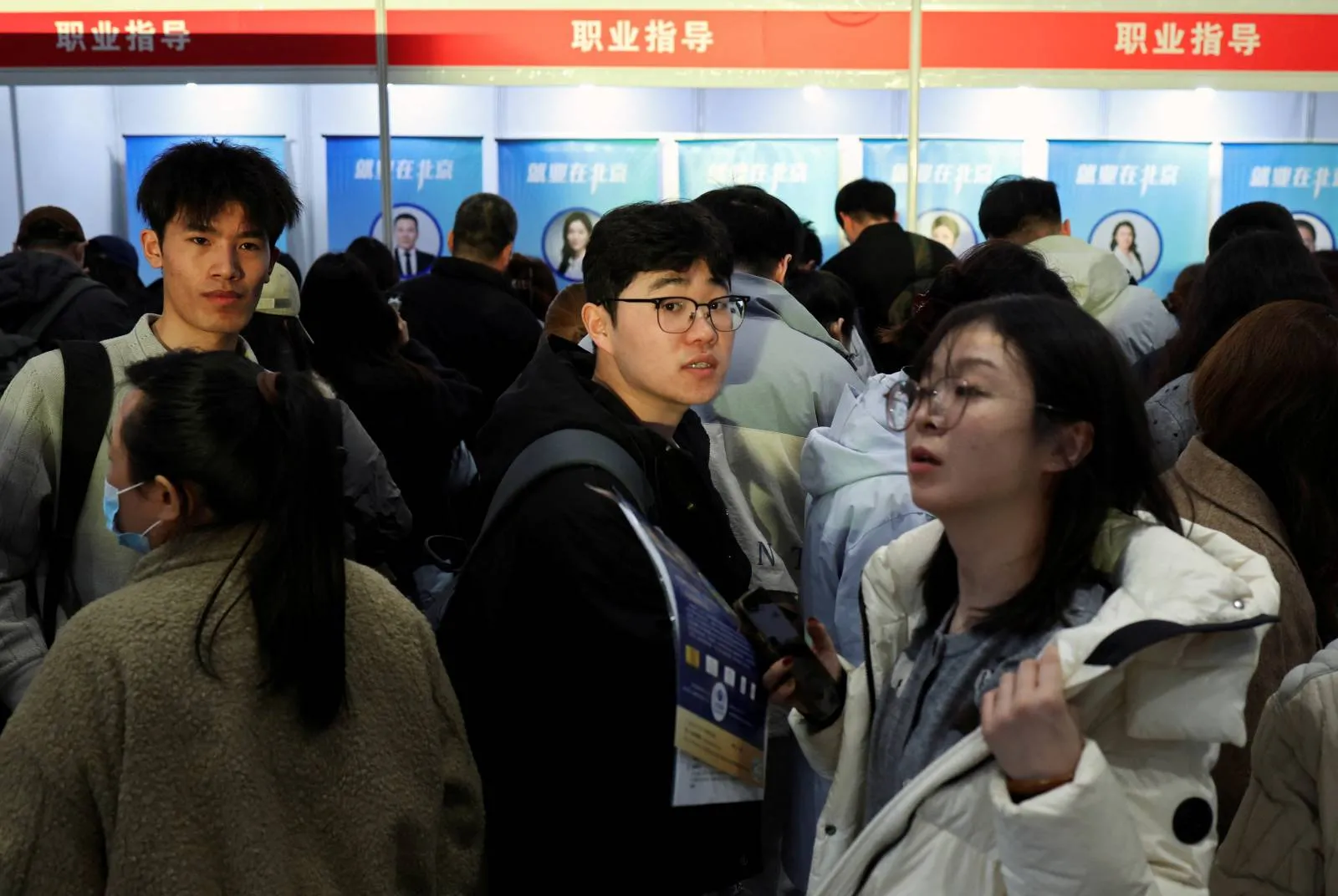
With domestic demand stagnant, China’s economy is struggling to create enough jobs for its new university graduates. That has changed the attitudes of young adults, who are now more likely to settle for stable jobs rather than pursue a corporate career.
Views
Why China’s Top Graduates Are Trading Ambition for Stability
By Hazel Hsuweb only
A recent graduate from Wuhan University named Dayuan (大圓) thought she was well set up to tackle the job market. Before getting her degree, she had completed four internships at major companies, including tech giants Tencent (騰訊) and RedNote (小紅書).
Dayuan quickly discovered, however, that finding a job was difficult. After submitting at least 100 resumes, she did get an offer from ByteDance (字節跳動), another top internet technology company. But she ultimately decided to stay in her hometown of Wuhan and work in a government relations position for a state-owned enterprise that paid 30 percent less than the ByteDance job.
Dayuan’s thinking reflects an evolution in the mindsets of many young adults in China. They once had the confidence of China’s ambitious “wolf culture.” More recently they have faced “involution” (neijuan, 內卷), the idea of being stuck in a competitive grind that requires them to work increasingly hard with little benefit.
Then came “lying flat” (躺平), or refusing to bow to societal pressure to work too hard and choosing to lead a more laid-back lifestyle, and even a desire to “run” (潤), to get out of China.
Stability is all that many of these young Chinese are looking for, but the job market is severely overcrowded.
A record 12.7 million Chinese graduated from a university this year, but the urban youth unemployment rate (covering individuals aged 16-24, excluding students) rose to 18.9 percent in August. That is the highest level since China changed its statistical methodology in 2023.
Those numbers could not have been welcomed by Chinese officials. Lin Thung-hong (林宗弘), a research fellow at Academia Sinica’s Institute of Sociology in Taipei, said political stability will always be Beijing’s top priority in handling employment issues. Its main consideration, he said, is preventing unemployment from leading to social unrest.
Employment Gauntlet
For young job seekers, the road to landing a job begins with an internship marathon. A state media survey found that more than half of university students take on internships beginning in their junior year, hoping employers will eventually notice them.
Employers, however, look not only at how many internships applicants complete, but also at whether they have experience at big companies and whether their experience is “vertical.” For example, an employer may want to see internships that all centered on the product manager role, from startups to big tech firms, as proof that an applicant can hit the ground running.
The process for becoming a civil servant or being hired by a state-owned enterprise can be equally daunting. For the 2026 national civil service exam, 3.718 million people registered and passed the qualification review. That works out to an average of 98 applicants competing for each opening, the most in six years.
The number of people registered for the civil service exam also exceeded the number of people registered for postgraduate degree entrance exams for the first time in 10 years.
This huge applicant pool reflected the depressed state of China’s private sector, where investment fell 10.1 percent year-on-year in the first eight months of the year, according to the National Bureau of Statistics.
Beijing has made tackling youth unemployment an “absolute top priority.” As a result, in 2026 it is applying a policy of “increasing employees and salaries” at state-owned enterprises for a fifth consecutive year. The policy enables state-owned enterprises to increase the cap on their overall payrolls when they expand hiring. Other companies, meanwhile, can receive a subsidy of up to 1,500 yuan (about US$225) for each new graduate they hire.
Academia Sinica’s Lin argued that Chinese bureaucrats have always had a survival instinct of “not standing out and not falling behind.” Today’s young people, he said, want to “reach the shore” of a secure job, not fight their way up the career ladder, and then make it safely to retirement and get out unscathed.
 During the 2025 fall recruitment season, Tencent held a campus recruitment event at Wuhan University for students graduating in 2026. (Photo: Dayuan)
After a few months in her new job, working fixed hours with two days off a week, Dayuan said she has no regrets and has even started taking surfing lessons on weekends.
Yet the public sector’s ability to absorb new workers has its limits. China’s economy is slow to emerge from its ongoing doldrums, and the number of young job seekers is still rising. Whether this will undermine social stability remains an open question.
Have you read?
- What China’s Low GDP Target Means for Its Economy
- Hong Kong’s Independent Bookstores Fight to Keep the Lights On
- What Is the New Path for "China's Hong Kong"?
Translated by Luke Sabatier
Uploaded by Ian Huang
Views

Subscribe to CWE Newsletter (every Thursday)
Stay abreast of what's happening in Taiwan with our weekly digest.
Keywords: