Taiwanese Civil Servant Uses ChatGPT to Uncover Fraud
Source:Meng-Yu Chi
A civil servant in Taiwan familiarized herself with generative AI to help the government screen two million court rulings for unscrupulous contractors.
Views
Taiwanese Civil Servant Uses ChatGPT to Uncover Fraud
By Peihua LuFrom CommonWealth Magazine (vol. 799 )
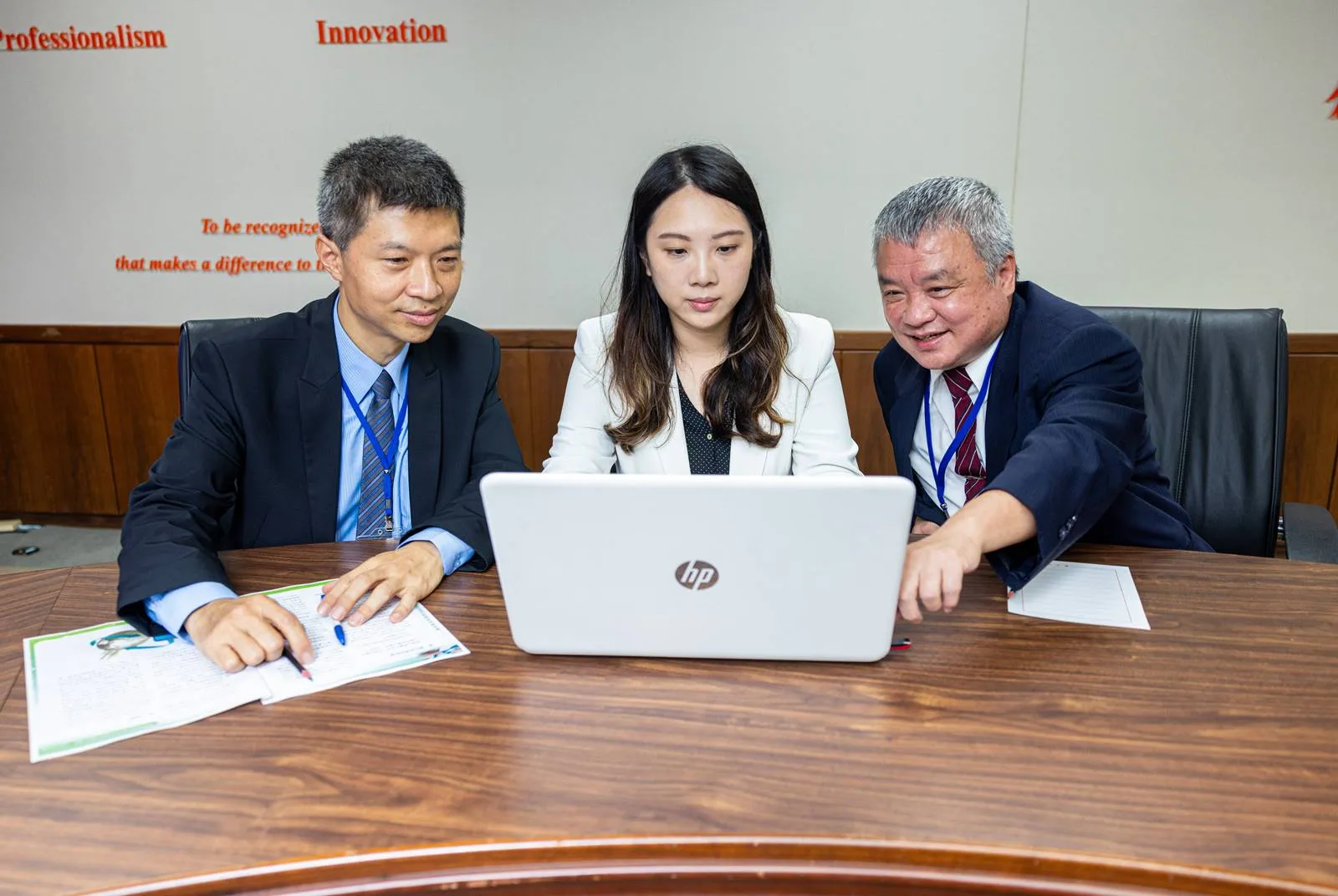
Four years ago, Wu Hsin-mei joined the National Audit Office, where she was tasked with monitoring the procurement of the New Taipei City government. Last year, Wu and her supervisor Hsu Chung-dao investigated the procurement of services for the maintenance of public facilities by the city government over the past three years. Such services include landscaping, patrols, inspections, and repairs. The pair spent two months sifting through court rulings, eventually pinpointing 18 contractors that had been convicted for violating the Government Procurement Act. A further check of documents submitted by the contractors to support contract performance found that such documents had been forged in 16 cases, involving contracts worth NT$150 million.
The New Taipei City Government has already sent these cases to the prosecutor’s office and is in the process of recovering some of the money paid. The much more valuable outcome, however, is that the New Taipei City Government is now taking the initiative to learn from the approach that Wu and Hsu took to thwart such fraud in the future. The workflow for checking whether contractors have fulfilled their contracts will use AI to automatically check faces and locations on images.
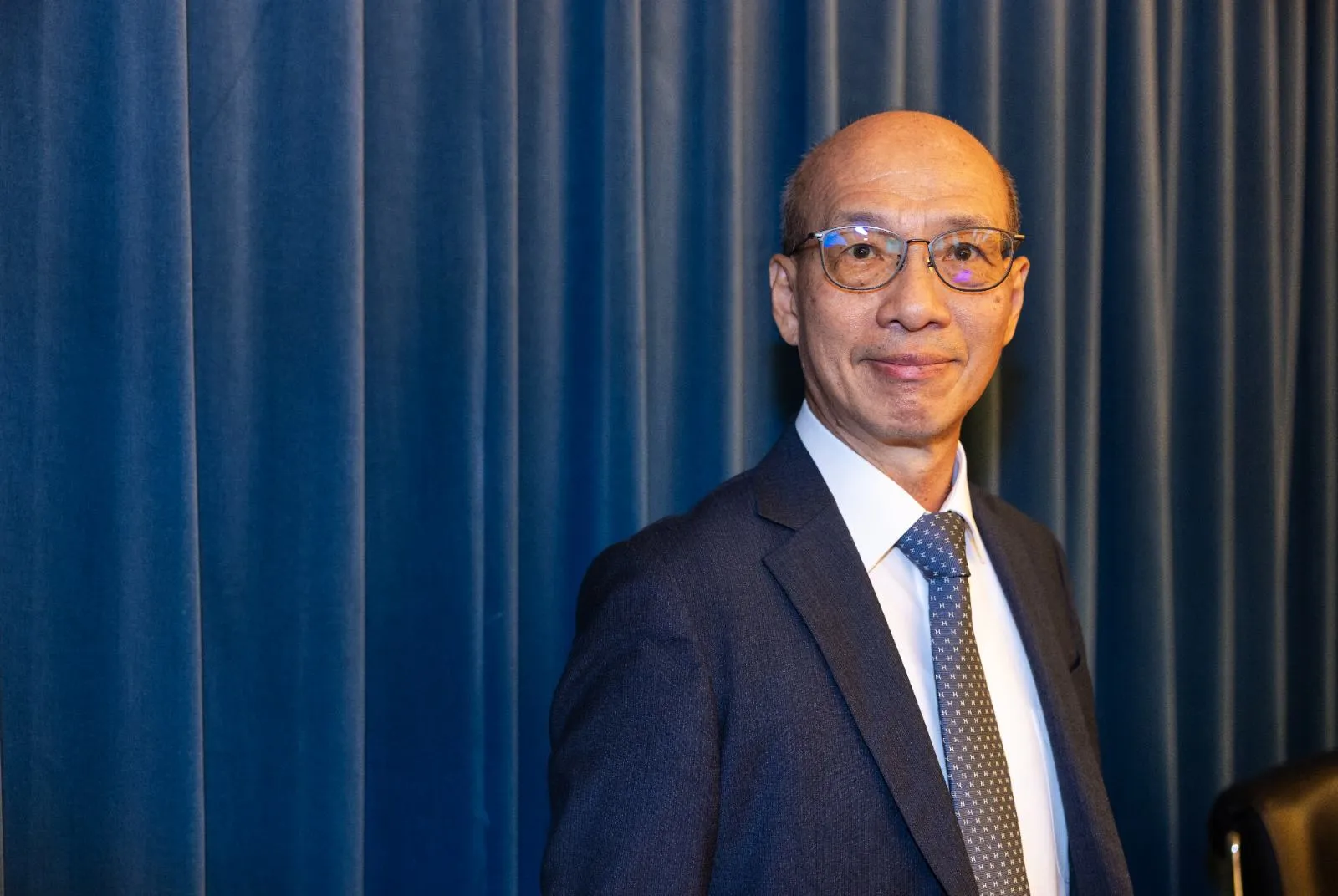
“We do not mean to nitpick,” explains Deputy Auditor General Lee Shun-pao. “We are telling government agencies that they can detect problems with this approach.”
Using ChatGPT to screen out convicted contractors from 2 million verdicts
Late at night some 18 months ago, Wu was waiting for a download of two million court rulings from the database of the Judicial Yuan to complete. These were civil and criminal case verdicts from 2013 to 2022 pertaining to violations of the Government Procurement Act, non-fulfillment of contractual obligations, payment of damages and so on.
Wu was working overtime in the wee hours because the Judicial Yuan mandates that large downloads of full-text rulings by external users must take place between midnight and 6 a.m. in order to prevent slowing down the system during office hours.
As Hsu points out, the first step in auditing work is determining the audit scope, and then collecting rulings involving high-risk contractors.
The problem, however, is that rulings might mention several contractors who were not necessarily all found guilty. Therefore, it is necessary to make an inventory of convicted contractors. The difficulty of having audit personnel read through two million court rulings made it infeasible in the past to screen the rulings for convicted contractors. Bringing in ChatGPT was a turning point.
At university, Wu studied architecture and urban planning, which had nothing to do with programming. But when the National Audit Office offered a course on generative AI last year, Wu enrolled on her own initiative. She did not just study application cases from Taiwan and abroad but also sought to apply her newly gained knowledge in practice by using generative AI in the workflow for checking cases.
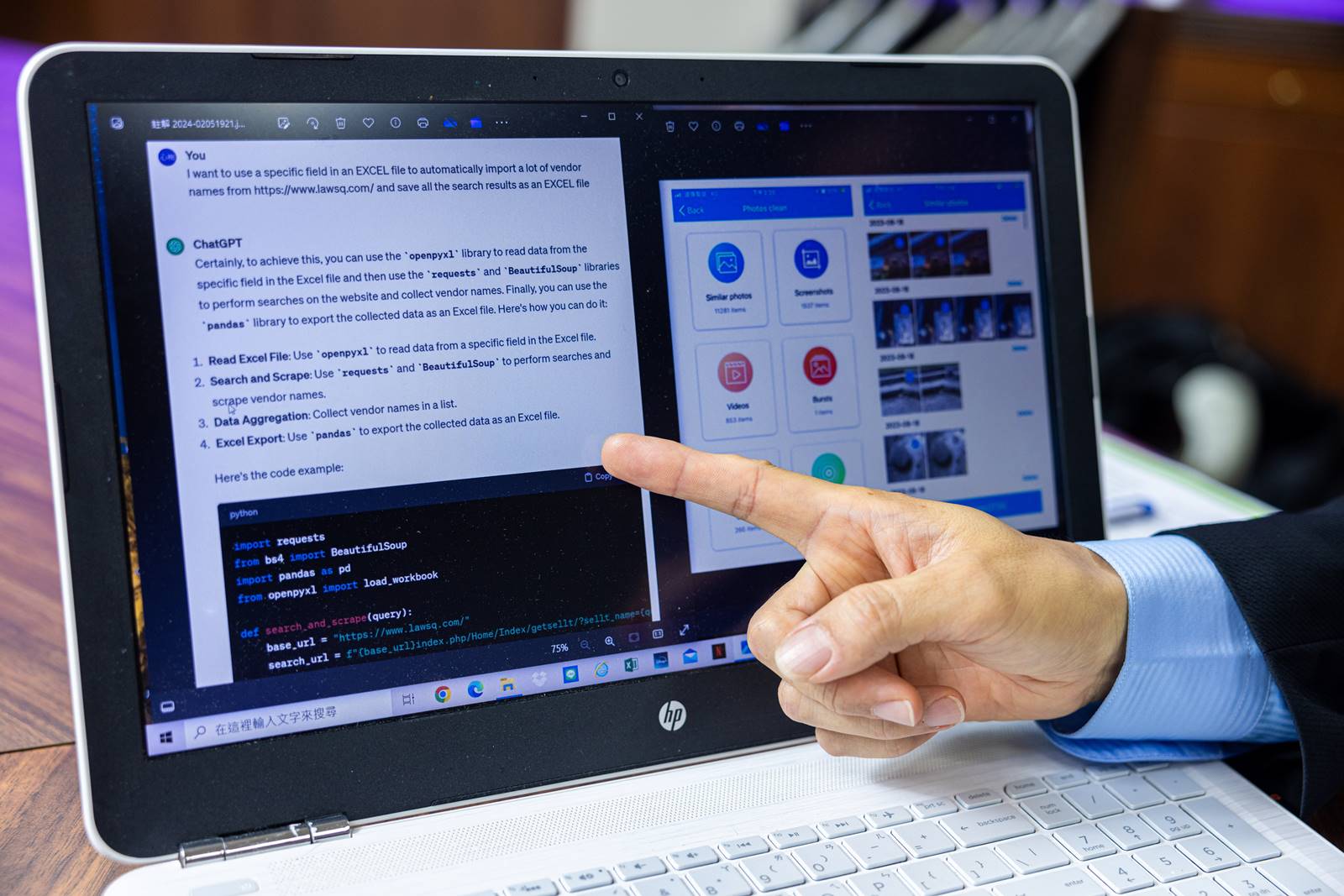
“First I asked ChatGPT to write a Python program for me,” says Wu. She used the program to screen the two million rulings for contractors that had been found guilty. Then she retrieved the public tender information of the New Taipei City Government from the database of the Public Construction Commission and matched it to service procurement tenders from the past three years that had been awarded to any of the convicted contractors.
“I told ChatGPT which data I wanted to be compared, how the file should be formatted, and which Excel functions to execute,” she explains.
 (Photo: Meng-Yu Chi)
Using a free app to find duplicates among thousands of photographs
Her investigations found that contractors that had been convicted between 2013 and 2022 had won 18 procurement contracts with agencies and schools under the New Taipei City Government.
Under the Government Procurement Act, the names of contractors who have violated the Act are published in the Government Procurement Gazette, banning them from bidding for government contracts for a period of three years. So where are the loopholes that make it possible that offenders still participate in tenders? This is related to a procedure called deferred prosecution, where the prosecutor can postpone prosecuting a defendant to give them an opportunity to “atone” for their deeds. If the defendant fulfills certain conditions such as apologizing to the victim, paying compensation or performing community service, the charges are dropped.
Hsu points out that when a court decides to defer the prosecution of corporate offenders, the decision is not sent on to government agencies, which means that they are not aware of the charges. As a result, they will not ask the Public Construction Commission to list these offending contractors as being barred from participating in tenders, enabling them to still bid for contracts.
But even if a contractor has a criminal record, this does not necessarily mean that they have breached the Act when providing services during the past three years. To determine whether problems cropped up during that period, audit office personnel must conduct on-site inspections to confirm contract performance.
Wu and Hsu had no idea what they were getting themselves into. The 18 cases alone came with huge stacks of documents meant to support contract performance. They knew that just the two of them would not be able to process this much information. But as they weighed their options, an idea suddenly struck Wu: She took out her iPhone and photographed all the photos that contractors had snapped to prove they had fulfilled their contracts. “I took photographs for a whole day,” Wu recalls.
She also remembered routinely using the mobile phone app Photos Clean, which detects duplicates and almost identical pictures, to free up space on her smartphone. Judging based on her own experience, the results were quite good.
In just 10 minutes, the app had searched over a thousand photographs, detecting identical pictures marked with different dates that contractors had submitted to repeatedly invoice the government. “Light and shadow, the location of fallen leaves, or even trash looked all the same [on these pictures],” says Wu.
She then moved on to use her smartphone’s facial recognition function, discovering that different contractors were using the same cleaning lady. When following up, Wu realized that the two companies were headed by the same person and that the same photograph had been used to invoice cleaning services in two separate tenders. The contractor had set up a second company to circumvent the tender rules that bar contractors from submitting more than one bid in a public tender.
In 16 out of the 18 cases involving high-risk contractors, documents had been forged, a ratio of nearly 90 percent. The auditors take this as proof that screening court rulings is a highly accurate method to detect irregularities.
After this two-month effort, Hsu, who has investigated government procurement cases for 25 years, is quite impressed. Employing AI tools not only saves time and effort but more importantly delivers results that cannot be achieved with conventional audit techniques. He points to the photographs. Comparing more than a thousand photographs with the naked eye and finding duplicates is simply not possible. “The contractors are smart; they use the same photo but enlarge it partially to make it look different,” he says in explaining the challenge.
ChatGPT, auditors’ good colleague
Meanwhile, ChatGPT has become a trusted consultant in Wu’s daily work. Before starting an investigation, she will ask ChatGPT what kind of faults or shortcomings she should look out for in certain business activities or regarding a certain government agency. “This gives me a more comprehensive perspective,” she explains.
In the future, Hsu and Wu will no longer be the exception among the more than 700 auditors as the National Audit Office is actively leveraging the new opportunities of AI development. Aside from holding courses, innovative consensus workshops, and audit AI hackathons, the National Audit Office is even cooperating with the private sector to build an AuditGPT.
Lee is quite pleased with these developments as auditors often feel a great deal of pressure. They are perceived as always prodding and poking around, in severe cases impeaching civil servants and thwarting businesses’ money-making schemes. He considers technology as godsend in that it lends wings to the internal control of the government, which ultimately is in the people’s best interest.
Have you read?
Translated by Susanne Ganz
Edited by TC Lin
Uploaded by Ian Huang
Views

Subscribe to CWE Newsletter (every Thursday)
Stay abreast of what's happening in Taiwan with our weekly digest.
Keywords: