Inside Taiwan’s Most Influential Tech Clique: The Rise of the TSMC Alumni Network
Source:TechTaiwan
A little-known Taiwanese firm has surged 26-fold in five years—despite modest revenue. At the center of AI’s next frontier, it now holds a critical piece of the puzzle: replacing copper with light.
Views
Inside Taiwan’s Most Influential Tech Clique: The Rise of the TSMC Alumni Network
By Liang-rong Chenweb only
Almost without notice, a new power bloc has emerged within the executive ranks of Taiwan’s listed technology companies—what industry insiders half-jokingly refer to as a “TSMC alumni network.”
Among its most prominent members are MediaTek CEO Rick Tsai (蔡力行), a former TSMC co-CEO; Acer(宏碁) chairman Jason Chen (陳俊聖), previously a senior vice president of worldwide sales and marketing at TSMC; ShunSin (訊芯) chairman Shang-i Chiang (蔣尚義), a former TSMC co-COO; FocalTech (敦泰) chairman Genda Hu (胡正大), formerly TSMC’s head of marketing; and Quincy Lin (林坤禧), former TSMC CIO and now chairman of V5 Technology (倍利科技), which is preparing to go public.
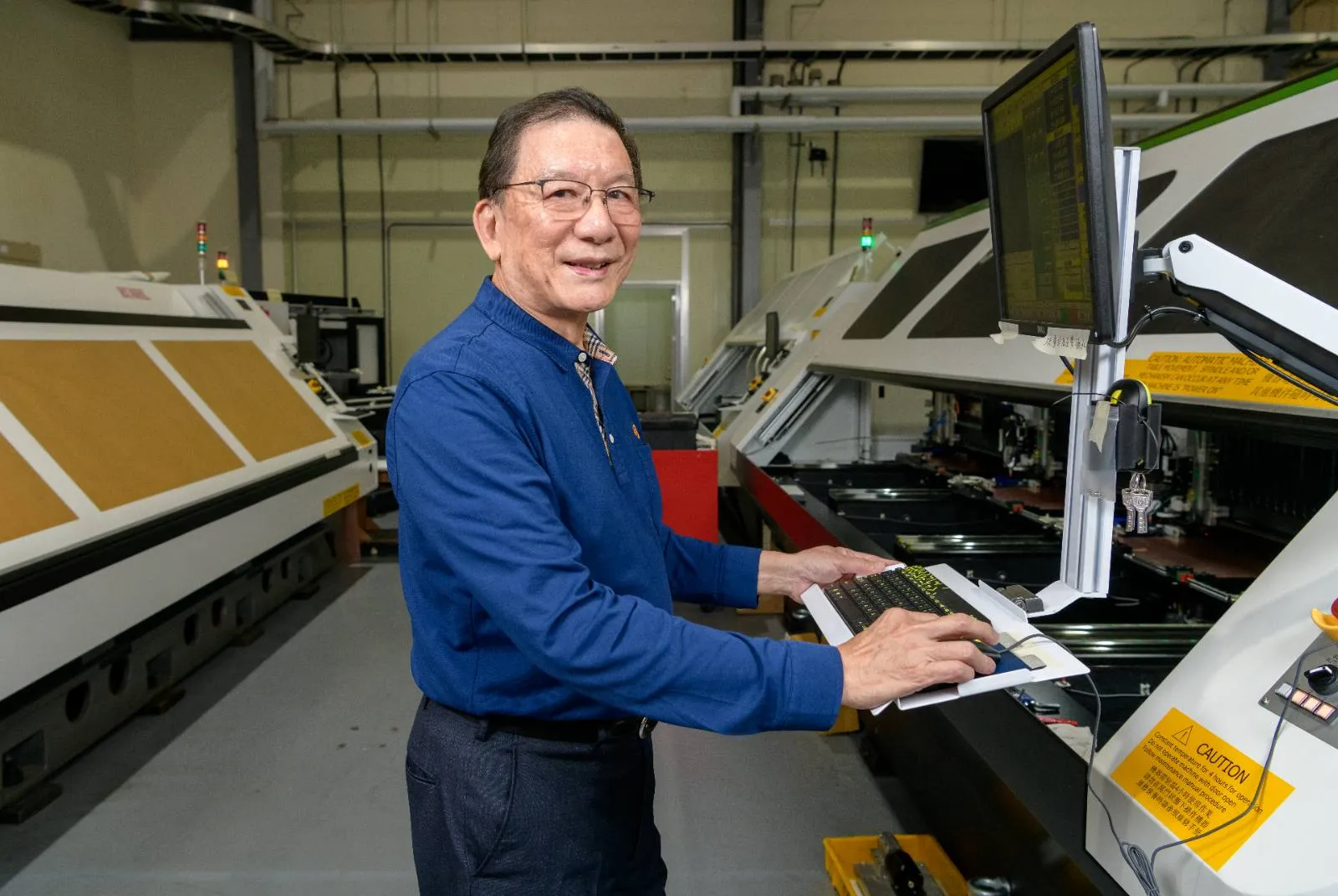
Yet perhaps the most compelling figure of all is D.D. Hu, general manager of FOCI, and a former TSMC department manager, who is nearly two decades younger than many of Morris Chang’s former lieutenants.
Since taking the helm in February 2021, Hu has overseen a remarkable transformation. In just five years, FOCI’s share price has surged 26-fold.
Inside FOCI’s Turnaround: What Drove a 26x Surge in Five Years
This is despite the company generating only NT$1.89 billion in revenue last year and just over NT$20 million in profit. Its market capitalization, however, has approached NT$80 billion, nearly matching that of Acer. It is one of the most striking “AI-era” revaluations in Taiwan’s electronics sector.
The key driver, according to D.D. Hu, was laid out in detail at the company’s investor conference in late 2024.
During the presentation, he showed a co-packaged optics (CPO) architecture diagram sourced from one of TSMC’s public talks.
In a typical CoWoS layout, high-bandwidth memory stacks flank the central logic, while a row of small blocks labeled “SiPh” represents silicon photonics components. These blocks correspond to FOCI’s FAU, a high-precision optical connector scheduled for mass production in 2027.
Within a module just seven millimeters wide, dozens of fiber cores and micro-lens arrays are integrated to guide laser signals from TSMC’s COUPE photonics engine into NVLink switches. Despite its small size, the FAU sits at the heart of the system’s optical interconnect architecture.
The Key Bottleneck in Scaling CPO
Hu said the main bottleneck to bringing CPO into mass production lies in the FAUs supplied by FOCI, as well as the assembly process required to integrate them with GPUs and other AI accelerators.
“This is widely seen as the least ready part of the stack,” he said, “and it’s exactly where we’re working closely with customers to make it production-ready.”
According to Morgan Stanley, in the first year of silicon photonics mass production, FOCI is expected to be the leading supplier of FAUs for Nvidia and TSMC, with a market share of up to 50%.
According to TSMC data, integrating CPO into switch ASICs and using optical interconnects can reduce interconnect power consumption by roughly 50% and cut latency to one-tenth.
When deployed at the GPU level—integrated into the CoWoS package substrate—power consumption can be reduced even further, to about one-tenth of conventional levels.
The Man Behind the Shift from Copper to Optics
With his short hair and understated demeanor, D.D. Hu comes across as a quintessential Hsinchu engineer.
But industry insiders say he is a pivotal figure in whether Nvidia can successfully replace copper cabling in its server racks with optical fiber—unlocking significant power savings in the process.
………..
(To read this exclusive story in full, visit the Tech Taiwan Substack)
Have you read?
- Why Taiwan’s Chip Veterans Are Starting Over in the AI Era
- How a Taiwanese VC Broke Into the Commercial Space Industry
- Exclusive: How Macronix Became an Unlikely Winner of the Memory Supercycle—Without AI
Uploaded by Ian Huang
Views

Subscribe to CWE Newsletter (every Thursday)
Stay abreast of what's happening in Taiwan with our weekly digest.
Keywords: