How Has Taiwan Metalworker King Slide Pivoted to Leading in AI Server Rails?
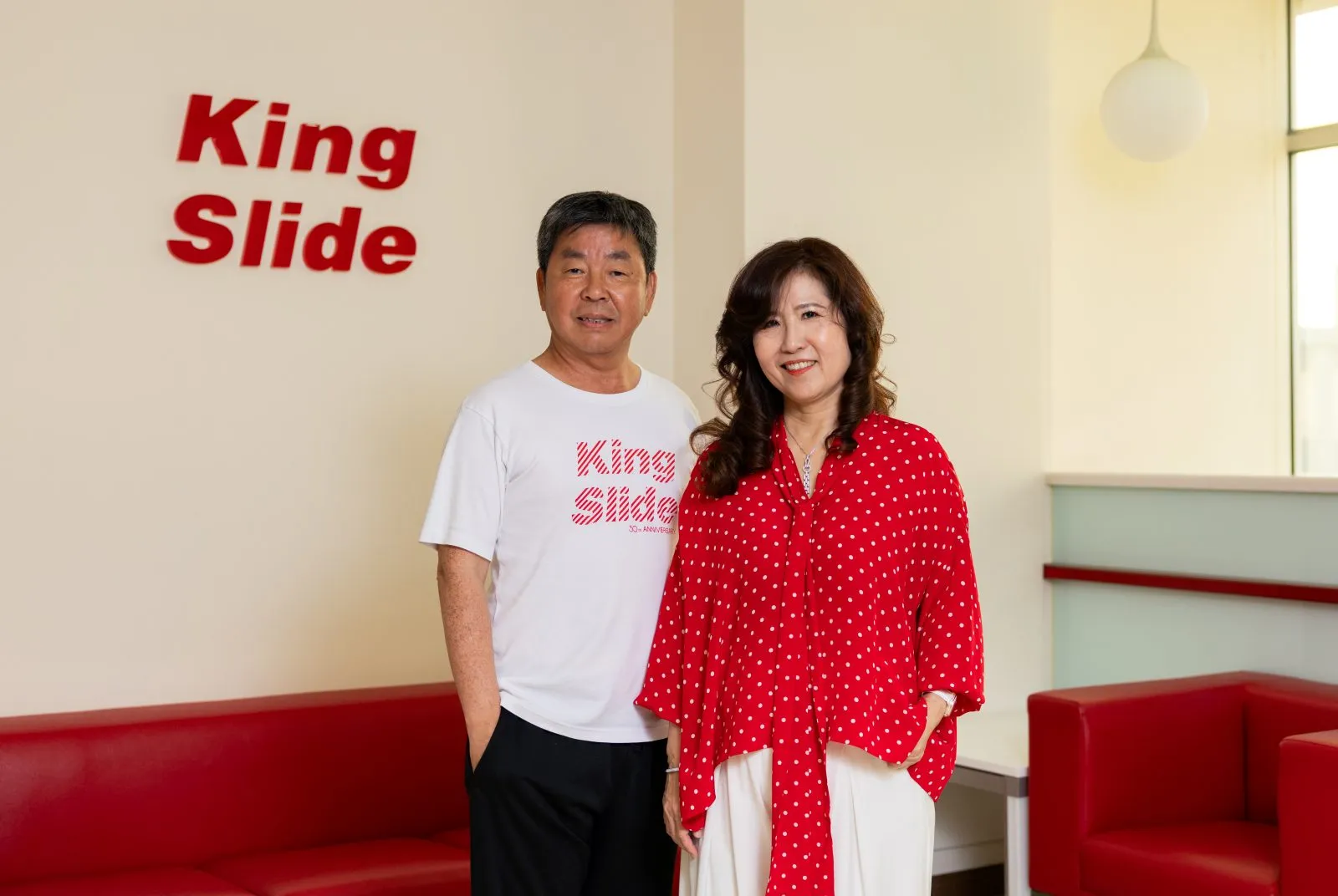
Source:Kuan Hsieh
The ability to safely extract and rapidly service a high-value AI server depends on a component that often goes unnoticed: the slide rail. Having accumulated more than 3,000 patents, King Slide has become an irreplaceable partner for NVIDIA and leading cloud infrastructure providers alike.
Views
How Has Taiwan Metalworker King Slide Pivoted to Leading in AI Server Rails?
By Kai-yuan Tengweb only
Whether an AI server, priced higher than a luxury automobile, can be easily maintained depends entirely on the humble metal rails that slide it into and out of server racks.
Based in Kaohsiung, King Slide is the world leader in server rail manufacturing, counting among its customers NVIDIA and the four major cloud service providers.
King Slide’s revenue has nearly tripled over the past five years. Its gross margin surged from 50% to 76%, while its earnings per share surpassed NT$100 in 2025, putting it ahead of TSMC.
An AI server rack as tall as a refrigerator stands in King Slide’s conference room. General Manager Jane Lin (林淑珍) pulls out a server weighing dozens of kilograms with a light tug of her hand.
“GPUs are too expensive to risk a fall. Our rails make sure that never happens,” she says.
With the launch of NVIDIA’s next-generation AI products, market estimates suggest King Slide now commands more than 70% market share.
Twenty-six years ago, King Slide was still making furniture components such as slide rails and hinges. As Chinese competitors emerged, one customer accounting for 40% of the company’s revenue demanded price cuts or threatened to pull orders, pushing the company into an existential crisis.
Executive Vice President JC Wang (王俊強) recalls that when the company decided to pivot to server rails, it entered the tech industry with little confidence.
“I visited major tech companies wearing my factory uniform while everyone else was in suits. My business card even said ‘King Slide Metalworker.’ At the time, I felt inferior,” he recalls.
But he did not back down. Wang brought customer demands back to headquarters and worked with his wife, Lin, who oversaw finance and operations. Together, they led the R&D and manufacturing teams through repeated trial and error.
They dismantled and studied every server rail product on the market, challenging an industry then dominated by American companies.
Before long, King Slide had entered the supply chains of Compaq, IBM, HP Inc., and Sun Microsystems.
King Slide established its position through two design innovations.
In the past, installing rails required more than a dozen screws, making assembly cumbersome and increasing the risk of hand injuries. King Slide replaced the screws with a one-click latch system.
Another breakthrough involved disassembly. Instead of reaching behind servers and risking injury from trays weighing more than 100 kilograms, engineers could detach the rails by pressing a button near the front of the rack.
“By making products easier to use, customers became more dependent on King Slide,” a sales executive says.
King Slide has another long-standing principle: more than 20 years ago, it required all products to carry the “King Slide” logo. Even when customers objected, the company refused to compromise.
Inside the sample room, Wang disassembles a furniture rail filled with metal parts of different sizes. “You can think of slide rails like mechanical watches. Every component has to fit into an extremely small space,” he says.
These intricate structures have become the moat protecting King Slide’s business.
Over the years, King Slide has accumulated more than 3,000 patents. In recent years, it has averaged five to six new patents every week.
Lin says the company is now even defining new rail standards for the AI industry.
In the AI era, product cycles have accelerated dramatically. Furniture rails used to remain on the market for more than a decade, but in the GPU era, new platforms are introduced almost every six months.
As a result, King Slide increased its in-house production capacity to better control quality, precision, and development speed. A single rail set may contain more than 100 metal and plastic components, each requiring specialized molds.
“Others are still working on the first generation while we’ve already moved several steps ahead,” Wang says.
From a Kaohsiung metalworking factory to a key supplier for AI servers, King Slide has spent more than two decades proving that seemingly humble components can become some of the hardest parts to replace in the AI era.
Have you read?
- Exclusive: Backed by a TSMC CoWoS Veteran, MediaTek Targets Google and Broadcom
- What TSMC's CoPoS Move Really Means
- The $12 Billion Taiwanese Chip Company That Nvidia Trusts More Than Anyone Else
Translated by Jack Chou
Uploaded by Ian Huang
Views

Subscribe to CWE Newsletter (every Thursday)
Stay abreast of what's happening in Taiwan with our weekly digest.
Keywords: