Beyond the Silicon Shield: Taiwan Foreign Minister on Making the World Taiwan's Shareholder
Source:CommonWealth Magazine
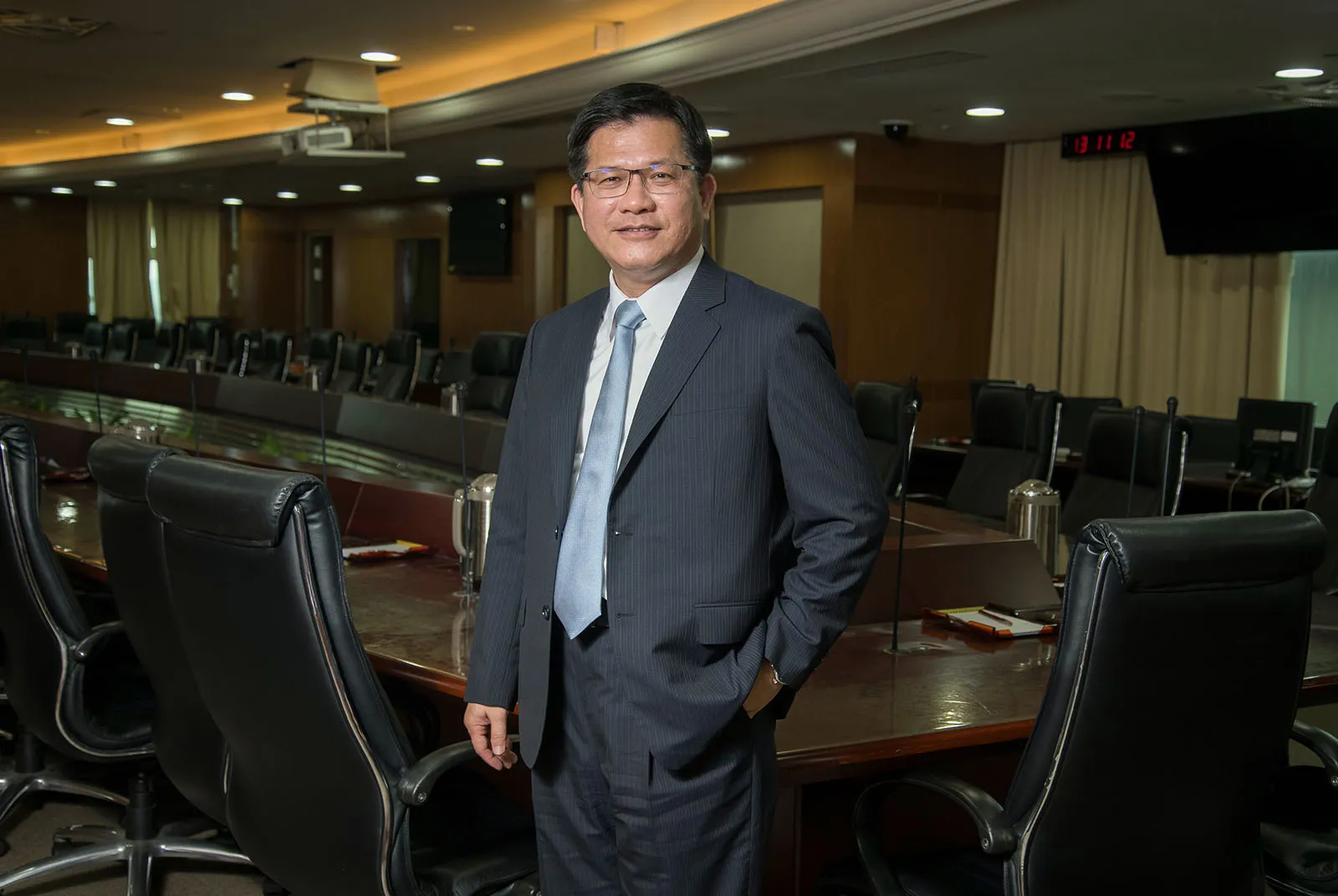
Lin Chia-lung, an academic-turned-politician who has served as Taichung mayor and transportation minister, defines his role as foreign minister through an economic security strategy: rather than passively guarding the "silicon shield," he aims to turn Taiwan's technological strength into leverage, making countries around the world stakeholders in Taiwan's success.
Views
Beyond the Silicon Shield: Taiwan Foreign Minister on Making the World Taiwan's Shareholder
By Kwangyin Liu, Hazel Hsuweb only
Two days after returning from a trip to Europe, Foreign Minister Lin Chia-lung showed no sign of fatigue. Since taking office over two years ago, Lin has visited 24 countries, logging air miles equivalent to circling the globe 14 times. This latest trip marked his third visit to Poland and the second to Italy.
Taiwan's international space is famously constrained by its unique diplomatic statu. Kenya, for instance, recently announced it will deny entry to holders of Republic of China (Taiwan) passports. Against that backdrop, Lin appears to be charting a new course built less on conventional diplomacy than on economic diplomacy.
On this trip, he first traveled to Warsaw, where he witnessed the Taiwan Electrical and Electronic Manufacturers' Association (TEEMA) announce the site selection for a technology park focused on AI data centers, smart cities, and electric vehicles. He then flew to Milan, visiting GlobalWafers, Hiwin, and an investment site of Taiwan Cement subsidiary NHOA Energy. Just over a year ago, he traveled to Texas and Houston to push forward Taiwan-U.S. economic and technology diplomacy.
A political science PhD from Yale and active in national politics for two decades, including stints as Taichung mayor and transportation minister, Lin brings a distinct strategic approach to the foreign ministry: converting Taiwan's technological strength into leverage for expanding the country's international space.
In an interview with CommonWealth Magazine, he laid out both the philosophy behind that strategy and concrete examples of the industrial partnerships underpinning it. Edited excerpts follow.
Making the World Taiwan's Shareholder
Q: Taiwan's position in the global economy has shifted in recent years. What do you mean by "economic diplomacy"?
For decades, Taiwan played the role of contract manufacturer in the global economy—chasing wherever costs were lowest. What's changed is that the world has pushed Taiwan upward, whether we wanted it or not.
This round of global change began with President Trump's first-term trade war with China, which triggered a reorganization of global supply chains. Then came the pandemic, which exposed the fragility of those chains. Then rising geopolitical tensions, Russia-Ukraine, and in the Asia-Pacific region turned economic security into a matter of national security.
Taiwan maintains 111 overseas missions, constantly working to join international organizations, there's barely time to sleep. China isn't just targeting Taiwan; it's picking fights with neighbors across the region. Looked at another way, Taiwan is working around the clock, helping guard the first island chain for the entire world.
Q: Taiwan's semiconductor industry has become a strategic battleground. How do you convert that advantage into diplomatic leverage?
I don't like the term "silicon shield", it's too defensive, as if we can only hide behind semiconductors and hope no one attacks us. My view is that Taiwan is moving from "China+1" to "Taiwan+1," and now to "Taiwan+N." The silicon shield is about defense, about fear of being attacked. What I'm talking about is offense, making Taiwan indispensable, and making others want to build wealth alongside us.
My strategy is simple: turn the world into Taiwan's shareholders. There's a difference between being a "stakeholder" and being a "shareholder", it’s a small difference in wording, but a completely different position. A stakeholder has an interest in your wellbeing; a shareholder has actually put in capital. When Taiwan profits, they profit, and if Taiwan were to be swallowed up, their share would be swallowed up too.
How do we do that? By finding shared interests and forming partnerships. That's why, when I look at Trump's new policies, I don't ask whether they're good or bad for Taiwan, I look at what he wants and where our interests overlap.
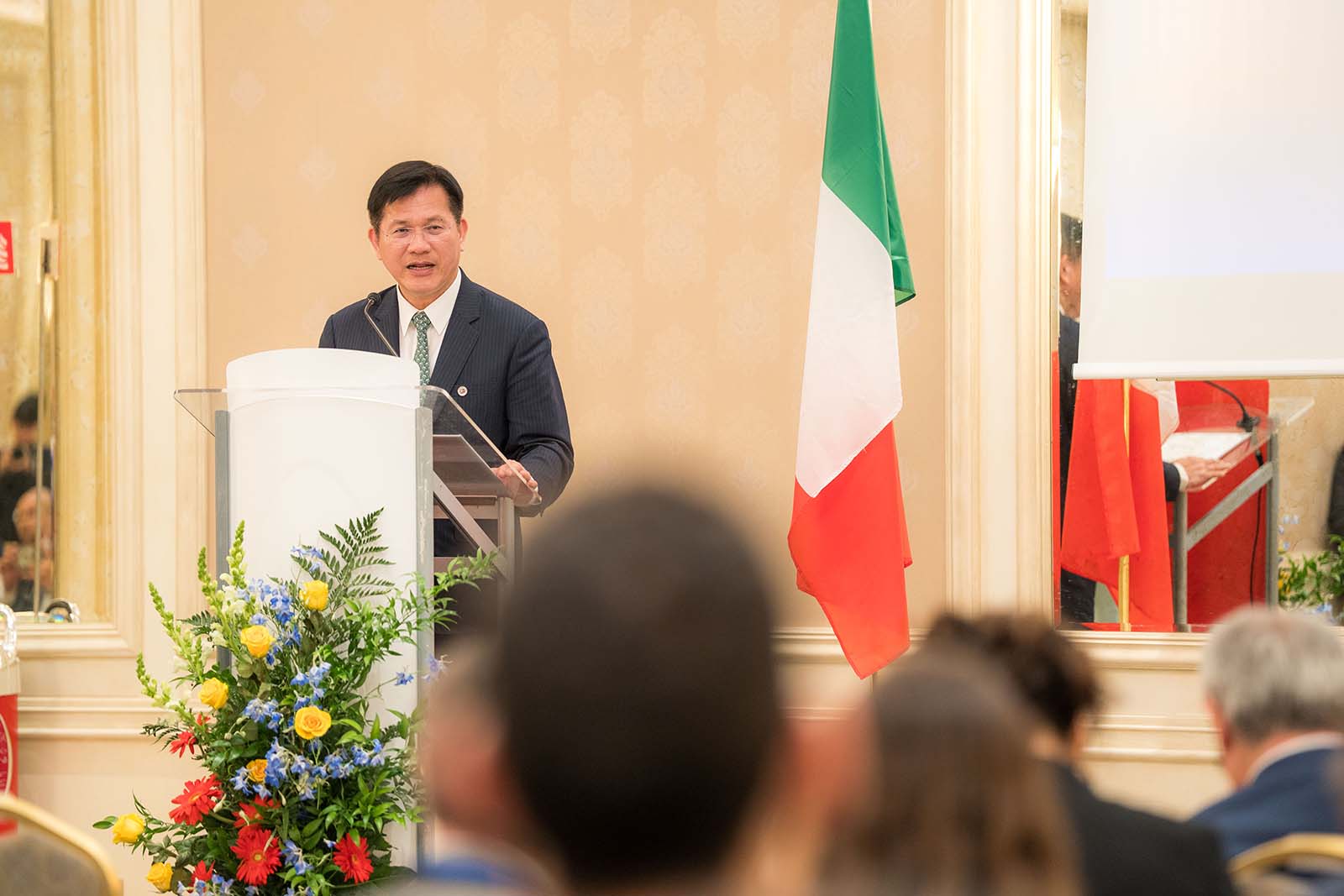 Foreign Minister Lin Chia-lung attends a Taiwan-Italy business exchange event. (Photo: MOFA)
The Three Pillars of Economic Diplomacy
Q: With that strategy behind you, how do you actually turn countries into Taiwan's shareholders?
My approach is what I call the "joint fleet", a team of teams, built on four elements.
First, large companies lead, bringing small and midsize suppliers with them to move quickly once they land abroad; in today's market, speed matters more than individual expertise. Second, public-private partnership, since anything touching security, economics, or tariffs inevitably involves government interference and regulations. Third, integrating hardware and software, as systems integration is an area where Taiwan has traditionally been weaker. Fourth, connecting domestic and overseas markets: Adapting the Taiwan model locally, "local for local", and building shared prosperity with partner countries.
Alongside market access, three things need to move together: technology, talent, and capital.
Technology means core competitiveness in critical technology. It's not just about moving west or south, but continuously moving up. Talent is the foundation and Taiwan's engineering culture is uniquely balanced in both quality and quantity; wherever I travel, the U.S., Japan, Europe, people all say Taiwanese talent is essential.
Then there's capital. Countries offer various tools for investing in Taiwan's capital markets, but I don't think we can do without a sovereign wealth fund.
Q: Why is a sovereign wealth fund so important? Isn't the National Development Fund enough?
Because a sovereign wealth fund allows for strategic investment. With proper design and oversight, it's a very positive tool. The National Development Fund can't invest overseas.
I want to push for integrating our national financial resources. We need capital in hand to be able to partner with others. Look at the U.S. International Development Finance Corporation (DFC), which saw its investment cap raised to $205 billion at the end of last year.
The Fleet in Motion
Q: Where has this joint fleet actually reached so far?
In Poland, Foxconn formed a joint venture with the state-owned electric vehicle company EMP, a win-win situation, since EMP had previously been working with China's Geely. Our MIH alliance has been building for several years and now has an outlet; with more than 2,000 member companies, we can supply virtually every component for an EV. On this trip, I discussed the technology park in Poland specifically to let Taiwanese companies begin local production quickly, since the EU also needs electric vehicles. I've now folded Poland into what was previously the Central and Eastern Europe resilience initiative—covering the Czech Republic, Lithuania, and Slovakia—upgrading it to version 2.0.
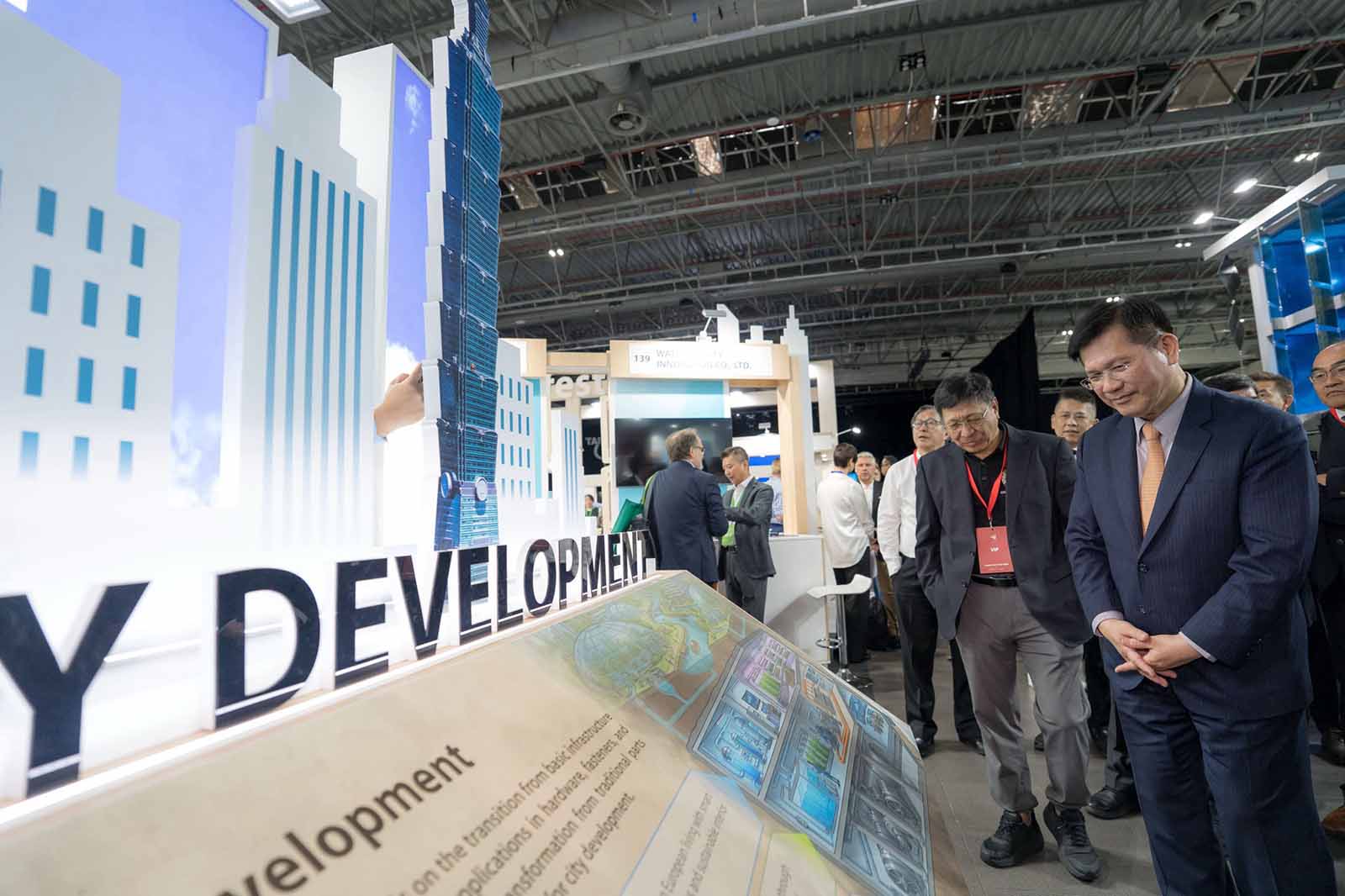
In the Czech Republic, I visited Foxconn's plant and could see it has clearly moved beyond assembly. There's local demand for AI data centers, and through our Central and Eastern Europe cooperation framework, we're extending from semiconductors to AI to drones, signing government-to-government memorandums of understanding.
Even when the Czech government changes hands, our shared interests don't get voted out, because our interests are now their interests too.
In Ukraine, Taiwan has two major projects underway: smart healthcare at Unbroken Hospital in Lviv, supporting soldiers and civilians wounded in the war, and 5G applications led by Chunghwa Telecom in Bucha to support smart-city development.
Q: We've heard from companies that they can handle many things themselves, but they need government help with industrial park infrastructure, water, electricity, management. Can the foreign ministry help with that?
In the past, the foreign ministry didn't handle economic matters, and the economics ministry didn't do diplomacy, everyone worked in their own lane. That's changed. The Executive Yuan has formed an economic diplomacy task force involving ten ministries. I now work closely with the economics minister through a joint ministerial mechanism, so every agency understands the policy and can coordinate.
The joint fleet I've described also includes industry associations. The goal is to move in sync, globally, and land locally.
Taiwan is no longer a contract-manufacturing island chasing the lowest cost. We've climbed up—and we're making the whole world Taiwan's shareholder.
Have you read?
- From a 1989 Exchange Trip to Canada's Taiwan Envoy: Marie-Louise Hannan's Case for Canada in Taiwan
- Can Civic AI Save Democracy Before Algorithms Destroy It?
- Will Europe Choose Taiwan as Trust in China Fades?
Edited by Susanne Ganz
Uploaded by Ian Huang
Views

Subscribe to CWE Newsletter (every Thursday)
Stay abreast of what's happening in Taiwan with our weekly digest.
Keywords: