How MediaTek Built a New Team With Intel and Apple Veterans
Source:TechTaiwan
MediaTek is transforming its supply chain for the AI era by hiring industry veterans, investing billions to secure critical components, and adopting closer supplier collaboration to meet the industry's demand for faster production ramps.
Views
How MediaTek Built a New Team With Intel and Apple Veterans
By Liang-rong Chenweb only
Picking up where the previous newsletter left off.
When Google Chief Technologist and Senior Vice President of AI & Infrastructure Amin Vahdat took the stage at SEMICON Taiwan 2026 for the first time, he made a striking declaration: under the competitive pressure of a “one generation per year” cadence for AI chips, production can no longer ramp gradually. It must reach maximum capacity as soon as mass production begins. (That means yields—and the entire supply chain—must keep pace.)
Perhaps not coincidentally, MediaTek General Manager of Global Supply Chain Management T. Y. Lau(劉添益), whose company is a Google supplier, showed the exact same “square wave” chart during his English-language presentation the day before.
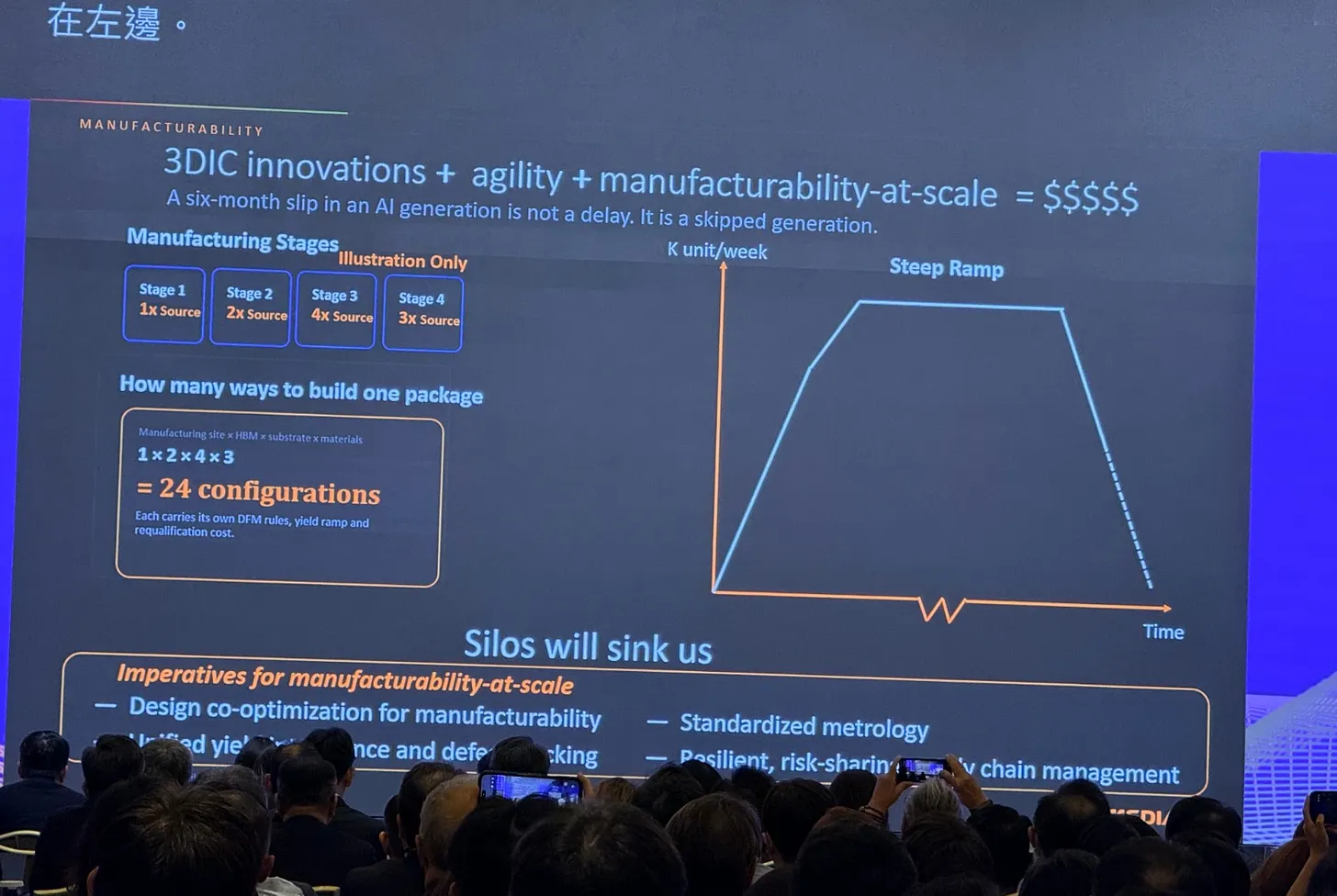
Lau, who came from Intel and joined MediaTek just two years ago, delivered an impassioned presentation. He said this kind of steep curve is what “our customers” now expect: a “steep ramp.”
In effect, this means reaching maximum capacity several months earlier than in the past.
How can that be done?
It requires a major overhaul of operating processes.
The supply-chain veteran, who spent more than three decades at Intel, had a message for the many suppliers in the audience: First, the supply chain needs to “shift left.”
In other words, key component suppliers and partners need to be involved from the earliest stages, when a product’s technical architecture is first being defined.
Do not wait until the design is finalized before planning the supply chain and asking suppliers to source raw materials and equipment. By then, it will be too late.
He also said that MediaTek has now learned that “industry leaders” need to share risk with their supply chains. Otherwise, “your partners will not start investing years ahead of time.”
That comment naturally reminded me of a major development last week: MediaTek issued US$3.9 billion in overseas convertible bonds subscribed by Nvidia and Google. Nvidia took the vast majority, at US$3.5 billion.
Most outside discussion has focused on how Nvidia could use the investment to deepen its cooperation with MediaTek, allowing it to sell its networking technology and customized HBM into the ASIC ecosystem beyond GPUs. I will not repeat the details here.
But what does MediaTek need that US$3.9 billion for? It is clearly related to the US$5 billion fund announced during its last earnings call to invest in the supply chain.
At the end of the second quarter of 2026, MediaTek had NT$189 billion in cash and cash equivalents on its balance sheet (about US$6 billion, while Broadcom had four times as much cash). Coming up with US$5 billion all at once would have been a stretch.
The convertible bond arrived at just the right time. Bernstein Securities noted that it would be sufficient to help MediaTek secure memory or other critical components for customers beyond Google, particularly when prepayments are required.
One example is ABF substrates, currently among the components in shortest supply.
One industry source told me that Nvidia and Broadcom have already made prepayments to lock up capacity at a major Taiwanese substrate supplier through 2031, and are even discussing 2033. MediaTek, however, has yet to take comparable measures.
And as the supply-demand imbalance has grown more severe, sellers’ terms have become increasingly stringent. At the beginning of this year, contracts still allowed buyers to receive refunds for prepaid capacity they ultimately did not use.
Now, the terms have shifted to the harshest form of “take-or-pay”: whether the capacity is eventually used or not, there are no refunds.
Only 25% of the Cost Is in the Wafer?
Lau also showed a pie chart that sparked intense discussion afterward: the cost structure of Nvidia’s B200.
The following chart showed that, excluding expensive HBM, wafer production—that is, the GPU die itself—accounts for only 25% of the remaining cost.
……
(To read this exclusive story in full, visit the Tech Taiwan Substack)
Have you read?
- Why Taiwan Got Micron to Break Precedent on Payouts
- ASML, TSMC Push 12-Inch Photomasks as High-NA EUV Enters Next Phase
- Why Google Is Building Its Own Nvidia
Uploaded by Ian Huang
Views

Subscribe to CWE Newsletter (every Thursday)
Stay abreast of what's happening in Taiwan with our weekly digest.
Keywords: