SEMICON Taiwan 2026: Micron Counters Rivals, Declares AI Still 'Massively Undersupplied'

Source:Chien-Tong Wang
Micron says AI's future will be constrained not by software, but by hardware. At SEMICON Taiwan 2026, the company argued that global AI memory capacity remains severely undersupplied and called for massive investment in memory manufacturing, advanced packaging, and research to meet surging demand.
Views
SEMICON Taiwan 2026: Micron Counters Rivals, Declares AI Still 'Massively Undersupplied'
By Judy Linweb only
Silicon Valley's hope that clever software, token compression, and algorithmic efficiency will tame artificial intelligence’s insatiable hardware demands is an illusion, according to Micron Technology’s top technology executive.
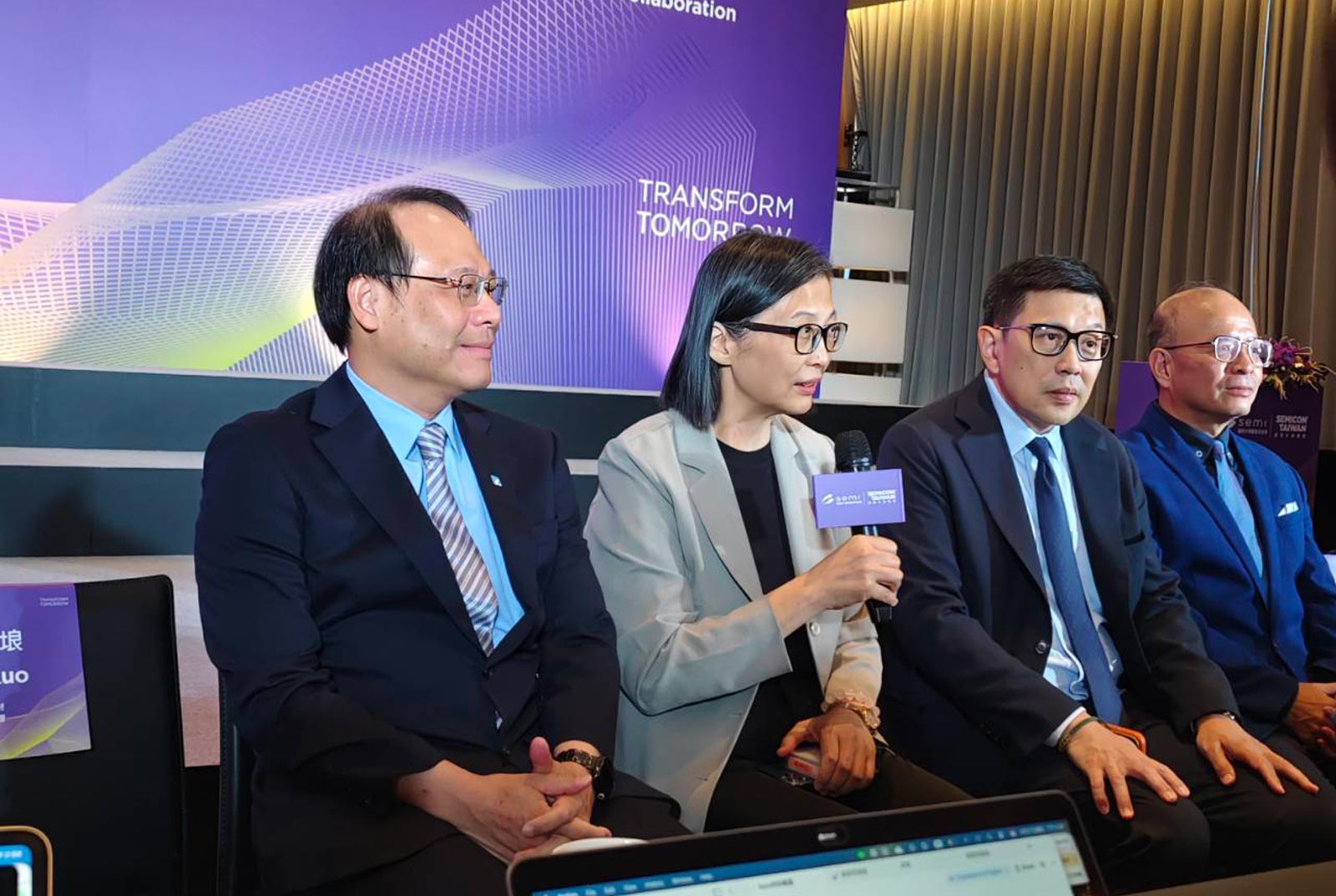
Addressing the SEMICON Taiwan CEO Summit, Scott DeBoer, Micron’s President and Chief Technology and Products Officer, rebutted prevailing industry optimism that software-side optimizations can rein in ballooning infrastructure footprints. Directly countering earlier keynote remarks by industry peers, DeBoer warned that global AI clusters remain "massively undersupplied" and will stay that way for years without a colossal, brick-and-mortar manufacturing build-out.
The Capacity Illusion
While algorithmic refinements and next-generation architectures pull more bandwidth out of individual memory dies, DeBoer stressed that efficiency is not a substitute for raw physical silicon.
"The only difference I would say to what Ronnie said in her very eloquent speech this morning is you actually do have to expand memory capacity," DeBoer said, referencing earlier presentations on architecture-driven bit efficiency. "There’s no question that we're vastly undersupplied in the world... The capability needed for the build-out across all the data centers is still massively undersupplied over the next several years".
DeBoer dismantled the notion that high-bandwidth memory (HBM) can solve the problem on speed alone, comparing AI acceleration to high-performance automotive engineering:
- Bandwidth as Horsepower: High bandwidth feeds tensor cores, but a larger engine is useless without fuel.
- Capacity as the Fuel Tank: As bandwidth accelerates, the physical volume of memory required to house model parameters and key-value (KV) context windows must expand in lockstep.
- Thermals as the Tires: Localized heat has become the physical governor on processing speed. Stacking memory over blazing logic dies creates thermal hotspots that throttle operational bandwidth regardless of software architecture, requiring complex heat-dissipation conduits engineered directly into the die.
Software Cannot Patch a Hardware Bottleneck
The belief that software efficiency can bypass the hardware crunch collides directly with sub-micron manufacturing realities. DeBoer issued a blunt assessment of advanced packaging, noting that the equipment industry is already falling behind the aggressive deployment roadmaps required for HBM4E, HBM5, and vertical 3D stacking.
Specifically, hybrid copper-to-copper bonding—the critical process required to stack memory directly onto logic without resistive microbumps—remains an acute industry bottleneck. High-volume manufacturing yields, surface defect density, and inline metrology lag far behind where commercial roadmaps need them to be.
At the same time, hyperscale data centers are consuming an overwhelming share of leading-edge DRAM wafers, setting off a zero-sum squeeze against edge applications. Automotive platforms and autonomous robotics now demand near-data-center bandwidth under severe power and cost restrictions, creating severe supply friction as data centers monopolize global cleanroom capacity.
A Quarter-Trillion-Dollar Bet on Physical Reality
To back its stance that hardware expansion cannot be sidestepped, Micron is executing one of the most aggressive capital deployment programs in semiconductor history: an estimated $250 billion global investment over the next decade across fabs and packaging facilities in Taiwan, the United States, Singapore, and Japan. The company’s CEO Sanjay Mehrotra announced the US$250 billion investment plan in July, but only mentioned that it is opening a new manufacturing site in central New York.
Complementing the manufacturing push, the company has launched Micron Research Labs with a $10 billion, 10-year funding mandate alongside an expanded AI strategic venture fund to tackle basic materials science and interconnect physics a decade out.
DeBoer’s address delivered a sobering operational reality check to tech sector leadership: algorithms do not run on air. As model architectures balloon and hyperscalers race to claim foundation-model dominance, the limits of artificial intelligence will not be decided by what software engineers can compress—they will be dictated by how fast foundries can pour concrete, install equipment, and stack physical silicon.
Challenging Moore’s Law Skepticism
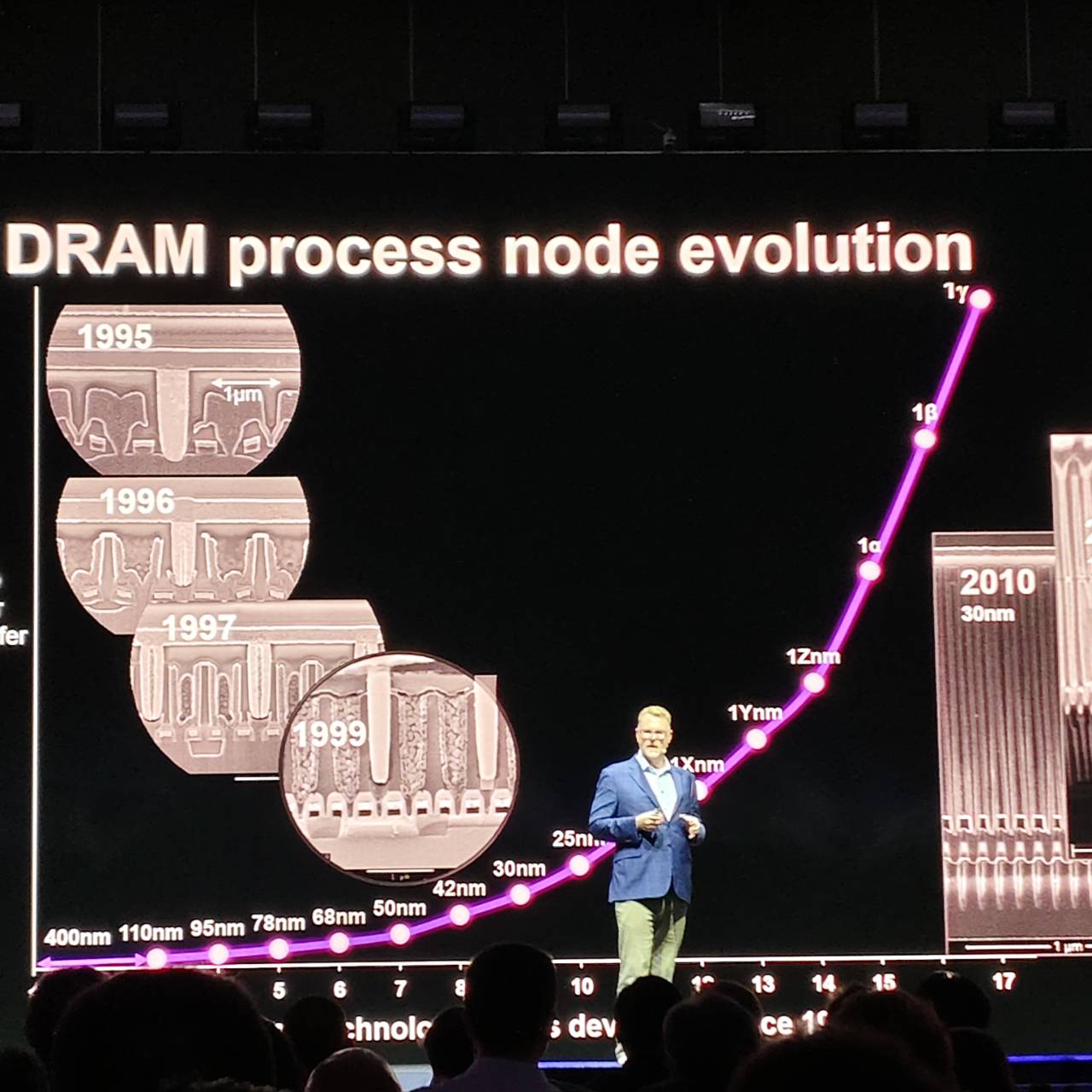
Rejecting persistent assertions that Moore’s Law is dead, DeBoer pointed to DRAM's 30-year trajectory across 15 technology nodes, where density continues on an exponential curve via architectural innovation rather than planar lithography shrinking alone. Leading-edge DRAM can now fit more than 1,500 memory capacitors across the width of a single human hair.
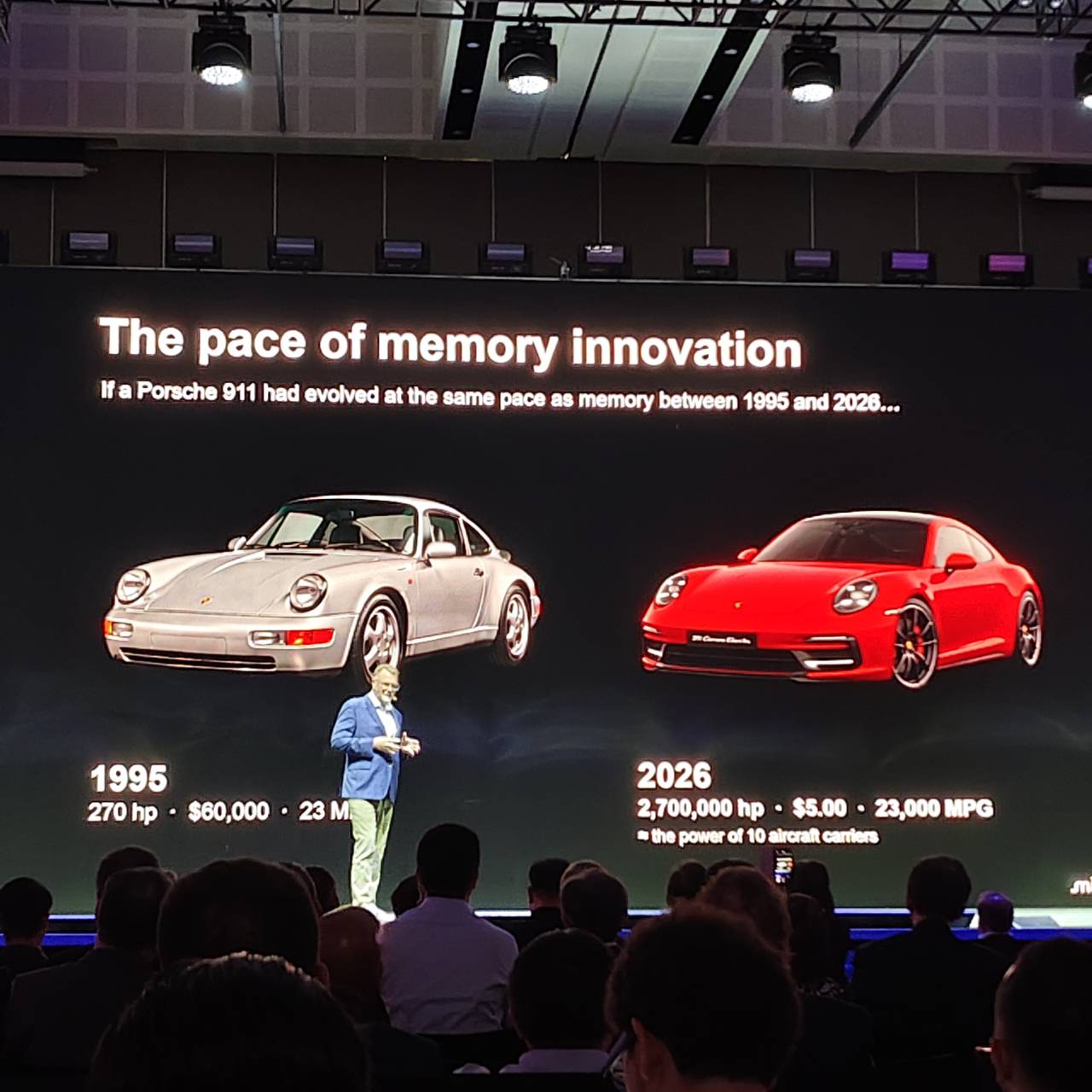
To illustrate this curve, DeBoer compared memory scaling to a 1995 sports car:
- 1995 Baseline: A Porsche generating ~270 horsepower, costing $60,000, and getting 23 miles per gallon.
- DRAM-Equivalent Today: That same vehicle would produce nearly 3 million horsepower, cost $5, and achieve 23,000 miles per gallon.
The Packaging Bottleneck: Hybrid Bonding Lags
While HBM captures industry headlines, DeBoer underscored that packaging cannot mask weak silicon: baseline DRAM transistor performance fundamentally underpins final stack yield and capability.
Beyond silicon, DeBoer issued a direct challenge to the semiconductor equipment industry regarding advanced packaging. While wafer-to-wafer bonding is transitioning from NAND into DRAM, hybrid copper-to-copper bonding remains an acute industry bottleneck. Die-to-wafer bonding, stacked-to-wafer integration, and sub-micron inline metrology significantly lag behind the high-volume manufacturing requirements needed for upcoming HBM4E, HBM5, and vertical 3D integration.
Over the past year, localized heat buildup has emerged as the primary operational governor on memory bandwidth. In dense 2.5D and 3D packages, heat generated by base logic dies must travel vertically through stacked DRAM dies to reach cooling plates, necessitating custom structural cooling conduits engineered directly inside the memory dies.
Tokenomics and the Broader AI Fabric
Sustaining the unit economics of generative AI—the cost per served token—requires architectural restructuring:
- Vertical 3D HBM: Stacking memory dies directly atop host logic accelerators slashes physical trace lengths, eliminates wiring capacitance, and delivers massive bandwidth gains tailored for high-speed inference.
- Full Data Center Hierarchy: Hyperscale AI cannot rely solely on HBM. It depends on high-density DDR5 modules, low-power DRAM (LPDRAM) modules for offload caching, and high-performance PCIe enterprise SSDs. DeBoer noted that NAND flash has completed an unexpected turnaround from an "atrocious commodity business" into a high-performance AI pillar.
- Edge Collisions: Fast-expanding edge AI deployments in autonomous driving and robotics are creating fierce wafer-allocation competition with data center HBM, exacerbating broad DRAM supply tightness.
DeBoer’s speech drew a hard line under an uncomfortable industry reality: algorithmic breakthroughs mean nothing if the underlying silicon cannot dissipate heat or move data fast enough to keep tensor cores fed. With hyperscale data centers facing structural bit shortages and high-volume hybrid bonding still plagued by maturity hurdles, the memory bottleneck is no longer a downstream logistics issue—it is an existential ceiling on artificial intelligence.
Backing that warning with a $250 billion capital and research offensive, Micron is betting that the balance of semiconductor power has permanently shifted. The AI revolution will not be crowned by who builds the biggest processor, but by who solves the brutal, sub-micron physics of keeping it fed.
Have you read?
- Taiwan's "Big Six" Vie for Dominance in Upcoming Quantum Computing Showdown
- King Slide’s 87% Gross Margin Tops Nvidia’s. What Makes Its Server Rails So Hard to Replace?
- Two-Way Bet: Why Chip Materials Suppliers Are Localizing in Taiwan and Arizona
Uploaded by Ian Huang
Views

Subscribe to CWE Newsletter (every Thursday)
Stay abreast of what's happening in Taiwan with our weekly digest.
Keywords: