Headline: MEAN WELL Turns Sustainability into a Competitive Advantage

Source:MEAN WELL
"A company's commitment to pursue ESG is no longer enough—it's time to actually execute and verify progress." MEAN WELL, a global a global leader in standard power supply solutions supplies, has turned sustainability into a powerful competitive asset and driver of innovation, even as many companies still view decarbonization and carbon accounting as forms of regulatory pressure and cost burdens. MEAN WELL is leading the way thanks to more than 40 years of unwavering commitment to its own brand and its belief in the common good.
Views
Headline: MEAN WELL Turns Sustainability into a Competitive Advantage
By MEAN WELLweb only
For Patrick Wang, Chief Sustainability Officer at MEAN WELL, the real challenge of ESG has never been companies' willingness to pursue it, but whether they translate ESG principles into quantifiable, manageable, value-creating actions in daily operations.
As decarbonization, carbon inventories, and compliance with international sustainability standards gradually become fundamental capabilities for companies, MEAN WELL has chosen to go further, beginning the second critical five-year phase of its ESG program. From brand development, watershed management, and supply chain decarbonization to the commercialization of green technologies, MEAN WELL is addressing a deeper question: Can sustainability become a company's competitive advantage for the next decade?
Refusing a large OEM order to pursue its own brand
MEAN WELL's emphasis on sustainability predates ESG's rise to mainstream status. Soon after founding the company in 1982, MEAN WELL’s founder, Mr. Jerry Lin turned down a NT$200 million OEM order from a major technology company, driven by a belief that businesses must build their own brand: "A brand is a company's lifeblood."
This decision came to define the core logic underlying MEAN WELL's 40-plus years of operation. "The brand is our core competitive strength," Wang said. By building a brand, he explained, a company does more than passively respond to customer demands—it can determine its own direction and even exert influence over the supply chain and broader industry.
MEAN WELL currently maintains more than 260 distributors in major cities around the world. The value of this global network lies not just in selling products, but in the opportunity it represents to spread the company's sustainability message. More importantly, it also demonstrates the forward-looking thinking that underlies MEAN WELL's commitment to both building its own brand and setting its own sustainability standards.
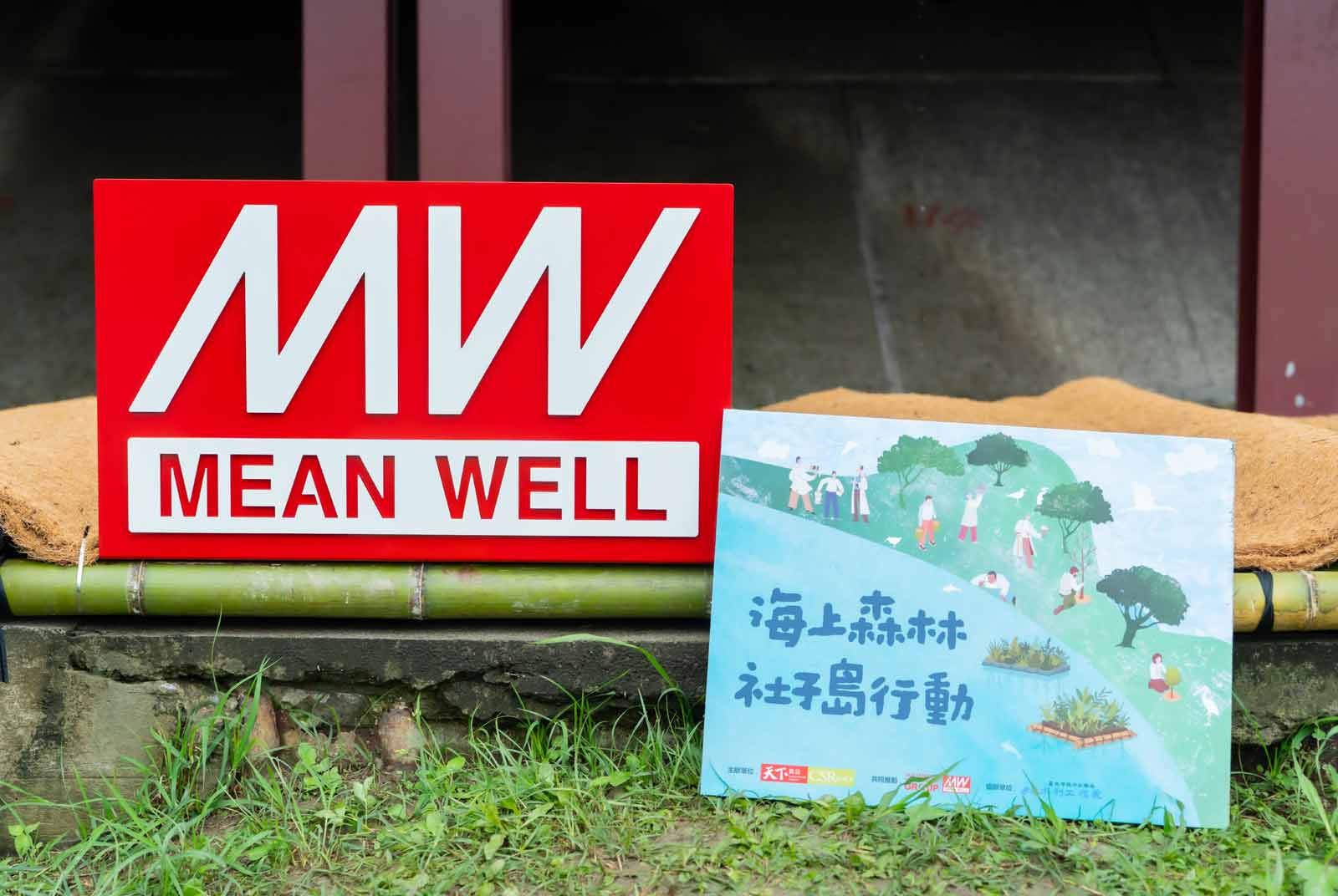 MEAN WELL's "I Love the Tamsui River" campaign uses the tech industry's high-precision data monitoring to protect this vital waterway in Taiwan. The campaign demonstrates this Taiwanese company's commitment to protecting the environment and upholding sustainability principles.
A river shows how data can advance sustainability
MEAN WELL's commitment to sustainability draws on its founder's emotional attachment to the neighborhood where he grew up, which overlooks the confluence of two rivers as they merge into the Tamsui River.
In 2011, before the concepts of ESG or biodiversity were popularized, MEAN WELL launched the "I Love the Tamsui River" campaign. Much more than just a slogan, the campaign applied the tech industry's data-driven approach, creating a dedicated website that tracks water quality using the River Pollution Index (RPI).
Since 2019, MEAN WELL has partnered with CommonWealth Magazine to promote watershed conservation. Through continuous monitoring by civic groups and collaboration among government and community stakeholders, the Tamsui River's RPI score has fallen from around 6 to 2 over five years—a significant improvement, from moderately heavy pollution to mild pollution.
As it enters a new phase spanning 2024 to 2028, MEAN WELL has set its sights on biodiversity and the health of aquatic life. Having monitored fish under 15 cm in length beginning last year, this year MEAN WELL is going further by testing for heavy metal residues in fish over 15 cm, using scientific data to confirm the Tamsui River's genuine ecological recovery.
Partnering with the supply chain on decarbonization
This data-driven sustainability mindset is also taking hold in MEAN WELL's supply chain.
With the advent of international regulatory standards such as CBAM, CSRD, and CSDDD, it is no longer viable for manufacturers to scrutinize only their own factories when most carbon emissions originate with upstream suppliers. If these suppliers lack the ability to conduct carbon inventories, brand companies will, in turn, find it difficult to understand the carbon footprint of their own products. MEAN WELL has therefore chosen not to leave suppliers to their own devices when it comes to carbon inventories, but instead to serve a mentoring role.
Wang shared that by offering SDG lectures, professional instruction, carbon inventory systems, and related resources, MEAN WELL has helped hundreds of small and medium-sized suppliers learn greenhouse gas accounting. MEAN WELL has also developed the MWPro (MEAN WELL supplier material carbon footprint) management module, which factors suppliers' decarbonization outcomes into evaluation and business processes.
Effective carbon reduction can improve supplier evaluation results and create opportunities for closer business cooperation. "If sustainability efforts are limited to demanding that suppliers cooperate, it won't last long," Wang said. A truly effective approach helps suppliers see how they themselves can benefit—shifting decarbonization from a cost to be borne into a competitive advantage sought by the entire supply chain.
Even more noteworthy, MEAN WELL's pursuit of decarbonization doesn't stop at the management level—it has also been integrated into research and development.
Turning waste heat into a profit contributor
While many companies view decarbonization as a burden, Wang proposed a key change in mindset: "If you treat sustainability as a regulatory requirement to be fulfilled passively, it feels like a nuisance, but if you treat it as a target for active R&D investment, it can become a source of profit."
Consider burn-in tests, a necessary step in power supply production, as an example. Because they involve running power supplies at high load for extended periods, these tests generate significant waste heat while consuming large amounts of electrical power. MEAN WELL has developed energy recovery systems that convert this waste heat into electricity for use by the factory. In Taiwan alone, this saves approximately 1.4 million kilowatt-hours of electricity and reduces CO2 emissions by 730 metric tons annually.
More importantly, MEAN WELL has commercialized this internal innovation, promoting it to customers and distributors worldwide. These systems not only address the pain point of high energy costs but also create a new revenue stream for the company—a win for both the environment and profitability.
 "Do what's right for the long term, and make it a competitive advantage," said Wang, explaining why MEAN WELL embarked on its sustainability program long before regulations required it. It not only achieved a 50% reduction in carbon emissions ahead of schedule, but is now actively building an ESG ecosystem encompassing hundreds of companies.
From good intentions to an actual sustainability ecosystem
Having experienced the impact of the COVID-19 pandemic, MEAN WELL recognized the limits of any single company's resilience to risk and officially established the SDG Group in 2021. In addition to MEAN WELL itself, the alliance includes PowerNex, SHARE WELL, and the MEAN WELL Foundation, with the clear goal of creating 100 ESG companies—such as green energy startups, social enterprises, and environmental consultancies—by 2030. As of 2026, the number has passed 60, and the goal of 100 companies is expected to be achieved ahead of schedule, in 2028.
In this process, MEAN WELL acts as a "sharing platform." Startups need only bring their core expertise, while MEAN WELL provides robust logistical support—including ERP, distribution, manufacturing, HR, and finance—to help young teams quickly commercialize their sustainability concepts.
Despite global economic turmoil and the challenge of reducing carbon emissions as the business grows, MEAN WELL has relied on systematic management and careful planning of distributor shipments to reduce its use of high-emission air freight. While maintaining stable annual revenue growth of 10% to 15%, it achieved a sustainability milestone in 2024: halving carbon emissions relative to its 2021 baseline, ahead of schedule.
From that rejection, more than four decades ago, of a massive OEM order in favor of pursuing its own brand, to today's investment in watershed management, supply chain decarbonization, energy recycling, and ESG startup incubation—what may seem like very different kinds of action are, in fact, direct expressions of the same core values: doing the right things for the long term, and turning those right things into business capabilities. Just as the company's name means "having good intentions," every action demonstrates MEAN WELL's vision for a Taiwanese brand at the forefront of international sustainability efforts: when companies can make the most of every unit of electricity they consume and build an ecosystem around the common good, sustainability is no longer a burden, but the strongest and most lasting competitive advantage.
Views

Subscribe to CWE Newsletter (every Thursday)
Stay abreast of what's happening in Taiwan with our weekly digest.
Keywords: