Why Taiwan Has Yet to Face Power Shortages Amid the AI Boom
Source:CommonWealth Magazine
Taiwan's phase-out of nuclear power in 2025 combined with rising electricity demand due to AI prompted warnings of potential electricity shortages, but those concerns have not materialized. Why has the country's power supply held up?
Views
Why Taiwan Has Yet to Face Power Shortages Amid the AI Boom
By Guo Jia-hongweb only
Does Taiwan have enough power?
It has been one of the country's most contentious public issues in recent years, with the government repeatedly guaranteeing an uninterrupted supply of electricity, even as rising AI-related demand and the growing number of data centers being built have kept the business community on edge.
Yet, Taiwan has not experienced a major power shortage since the warnings first emerged, and the Energy Administration's most recent statistics on electricity usage revealed why: plummeting power consumption by non-tech industries because of economic weakness in those sectors.
That has freed up electricity to support surging power demand by the high-tech sector, leaving overall electricity consumption growth relatively flat. Over the past six years, total power use has only risen 6.5 percent.
Electronics Sector Power Usage Milestone
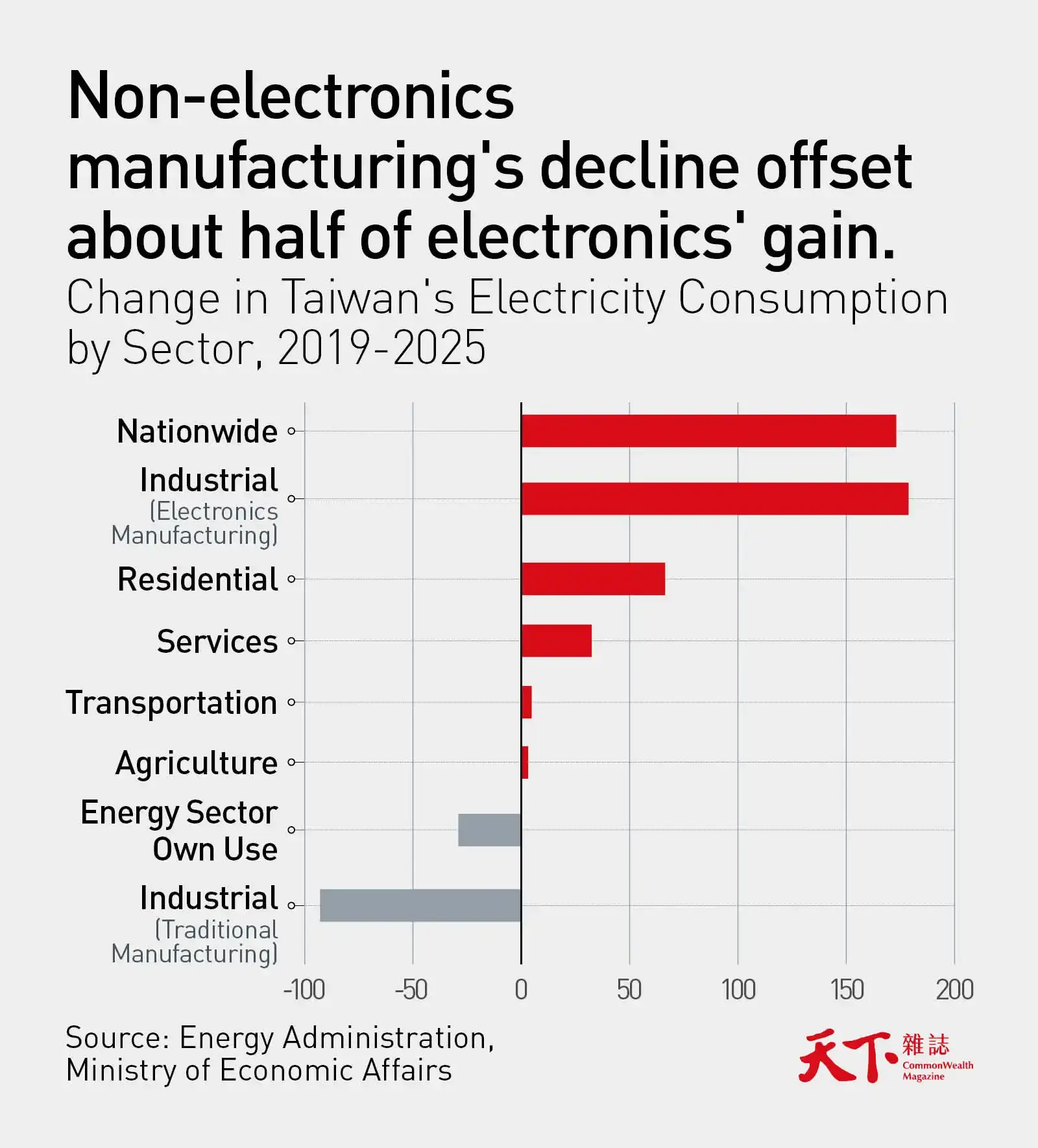
From 2019 to 2025, chipmaker TSMC and other key tech players were firing on all cylinders, leading to a 35 percent increase in power consumption by the electronics manufacturing sector over that period. The additional 17.9 billion kWh used in 2025 compared to 2019 was enough to power a third of Taiwan's households.
At the same time, the non-tech sector's power consumption fell by 9.3 billion kWh, offsetting about half of the tech sector's increase, thus limiting the potential stress on Taiwan's power grid.
The electronics manufacturing sector also consumed more power than the non-tech industrial sector in 2025 for the first time ever, and it used the most of any industry in Taiwan, accounting for just under 25 percent of the 283 billion kWh the country consumed during the year.
Sluggish demand was the main factor in the decline in power use by non-tech sectors. Businesses in those industries had to reduce capacity to cope with the dual blows of inflation and higher interest rates and then were hit last year by United States President Donald Trump's arbitrary (later ruled to be illegal) tariffs, further weakening their prospects.
Also bolstered by the AI boom, the ICT (information and communication technology) sector, which only accounted for 1.5 percent of total power consumption last year, saw its electricity usage rise 26 percent over the six-year period, the largest increase of any service-sector industry.
Residential Electricity Use on the Rise
While the industrial sector is by far the biggest user of electricity in Taiwan, residential electricity consumption was the second-biggest power consumption bloc, just above the service sector. It accounted for 19 percent of Taiwan's total power usage in 2025, using an additional 6.6 billion kWh last year compared to 2019.
With climate change ratcheting up the summer heat, the use of air conditioning has risen dramatically, resulting in a 4 percent increase in the residential sector's power consumption in 2024 alone.
Chen Chung-hsien (陳崇憲), the deputy director general of the Energy Administration, said Taiwan's economy has been relatively strong in recent years, making people feel more confident they can afford to use air conditioning and keep it on for longer hours.
In contrast, the energy sector's electricity consumption for its own use fell by 2.9 billion kWh during the period, serving as another factor in alleviating pressure on the grid.
That decline has been driven by government efforts to ramp up the use of renewable energy and natural gas-fired turbines, which need less electricity to operate than the nuclear reactors and coal-fired turbines they have replaced, thus reducing the overall electricity consumption of the energy sector.
28% Increase in Power Demand by 2035
Having old economy industries offset surging power demand in the tech sector has kept the pressure off Taiwan's power grid in recent years, but that model may soon become unsustainable.
The Energy Administration's Chen said that if the economic prospects of non-tech industries improve, their electricity use could rebound, which, combined with sustained growth in electronics manufacturing, could put the electricity grid under heavy stress.
In a June report, the Energy Administration projected that electricity consumption in Taiwan would average 2.5 percent growth a year over the next 10 years, largely due to semiconductor foundry expansion and the AI industry's development.
That would be higher than the 1.2 percent a year growth seen over the past 10 years and result in 28 percent more electricity use in 2035 than in 2025.
Chen suggested that gas-fired turbines will play the key role in stabilizing electricity supply in the future while the push for more renewable energy will help companies meet international norms.
For Chen Jong-shun (陳中舜), an associate research fellow in the Chung-Hua Institution for Economic Research's Center for Green Economy, the electricity challenge is slightly more complex.
The government, he said, has focused most of its attention in recent years on technical issues, such as its mantra to "eliminate nuclear power, reduce coal, increase natural gas, and extend renewable energy."
Ensuring a stable power supply, however, also requires an emphasis on reliability, power dispatch capabilities, energy safety and grid resilience, which will enable each energy source to play their specific roles.
Ultimately, according to Chen Jong-shun, the core issue is not which energy source should be used to generate electricity, but rather whether the system as a whole can continue to supply power reliably.
Have you read?
- A Hungarian Engineer's Path to a Taiwan Gold Card — and Why Europeans are Embracing Taiwan's Mandarin Language Centers
- Why France Chose Foxconn to Build Europe’s Most Advanced Packaging Plant
- Why Hungary’s China Bet on Batteries Faces Voter Backlash
Translated by Luke Sabatier
Uploaded by Ian Huang
Views

Subscribe to CWE Newsletter (every Thursday)
Stay abreast of what's happening in Taiwan with our weekly digest.
Keywords: