Exclusive: AmCham Veterans Recall the Fight to Preserve US-Taiwan Ties in 1979
Source:Judy Lin
At AmCham Taiwan’s 75th anniversary, Robert Parker and Don Shapiro revisit the 1979 Taiwan Relations Act, Taiwan’s transformation, and lessons for a new era of geopolitical uncertainty.
Views
Exclusive: AmCham Veterans Recall the Fight to Preserve US-Taiwan Ties in 1979
By Judy Linweb only
As the American Chamber of Commerce in Taiwan (AmCham Taiwan) celebrated its 75th anniversary on October 6, the occasion offered a timely opportunity to reflect on its role in strengthening US-Taiwan ties—especially as Taiwan once again faces tremendous geopolitical uncertainty.
That role was perhaps nowhere more consequential than in late 1978, when the United States announced it would derecognize the Republic of China on Taiwan and establish diplomatic relations with the People’s Republic of China. Amid the upheaval, AmCham took its concerns directly to Congress, arguing that a legal framework was essential to preserve substantive US-Taiwan relations and protect American business interests.
CommonWealth English interviewed Robert Parker, former AmCham Taipei president from 1978 to 1980, and Don Shapiro, senior advisor and retired editor-in-chief of AmCham’s Business TOPICS magazine. Together, they offer a rare firsthand perspective spanning more than half a century of Taiwan’s transformation.
The interview has been edited for brevity.
Q: Mr. Parker, you represented AmCham at the 1979 congressional hearings that helped shape the Taiwan Relations Act (TRA). What prompted AmCham to go before Congress?
Parker: AmCham had anticipated a fundamental change in US-Taiwan relations for years, particularly after Nixon’s 1972 visit to China and the Shanghai Communiqué. The question was not whether Washington would normalize relations with Beijing, but when—and what that would mean for Taiwan.
Beginning in 1976, we repeatedly asked the US Embassy, State Department and White House what arrangements were being made for Taiwan, but received no substantive answers.
When derecognition was announced, it became clear that Washington was poorly prepared for the consequences. The State Department’s proposed omnibus legislation also failed to address many of the practical needs of the future relationship. That was when we concluded that we had to go directly to Congress.
Q: You were essentially protecting the interests of American businesses in Taiwan?
Parker: Yes, exactly. Derecognition raised moral, military, and geostrategic issues. But we were a business organization, so I felt we had to explain why issues such as Taiwan’s security and arms sales were also business issues.
I remember beginning my testimony with security. My argument was simple: certainty is essential for business. If Taiwan was not secure, American companies operating here could not have that certainty. And security required Taiwan to have the defensive weapons necessary to defend itself.
Another issue was how the government in Taiwan would be treated. The Carter administration’s proposal talked about the “people on Taiwan” while avoiding the government itself.
I told Congress: when an American defense company sells a tank to Taiwan, it doesn’t sell it to the people. It sells it to the government. When American companies pay taxes in Taiwan, they pay the government, not the people.
The legislation therefore had to provide a legal basis for dealing with the government. Congress agreed.
Q: Was it difficult to make your voice heard in Congress?
Parker: It wasn’t difficult. There was no precedent in American history for breaking diplomatic relations with a friendly country. So there was a fundamental question: how do you maintain close, friendly relations after ending official diplomatic ties?
Congress recognized that something had to be done. It was also unhappy that Carter had largely left it out of the process. Just weeks before derecognition, the Senate had overwhelmingly urged the president not to change the mutual defense treaty with Taiwan without consulting Congress. Carter ignored that.
Frankly, they wanted to teach him a lesson: Congress matters, Congress has a major role in foreign policy, and Congress was going to assert that role.
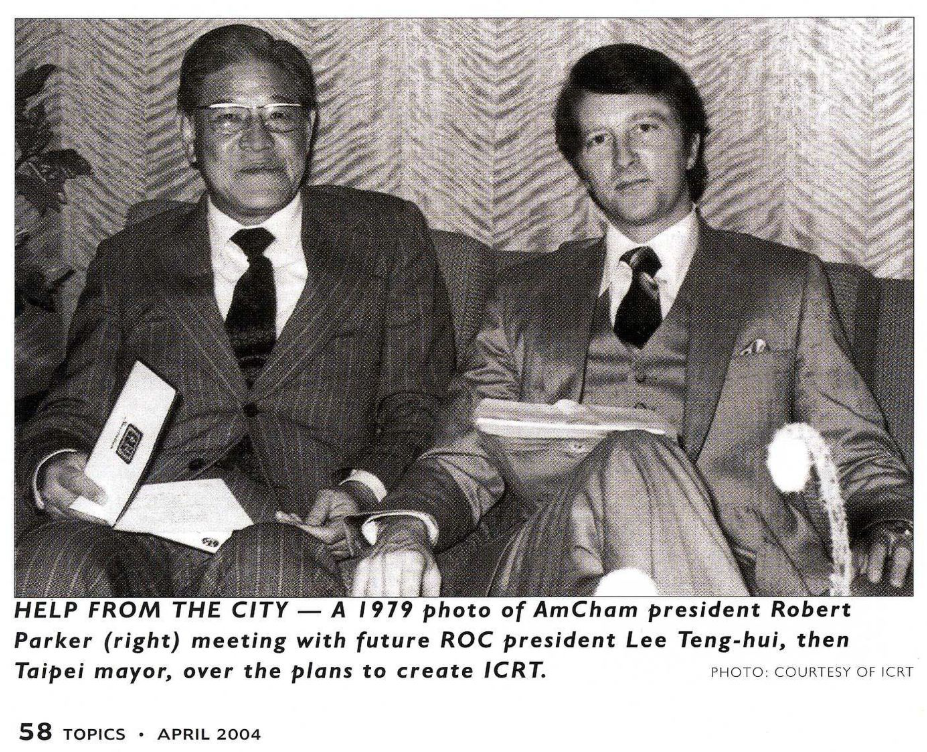
Q: What was happening within AmCham at the time?
Parker: It was complicated because many of our members were multinational companies, and their US headquarters were caught up in what we called “China fever”—tremendous excitement about China’s commercial potential. That didn’t change what we needed to tell Congress, but it affected how we said it.
I was elected AmCham president in November 1978, and Carter announced derecognition in mid-December, two weeks before my term began. The outgoing president’s headquarters told him, “Stay out of this. Don’t touch it.” So he turned to me and said, “It’s all yours.”
I stepped into the role before formally taking office. We ultimately had strong support from our member companies, but we had to navigate their concerns carefully.
Shapiro: The Chamber was extremely fortunate to have a president-elect willing to step up, with the background, energy, and competence to take this on.
Parker: I was 37. There wasn’t time to equivocate. We had to act.
Q: Mr. Shapiro, you first arrived in Taiwan in 1969. What were your first impressions, and what changes have been most memorable?
Shapiro: I flew from San Francisco to Tokyo and then Hong Kong, where a typhoon delayed me. When I finally landed at Songshan Airport and came into Taipei, the city was a mess—sewage had backed up, debris was everywhere, and there was a terrible smell. I thought, “What kind of place have I come to?”
The next morning, the sun was shining and everything had been cleaned up. I thought, “This is a really efficient place. Maybe I have to change my mind.”
Taiwan was under one-party rule, but what struck me was the tremendous energy of ordinary people working to improve life for themselves and their families. There was enormous energy going into business.
In 1969, Taiwan exported US$1 billion worth of goods for the first time—a major milestone. Today, Taiwan can export that much in roughly half a day.
I feel privileged to have watched both the political system evolve into a genuine democracy and the economy take off in ways I could never have imagined.
Q: How have you seen Taiwan’s sense of its own identity evolve?
Shapiro: When I arrived, there was still a Planning Commission for the Recovery of the Mainland and a Mongolian and Tibetan Affairs Commission. It had only been 20 years since the ROC government relocated to Taiwan.
The contrast with today is striking. We now commemorate the February 28 Incident with a national holiday. When I first came, 228 was something people were afraid even to talk about. They would look over their shoulders to make sure no one was listening and speak about it only in whispers.
That gives you a sense of how profoundly Taiwan has changed.
Q: Companies today face uncertainty over tariffs, export controls, industrial policy and supply-chain security. How do you view the longer-term changes in the US-Taiwan economic relationship?
Parker: We’ve moved far beyond the era when American companies invested in Taiwan largely because they could find hardworking, well-educated people at much lower costs. They generally manufactured here for export back to the United States.
Taiwanese companies, by contrast, saw the world as their market from very early on. That global outlook has been one of the keys to Taiwan’s economic success.
Shapiro: There is still tremendous uncertainty. But Taiwan has managed this difficult transition remarkably well. You can see it in its economic growth and in how far it has risen among America’s leading trading partners—to number four, something almost unimaginable just a few years ago.
Q: As Taiwanese supply chains invest in the United States, what advice would you give companies trying to succeed there?
Parker: Taiwanese companies could fall into the same trap American companies once did in Taiwan—a narrow focus.
A smaller company might see itself simply as part of TSMC’s US supply chain. But the opportunity is much broader. Support your existing customers, but also look beyond them to the wider American market.
Shapiro: American companies in Taiwan initially relied heavily on expatriates for leadership. Over time, they developed highly capable Taiwanese managers. Today, many AmCham member companies are led by Taiwanese executives, some with few or no expatriates.
Taiwanese companies in the United States will probably go through a similar process. Having people who truly understand the local culture and business environment is essential.
American companies here also benefited enormously from Taiwanese who had studied or worked in the United States and understood both cultures. They became invaluable bridges. That model can work in reverse.
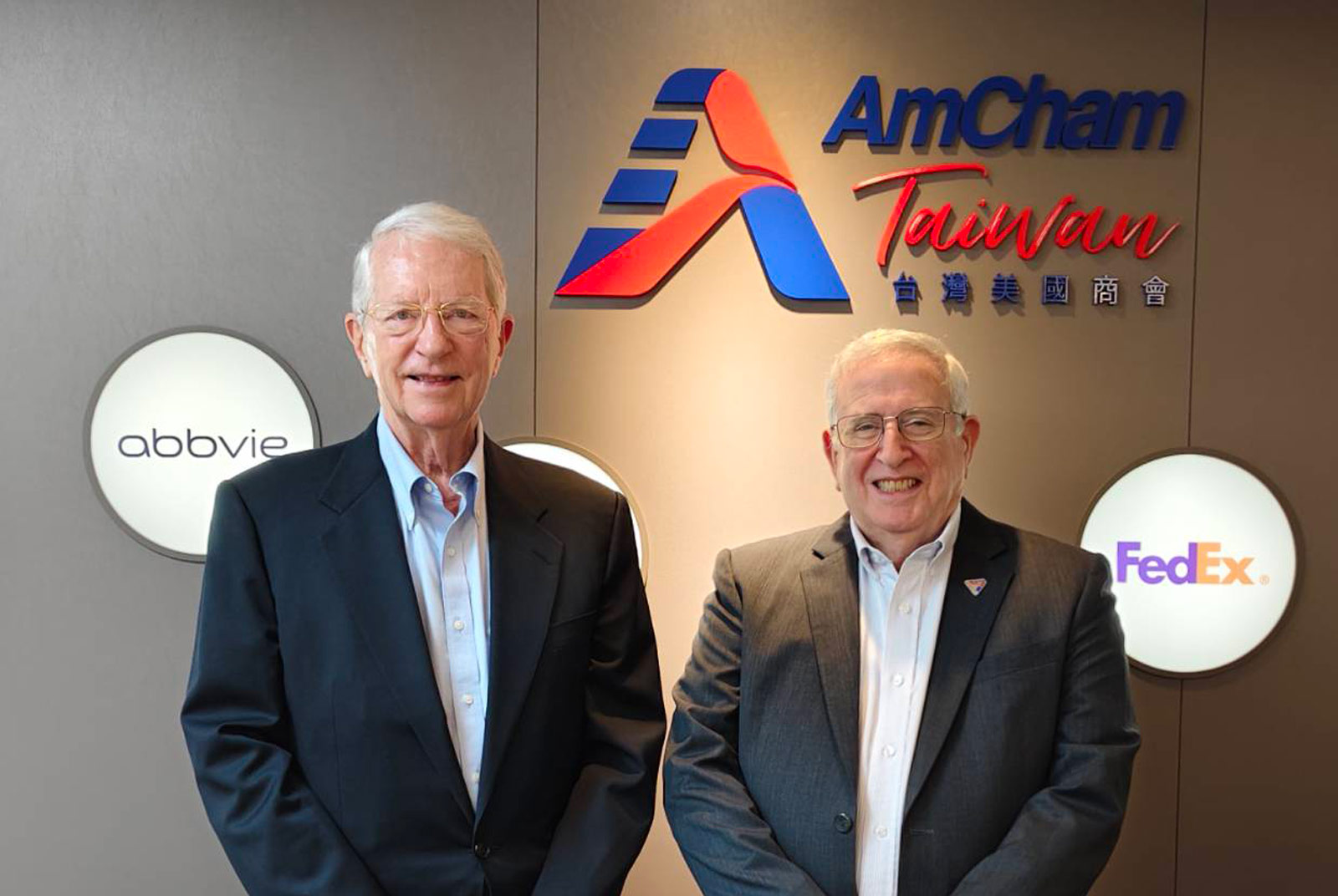
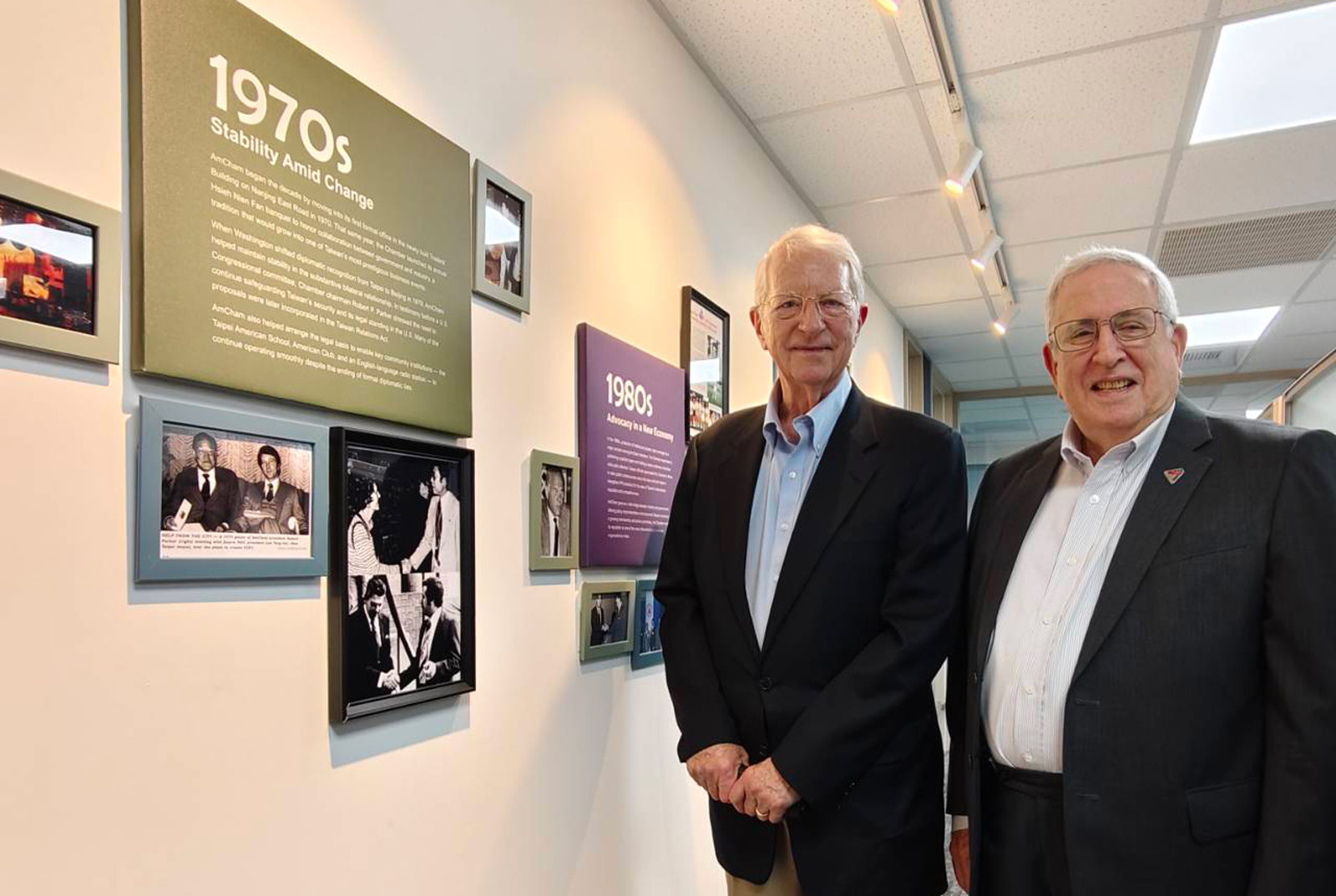 Robert Parker (left), former AmCham Taipei president from 1978 to 1980, and Don Shapiro, senior advisor (right). (Source: Judy Lin)
Q: As AmCham Taiwan celebrates its 75th anniversary, what lessons would you most like readers to take away?
Shapiro: Every era has brought its own challenges—from derecognition in the 1970s to Taiwan’s WTO accession and intellectual property rights.
What we’ve learned is that if we approach these issues thoughtfully and well prepared, we can make an impact. The Chamber’s past successes give us confidence to continue on that path.
Parker: For Taiwanese companies going to the United States, the short-term strategy should be: do what you do well. Get established and make your product extremely well. But maintain a longer-term strategic vision for how to move beyond that initial foothold and capture the enormous opportunities in the American market.
Second, whenever we talk about Taiwan and the United States, there is a major third party that cannot be ignored: China.
I think it is useful to come back to the Taiwan Relations Act. The TRA has been good for Taiwan, but I would argue it has also been good for China and the United States. Taiwan has thrived under the stability the TRA helped sustain, but so have China and the United States.
We have a structure that has helped preserve the status quo and maintain peace. We should keep that broader perspective in mind, because disrupting that structure in a way that destroys peace would be in no one’s interest.
Have you read?
- Why Doesn’t Taiwan Have an Embassy in the United States?
- “Deterrence Requires Resources”: AIT Director on Taiwan’s Critical Role in the First Island Chain
- How a Taiwanese Family Firm Powers America’s AI Boom
Uploaded by Ian Huang
Views

Subscribe to CWE Newsletter (every Thursday)
Stay abreast of what's happening in Taiwan with our weekly digest.
Keywords: