Who Pays to Keep Taiwan’s Energy Prices Down? Inside CPC’s Mounting Losses
Source:Kai-Cheng Chuang
Taiwan has kept energy prices down to curb inflation, but the cost is mounting. State-owned CPC has posted six straight years of losses and could approach insolvency in 2027 without government support.
Views
Who Pays to Keep Taiwan’s Energy Prices Down? Inside CPC’s Mounting Losses
By CommonWealth Magazineweb only
Taiwan’s government is preparing to spend nearly NT$415 billion (US$13 billion) to keep its energy system financially afloat.
On October 1, the Executive Yuan proposed NT$180.94 billion in subsidies for Taipower, CPC Corporation and other fuel suppliers to compensate for energy costs absorbed under government price-stabilization policies.
Another NT$233.83 billion would be injected directly into CPC as new capital to strengthen its balance sheet and fund energy infrastructure.
The reason is increasingly difficult to ignore.
CPC has lost money for six consecutive years. The government now estimates that its accumulated losses could reach NT$127.6 billion by the end of 2026, almost wiping out its NT$130.1 billion in paid-in capital.
Without intervention, the Executive Yuan says CPC could be on the verge of becoming insolvent in early 2027.
Why is CPC losing so much money?
CPC’s financial problems are closely connected to Taiwan’s efforts to prevent international energy shocks from flowing directly into household bills.
Since 2020, the company has had to navigate the pandemic, Russia’s invasion of Ukraine and, most recently, conflict in the Middle East.
Each episode pushed up international oil or natural-gas costs.
But Taiwan did not pass all of those increases on to consumers.
In 2026 alone, the government says gasoline and diesel prices were frozen 21 times and subject to limited increases another six times. Household natural-gas and bottled LPG prices have also been frozen through the end of the year.
Electricity prices have similarly been held unchanged in two successive pricing reviews.
That has protected consumers from some of the immediate impact of higher global energy prices.
But the costs did not disappear.
They remained on the balance sheets of CPC and Taipower.
Is CPC really going bankrupt in 2027?
The answer requires an important distinction.
In September, CPC board member Wei Hui-shan warned that if energy prices remained high and losses continued, the company could become insolvent in 2027, potentially forcing its board to consider bankruptcy or restructuring proceedings. At the time, CPC’s interest-bearing debt exceeded NT$850 billion and its debt ratio was reported at roughly 93%.
That warning quickly produced headlines suggesting that CPC could “go bankrupt next year.”
CPC pushed back.
The company said the characterization was misleading and stressed that its financial losses resulted largely from its public-policy responsibility to stabilize domestic energy prices rather than from an imminent collapse of its core business.
Yet the government’s own October 1 budget proposal confirms that the underlying balance-sheet problem is real.
Its official assessment says CPC’s accumulated losses could nearly exhaust its capital by the end of 2026 and leave it on the verge of insolvency in early 2027 without financial intervention.
In other words, “CPC will go bankrupt in 2027” overstates what has been established.
But “CPC faces a serious capital problem that requires government intervention” does not.
Why doesn’t Taiwan simply raise gasoline and gas prices?
Because energy prices feed directly into inflation.
Higher gasoline prices raise transportation costs. More expensive natural gas affects households and businesses. Higher electricity rates can spread through manufacturing, retail and services.
Taiwan’s government has therefore used state-owned energy companies as a buffer between volatile international markets and domestic consumers.
This gives policymakers a way to soften inflation during periods of extreme energy volatility.
But it creates a trade-off.
Instead of households paying the full cost immediately through higher energy bills, part of the cost is initially absorbed by CPC and Taipower.
When their losses become too large, the government can then compensate them through subsidies or capital injections.
The cost has effectively shifted from the consumer’s monthly bill to the public-sector balance sheet.
Who ultimately pays for Taiwan’s energy subsidies?
The government’s latest plan illustrates two different mechanisms.
The NT$180.94 billion subsidy is intended to compensate energy companies for price differences they absorbed as part of government stabilization policies.
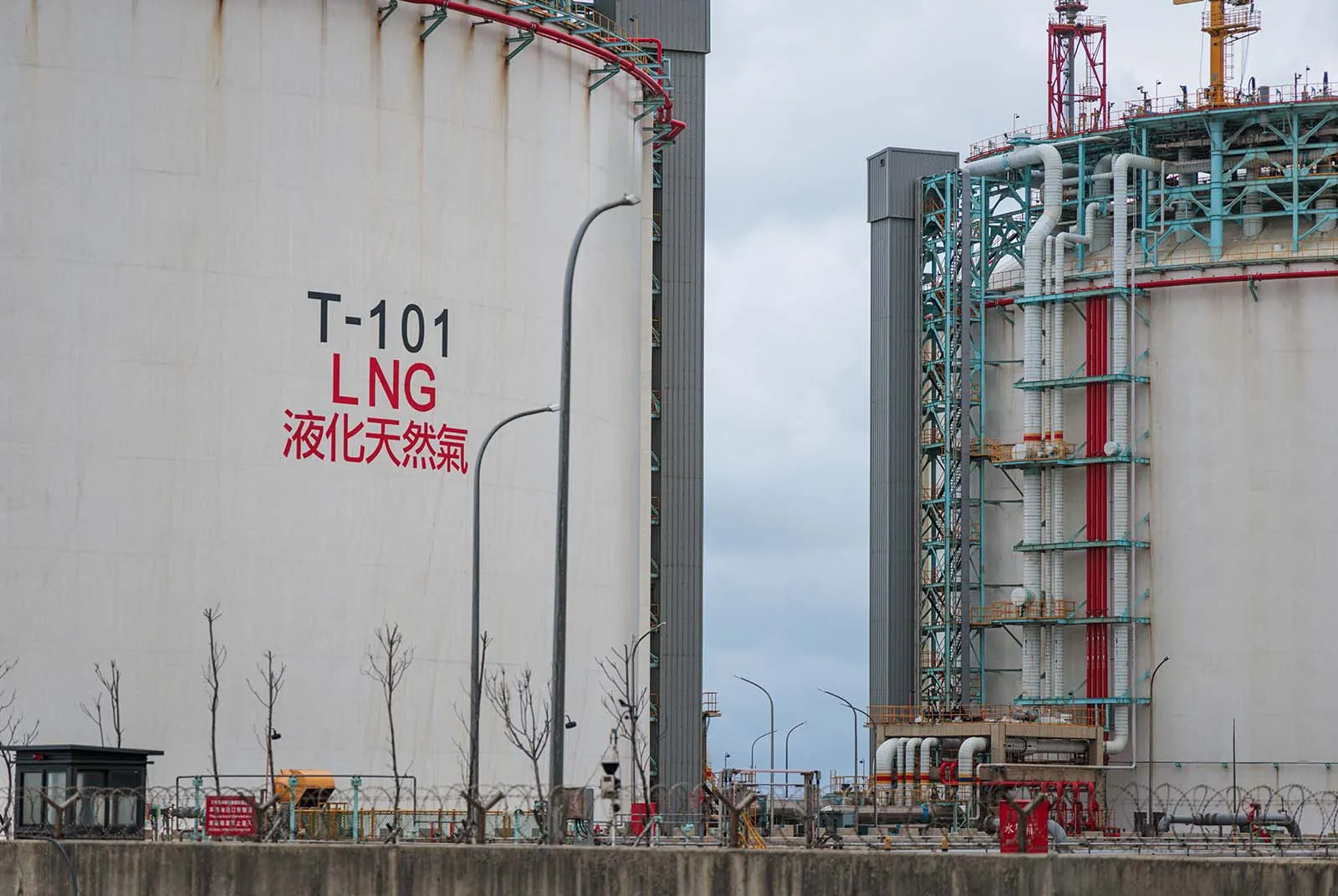
The NT$233.83 billion CPC capital injection, by contrast, is intended to restore working capital and improve the company’s financial structure while allowing it to continue investing in infrastructure such as LNG receiving terminals.
These are not identical forms of support.
But both ultimately rely on government resources.
Taiwanese consumers therefore avoid some energy costs at the point of sale, while part of the financial burden is transferred to state-owned companies and eventually to the government budget.
That does not necessarily mean the policy is economically irrational.
Governments often decide that preventing a sudden inflation shock is worth spreading the cost over time.
The question is how long that strategy can continue before the balance sheets of state-owned companies become unsustainable.
Did Taiwan’s U.S. natural-gas contracts cause CPC’s losses?
CPC says no.
Some reports linked the company’s financial problems to long-term purchases of U.S. liquefied natural gas, suggesting that trillion-dollar contracts had contributed to its losses.
CPC rejected that interpretation.
The company says its LNG strategy is deliberately diversified, with supplies coming from 14 countries and procurement based mainly on medium- and long-term contracts supplemented by spot purchases.
It also stressed that 20- to 25-year LNG contracts are paid gradually as gas is delivered rather than as a one-time expenditure.
The company attributes its recent losses primarily to the gap between volatile international energy costs and domestic prices constrained by stabilization policies.
AI is making the energy equation more difficult
Taiwan’s energy challenge is no longer only about keeping household prices affordable.
It must also supply an economy increasingly dominated by electricity-intensive semiconductor and AI industries.
From 2019 to 2025, electricity consumption by Taiwan’s electronics manufacturing sector rose 35%, adding 17.9 billion kWh of demand.
Taiwan has so far avoided the severe shortages many feared partly because electricity use in weaker non-tech industries declined at the same time, offsetting around half of the increase from technology manufacturers.
That unusual balance helps explain why Taiwan has yet to face major power shortages despite the AI boom.
But it may not last.
The more AI fabs, advanced packaging facilities and data centers Taiwan builds, the more electricity and natural-gas infrastructure the island will need.
And Taiwan remains heavily dependent on imported energy, a vulnerability that becomes even more important when semiconductor demand and energy security are considered together.
This means CPC’s financial health is not simply an accounting problem.
The company is responsible for securing much of the imported fuel needed to keep Taiwan’s households, power plants and industrial economy running.
Taiwan’s energy prices are not really “free”
Price controls can change when consumers pay for energy.
They cannot eliminate the underlying cost.
Taiwan’s approach has helped insulate households and businesses from some of the sharpest swings in global oil and gas markets.
It has also helped prevent imported energy inflation from immediately spreading through the broader economy.
But six consecutive years of CPC losses show the limits of using a state-owned company as a shock absorber indefinitely.
The government’s latest NT$415 billion support package is designed to prevent the company’s finances from deteriorating further while keeping energy prices stable.
That buys Taiwan time.
It does not remove the central dilemma.
As global energy volatility rises and Taiwan’s AI economy demands more power, the country will eventually have to decide how the cost should be divided among consumers, energy companies and taxpayers.
FAQ
Is CPC going bankrupt?
CPC has not announced that it will go bankrupt. However, the Executive Yuan estimates that accumulated losses could reach NT$127.6 billion by the end of 2026, nearly exhausting the company’s NT$130.1 billion capital and putting it close to insolvency in early 2027 without additional support.
Why has CPC lost money for six years?
CPC says international oil and natural-gas prices have risen sharply during successive global crises, while the company has absorbed part of those higher costs to stabilize domestic prices.
How much money is Taiwan giving CPC and Taipower?
The Executive Yuan’s October 2026 proposal includes NT$180.94 billion in subsidies for energy-price stabilization and an additional NT$233.83 billion capital injection into CPC.
Why doesn’t Taiwan simply raise energy prices?
Higher gasoline, gas and electricity prices can feed into inflation and raise costs across the economy. Taiwan has therefore used price freezes, limited increases and government support to spread the impact of global energy shocks over time.
Does AI make Taiwan’s energy problem worse?
Potentially. Semiconductor manufacturing, advanced packaging and data centers require large amounts of electricity. Taiwan’s technology sector is already accounting for a growing share of national power demand, increasing pressure on generation and fuel infrastructure.
Have you read?
- Why Doesn’t Taiwan Have an Embassy in the United States?
- What Is Taiwan’s “Silicon Shield”—and Does It Still Protect Taiwan in 2026?
- From Atoms for Peace to “No-Nuclear Homeland”: Taiwan’s Nuclear Power Referendum Explained
Uploaded by Ian Huang
Views

Subscribe to CWE Newsletter (every Thursday)
Stay abreast of what's happening in Taiwan with our weekly digest.
Keywords: