Why a Taipei-Manila-Tokyo Triangle Is Becoming Asia's Most Consequential Minilateral
Source:Getty Images
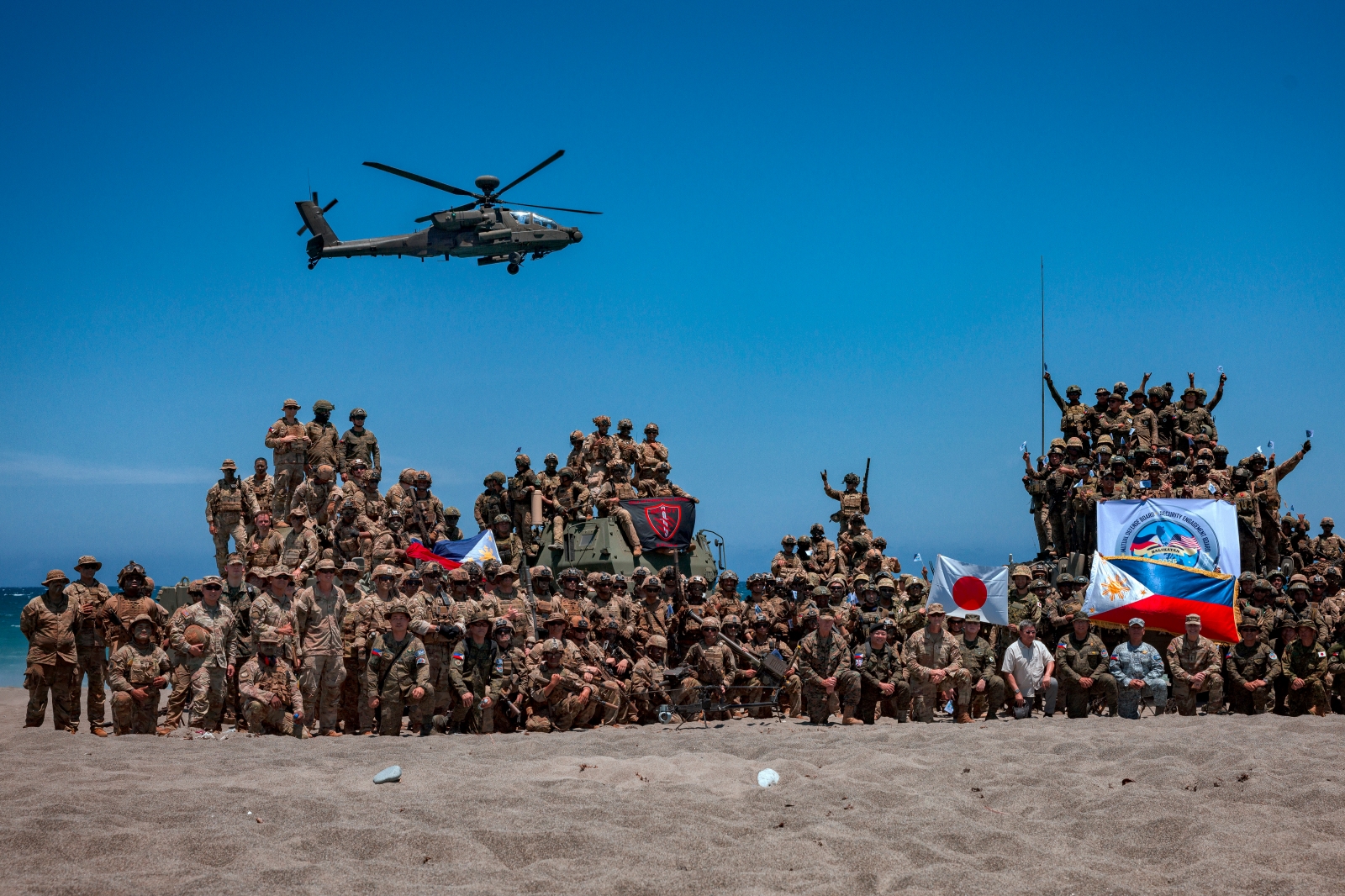
Closer ties among Taiwan, Japan and the Philippines are creating a new strategic triangle in Asia, linking maritime security, supply chains and economic cooperation as China expands its regional presence.
Views
Why a Taipei-Manila-Tokyo Triangle Is Becoming Asia's Most Consequential Minilateral
By Manoj Kumar Panigrahiweb only
A unique cooperation has begun in the region. It is the cooperation and support from Japan and Taiwan to the Philippines. It is the transfer of retired ships to Manila from Japan and Taiwan.
In the past, Manila has received support from Japan, in various forms to boost its maritime strength. Japan has recently donated generator sets to be used as backups during any failure of electricity supply. In May 2025, Japan and the Philippines have agreed to a much larger project where Tokyo will fund US$507 millions for the construction of five large patrol ships for the PCG through its Official Development Aid from Japan International Cooperation Agency.
The recent transfer of Taiwan's de-commissioned Coast Guard vessel CG123 to Manila marked one of the first such transfers between Taiwan and the Philippines. The 500-tonne-class Kinmen patrol vessel was transferred to Manila based We Protect Our Seas (WPS) Foundation, which was later donated to the Philippines Coast Guard (PCG) and renamed as BRP Sarangani. PCG Spokesperson for the West Philippine Sea (WPS), Rear Admiral Jay Tarriela has clarified that there was no involvement of PCG in the transfer and rather, it was first donated to a nonprofit, nongovernment foundation.
Such an act can be said as one of the first forms of cooperation between the two. Since the acceptance of the vessel by the PCG from Taiwan, there has been no official statement released from the Ministry of Foreign Affairs of People’s Republic of China (PRC). A few weeks prior to the transfer, the Philippines Foreign Ministry cited its 1975 Joint Commiuniqué with Beijing, which “recognized the Government of the PRC as the sole legal government of China.
This policy remains consistent, clear and unchanged.” It also added that the policy “does not preclude the Philippines from pursuing economic, cultural, and functional cooperation with Taiwan”. To refute, China’s Global Times, stated, that “no matter how the Democratic Progressive Party (DPP) colluded with external forces to seek ‘diplomatic breakthroughs’... .such attempts will be all in vain and doomed to fail”.
Since Taiwan hosts over 200,000 Filipinos living in Taiwan, including a majority of them employed as Overseas Foreign Workers in several aspects of Taiwan’s society, it is imperative for both Manila and Taiwan not to have any cooperation. Taiwan’s Foreign Minister has also stated that Taipei is going to open a new representative office in Cebu as it would support a Taiwan-Philippines Economic Corridor.
This corridor complements the Philippines-Japan-United States’s Luzon Economic Corridor, which aims to increase the supply chain and deliver economic prosperity of the Philippines. Tourism also plays a major part in the Manila-Taipei relations. As per Taiwan’s Tourism Administration, more than 210,000 Philippine visitors traveled to Taiwan in the first quarter of 2026, which is a 43% increase compared to the same period in 2025. In a similar way, as per the Philippine Department of Tourism 93,727 Taiwanese visited the Philippines between January and May 2026 as compared to 86,685 visitors in the same period of 2025. Such a rise shows a remarkable increase in the people-to-people movement and supporting the mutual economic ties.
What implications does it have to the Indo-Pacific?
The cooperation between Manila-Tokyo-Taipei has its own uniqueness. Given Taiwan not being recognized as a country, both Manila and Tokyo and other countries find themselves cooperating with Taipei through several non-political and non-kinetic avenues either through bi, mini or through multilateral forums.
First, with China’s growing naval maneuvers beyond First Island Chain, the recent cooperation between the three is crucial in having openness and transparency in operating in the region and to challenge China’s claim of Batanes region as its and also the increase of its maritime militia and coast guard operations in the waters of east of Taiwan.
Second, all the three are part of a multilateral group called Pax Silica. This is a United States effort on Artificial Intelligence (AI) and supply chain security, to advance new economic security consensus among allies and trusted partners. Along with the United States, other major countries of the Indo-Pacific, which is India, and South Korea play a crucial role in the group. By increasing cooperation among them, countries can secure their supply chain in crucial technologies.
Third, is to increase the cooperation among each other by focusing on the Humanitarian Assistance Disaster Relief (HADR) format. Since the region is one of the most important and busiest sea lanes for the countries’ economies, any accident in the region will need multilateral efforts to address such a crisis.
Therefore, having such mutual training and information sharing will assist in faster responses.
(This piece reflects the author's opinion, and does not represent the opinion of CommonWealth Magazine.)
CommonWealth Magazine welcomes op-ed submissions. Please send your article proposals to [email protected]
About the author:

Dr. Manoj Kumar Panigrahi is an Associate Professor at Jindal School of International Affairs, OP Jindal Global University, India. He is currently a 2026 MOFA Taiwan Fellow at National Chengchi University.
Have you read?
- From Nanjing to Shenzhen: Taiwan’s Place in China-Hosted APEC
- Teaching Taiwan in India
- India’s AI Strategy in a Changing Global Technology Landscape
Uploaded by Ian Huang
Views

Subscribe to CWE Newsletter (every Thursday)
Stay abreast of what's happening in Taiwan with our weekly digest.
Keywords: