The Massage Industry Rises in Taiwan - And Even Gets a Gold Medalist.
Source:Alora Griffith
Taiwan’s massage industry is shedding old stereotypes as wellness demand grows and professional standards rise. Gold medalist Sheila Tse’s journey from Xiaoliuqiu therapist to award-winning instructor shows how bodywork is becoming a serious career and business.
Views
The Massage Industry Rises in Taiwan - And Even Gets a Gold Medalist.
By Julien Oeuilletweb only
Sheila finally has a drink.
In front of me is a woman sporting a flowing, bohemian dress paired with what looks like an Olympic gold medal dangling around her neck.
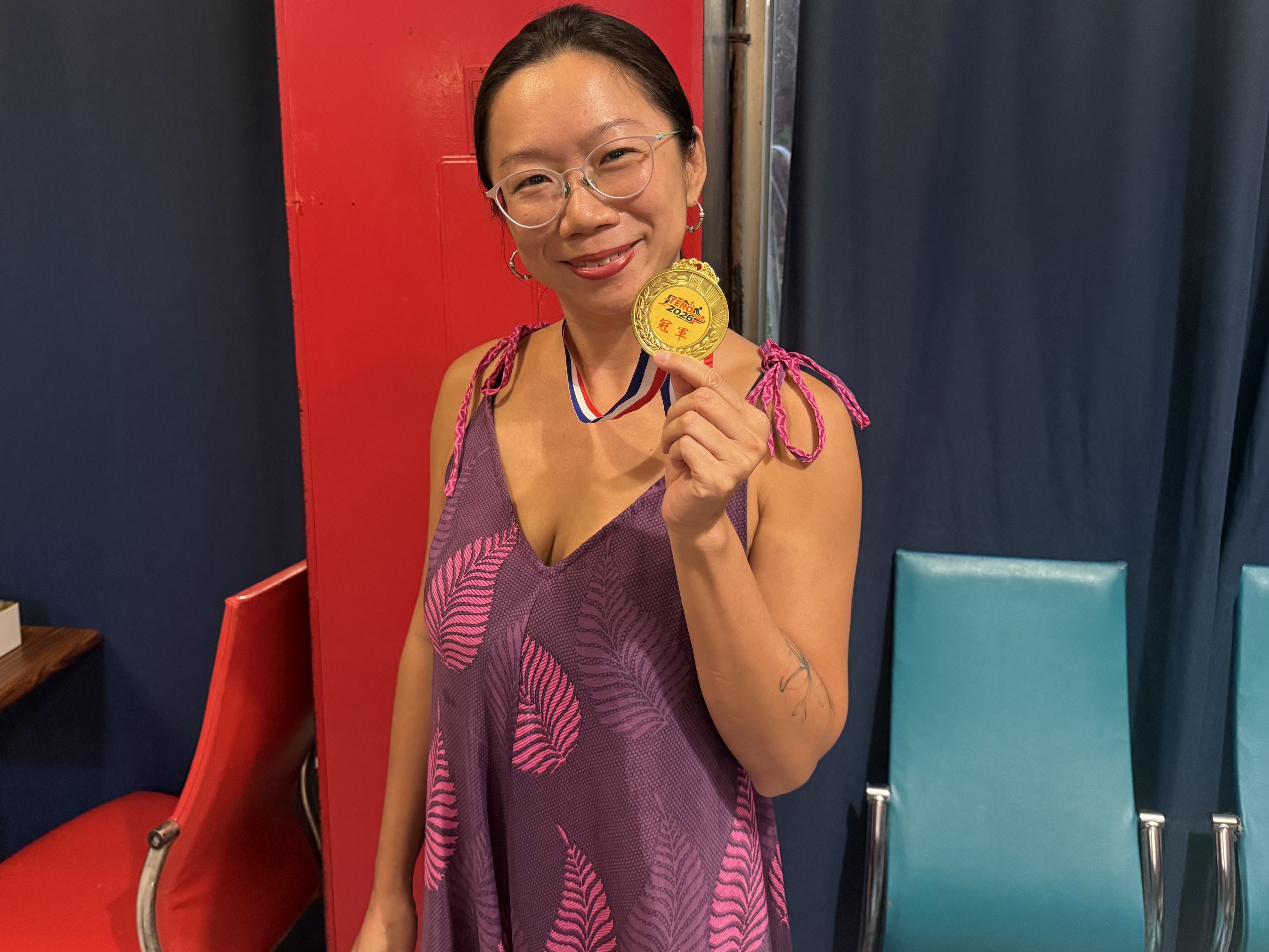 Sheila enjoying her medal after a tough competition. (Photo: Julien Oeuillet)
“I slept ten hours after the competition!” she says. “The first night, I was dead!”
She is not talking about athletics or even a math test. This gold medal is for a massage competition.
“The preparation, no alcohol! That was tough! Also the night before the competition: no AC! Because air conditioning tends to make me congested. And if I cannot breathe well, my work is not good. Bodywork depends a lot on breath.”
Sheila, whose Chinese name is 謝翠芹, just won first place in one of the categories of TERO 2026, a Taiwan-wide massage competition. TERO stands for Taiwan Exercise Recovery Techniques Open.
The idea of a massage competition is intriguing, and yet the event gathered around 40 candidates. Pictures provided by Sheila show a wide place, the kind where indoor sports games take place, where several massage therapists work their trade in front of a panel of judges.
And that's how she got a medal.
“I never participated in a massage competition before,” Sheila says. “I think I spent so much time after getting the gold medal thinking why the hell did they choose me? Out of 40-ish massage therapists, I could not watch them while we were competing, but I know they are all great, I can even feel it. I see their setup is very professional, whatever movement I saw was very graceful and attentive.”
There were two categories divided further into one category for professionals and another for students of art. Sheila's category was 自由式—綜合手技, which can be translated as Freestyle Integrated Manual Technique.
“I competed in the professional category,” she says, “but I respect everyone, nobody is an amateur here.”
Sheila, who migrated from Hong Kong over a decade ago and has acquired Taiwanese citizenship, made a business out of her massage skills on the small island of Xiaoliuqiu, a well-known resort place off the shore of Taiwan south of Kaohsiung.
“I started my business as a massage therapist in 2020,” she explains. “I got training in Chiang Mai, in Thailand, in 2019. I started as a massage therapist who goes to resort hotels, in bedrooms, when I moved from Kaohsiung to Xiaoliuqiu. It was not easy. I sometimes felt scared, as a woman, going to a room with a client. But I have to be brave. I used safety protocols such as asking to keep the room door open, and telling the concierge which room I am going to and for what, so they know where I am. After a while, I got my first student, who wanted to learn massage from me. After that, reputation, word of mouth, more students came, and I started teaching.”
Sheila now primarily provides massage classes. “Most of my income comes from teaching, 60 to 70%. I now receive clients mostly when I have time. Other than that, I focus on teaching. I have a studio in my house, with a stretching area and a massage room, and a bedroom for students to stay over when they take a course. The course lasts 4 days, so they must stay in Xiaoliuqiu.”
Through her experience we discover there is a business for satisfying people's desire to learn how to practise something that, at its core, is about wellness and relaxation.
About the profile of her clients, she says, “I have students who are just curious, they simply want to do it on an amateur level, housewives, normal people so to speak, who simply want to have a new skill they can use on their loved ones. Other people want to change their path, salespeople or office workers, who explore the opportunity to perhaps become a bodyworker, so it's a way for them to try it out. And the third kind is professional massage therapists who want to learn another modality of massage, because there are a lot of modalities. There is Swedish massage, deep tissue, etc. Thai massage is just one modality. A lot of professionals want to learn different techniques to integrate them into their work.”
This is reflected in the competition she just participated in: the official rules for the category in which Sheila competed describe it as testing the ability to combine different schools of “bodywork” into one coherent treatment. Competitors were able to include techniques such as Chinese tui-na, European schools of massage, Thai massage, facial massage, shiatsu and so on, as long as no tools were used.
For the competition, judges evaluated elements such as touch quality, fluidity, rhythm, body mechanics and the underlying logic behind what the therapist was doing.
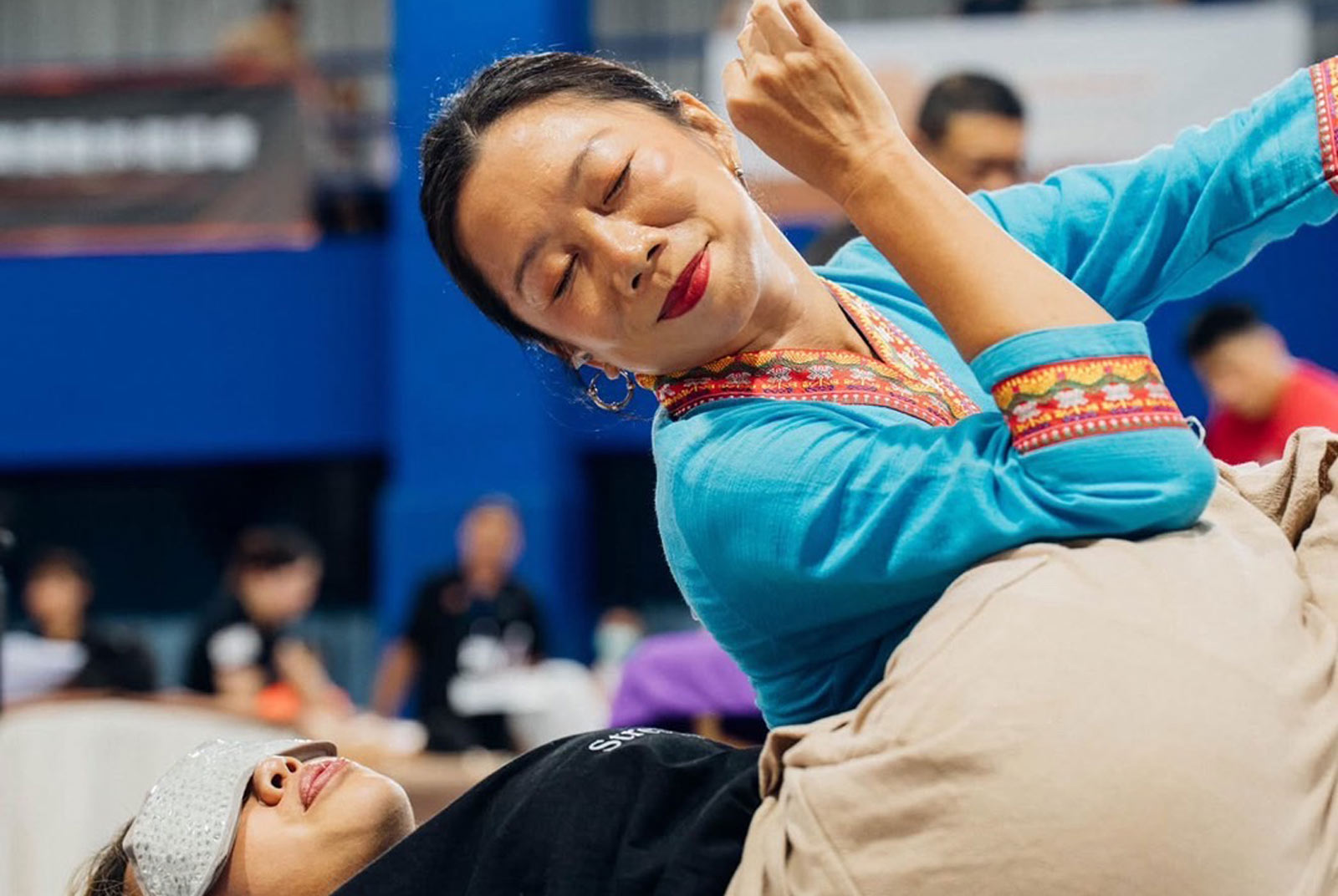
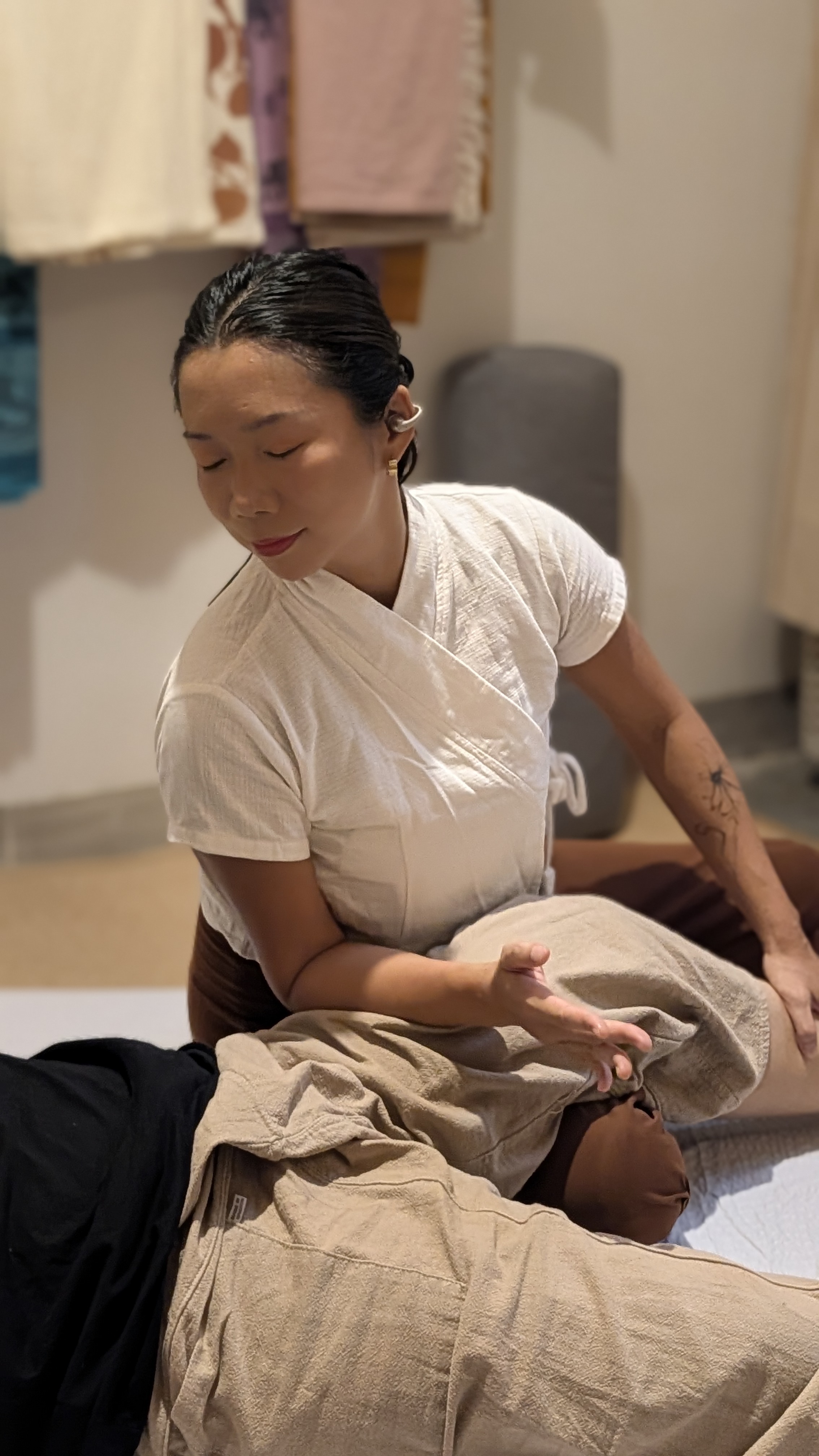 Sheila performing bodywork in her studio in Xiaoliuqiu. (Source: 高語君)
“I spoke with the judges a few days later and they gave me some feedback,” Sheila says. “They said I was in the very corner of the stadium, which is not a very good spot because Thai massage is on the floor, and being in this corner does not catch attention. But they said when they walked around and reached me, they felt my calmness and vibration with the model like it was contagious.”
I note she refers to the person she massaged as a model. The tone of the conversation is very much centred on mutual respect and, surprisingly, a lot of joy on an almost innocent level.
“The judges said I had a smooth flow and was very stable,” she adds, “but they said the most important thing is that I looked like I was genuinely enjoying myself. Massage normally happens behind closed doors. But in such a competition, you do it in front of everyone. That makes it very challenging. It takes a level of calmness, you have to be really resilient to bring massage therapy in front of a hundred pairs of eyes. Some people in the audience told me they could not stop watching and they were very moved.”
Massage as a job is still very misunderstood and overlooked.
The competition took place on 29 and 30 August. In an interview for CNA, the organisers claimed they created the event as part of an effort to professionalise and standardise massage therapy in Taiwan. They also stated they wanted the event to enlarge the sports-recovery market and connect Taiwan internationally.
“In Taiwan massage still is an industry that people look down on,” Sheila says. “They maybe think that you do this because you did not finish your education. It's not very respected by mainstream society. But now we have lots of influencers and massage therapist educators worldwide. They are teaching massage, they are showing their techniques, all these things make massage look more respectable, and especially quite hard to master! People now can see it takes skill.”
Skills but also self-discipline. “I spent a lot of time on details to prepare myself, including a lot of visualisation. I know that when I bring my technique there in the stadium, the most important thing is not the technique, it's the inner peace. If I am nervous it will affect it, and I think that day I managed to control my nerves very well. I spent a month training my breathing and self-control. No coffee, no alcohol for a month. A lot of grounding in nature. Being alone on the island was good for this but also had another effect: I was alone to train. I was the only one from Xiaoliuqiu to come to the competition, so I had no practice buddy. People who would be, say, in Taipei, they can practise with their friends before this competition, even between competitors, and they can talk about what to change or improve. But I was alone.”
And the industry is growing in Taiwan.
According to the Ministry of Health and Welfare, there were over 4,800 registered businesses in the field in 2017. By March 2024, the number had grown beyond 12,700. The Global Wellness Institute estimates that Taiwan's total wellness economy has an average annual growth of 4.8% between 2019 and 2024.
“I think after COVID a lot of people changed their perspective,” Sheila says. “They look at health and wellness differently. More people are willing to invest, including money, in taking care of themselves. Bodywork is one of these wellness things, along with yoga or meditation or freediving. The demand increased so of course more people became massage therapists. I also think the pandemic made more people want to do a job that is not 9 to 5. A massage therapist has full flexibility. We receive clients when we want and organise our time by ourselves.”
She believes potential clients also need to be told the truth about what massage is and what kind they would need. Sheila says, “I educate them. Some come with ideas such as thinking a massage has to be painful and rough, lots of therapists in Taiwan are beating you up! But actually a good massage therapy listens to the body and leads the body into recovery. Being rough will not bring the body to relax. It just makes the body more alert, but also makes it protect itself and not open up, whereas a good therapy is to invite the body to open up and release the tension. My primary style is Northern Thai style and it is milder and gentler. It is to entice the body, telling the body that it's safe now and can do its work to recover. In my training, the therapy itself doesn't heal or fix the client; we create the conditions for the body to heal. Our body has recovery power, but we just need to tell it, it's okay to do it now.”
Massage can have a strong impact on people. Sheila shared experiences of people who felt overwhelming emotions during her work, crying or falling asleep or suddenly coming up with personal reflections they may have been withholding for a long time. “I once had a client who cried,” Sheila says. “Her body was very buff, but that buffness did not look natural. Before I massaged her, I saw her shape and I thought, this body has a lot to say, I need to be very patient with it. I was very gentle. I knew she was very sensitive too so I did it extra slow. Right after the session her body just melted. And I saw her getting tearful. I did not ask her why, instead I told her if you want to take a moment to enjoy this peace I will leave you for a while. Massage therapy is somatic. Our bodies keep memories that they want to express but cannot express verbally. Sometimes a person just wants to release an emotion. And they cannot really explain it in words. And that's okay, it's purely somatic. I never push a client to verbalise something.”
This same need for self-care applies to massage therapists themselves. “Take good care of yourself first before you take care of other people,” Sheila says, “because a lot of therapists are compassionate to their clients but not to themselves, and that's a red flag. When you are tired, worn out, you are not going to last long in this career.”
This serves as a warning to anyone who considers the same career: you need to keep your body and mind in shape. And remember, as we were having this conversation, Sheila was just out of a Spartan regime she had to follow for her competition. “Therapists really invest in their own body and their own health. A lot! Students come to take my course and they are worn out, their bodies are just wrecked. And they don't want to spend time doing exercise, or spend money to eat better food. They don't want to make sacrifices to have a healthier lifestyle, such as sleeping earlier, waking up early, all these little things.”
Another aspect revealed by our conversation is that you do not need to be in Taipei to do this job.
In fact, being in a remote place served Sheila well. “Many people ask me, why do you do that on such a small island and not in Taipei or somewhere? Because there's not that much competition even in Taipei actually. But I would not have the ocean, not have nature, and I would not give the same quality. I think nature is one of the biggest factors in my therapist skills. It's a lifestyle.”
And the lifestyle is rewarded. As she puts her medal back in her bag, Sheila shows she's not much of one to brag but definitely one to enjoy life, whether it be through a nature-focused and healthy lifestyle, or letting go. “I still enjoy having a drink but I am not an alcoholic. To me, drinking is spending a good time with friends. That makes my heart happy, and when my heart is happy then my body is happy.”
Sheila's website: https://www.stretchologyasia.com/
Have you read?
- The Elephant in the Recording Room
- Joy Is Her Calling: How Lee A-Young Made Cheerleading a Career in Taiwan
- How DJ Swallow Set the Tempo for Taiwan’s Women DJs
Uploaded by Ian Huang
Views

Subscribe to CWE Newsletter (every Thursday)
Stay abreast of what's happening in Taiwan with our weekly digest.
Keywords: