Inside Grab's Singapore Headquarters: Southeast Asia's Super-App Leader Eyes Taiwan Expansion
Source:Chien-Tong Wang
Fourteen years after its founding, Grab has achieved its first full-year profit and is preparing for its biggest strategic leap yet: a US$600 million bid for Foodpanda Taiwan. The move would mark the super-app giant's first expansion beyond Southeast Asia, testing whether the hyper-localized playbook that helped it defeat Uber, build a digital finance ecosystem, and transform into an AI-driven platform can succeed in a new market. Can Grab replicate its Southeast Asian success in Taiwan—and beyond?
Views
Inside Grab's Singapore Headquarters: Southeast Asia's Super-App Leader Eyes Taiwan Expansion
By Yi-chih WangCommonWealth Magazine
At its Singapore headquarters, Grab has just marked its 14th anniversary — and delivered its first full-year profit since the company was founded. Net income reached $200 million on a revenue of $3.37 billion, with adjusted EBITDA up 60% year-on-year to $500 million.
Riding that momentum, co-founder and CEO Anthony Tan announced a $600 million deal to acquire Foodpanda's Taiwan delivery operations, a transaction now under review by Taiwan's Fair Trade Commission.
Grab operates across eight countries and more than 900 cities, serving over 52 million monthly transacting users through a super-app ecosystem spanning ride-hailing, food delivery, mobile payments, digital banking, and microloans — making it a daily gateway to digital life across Southeast Asia.
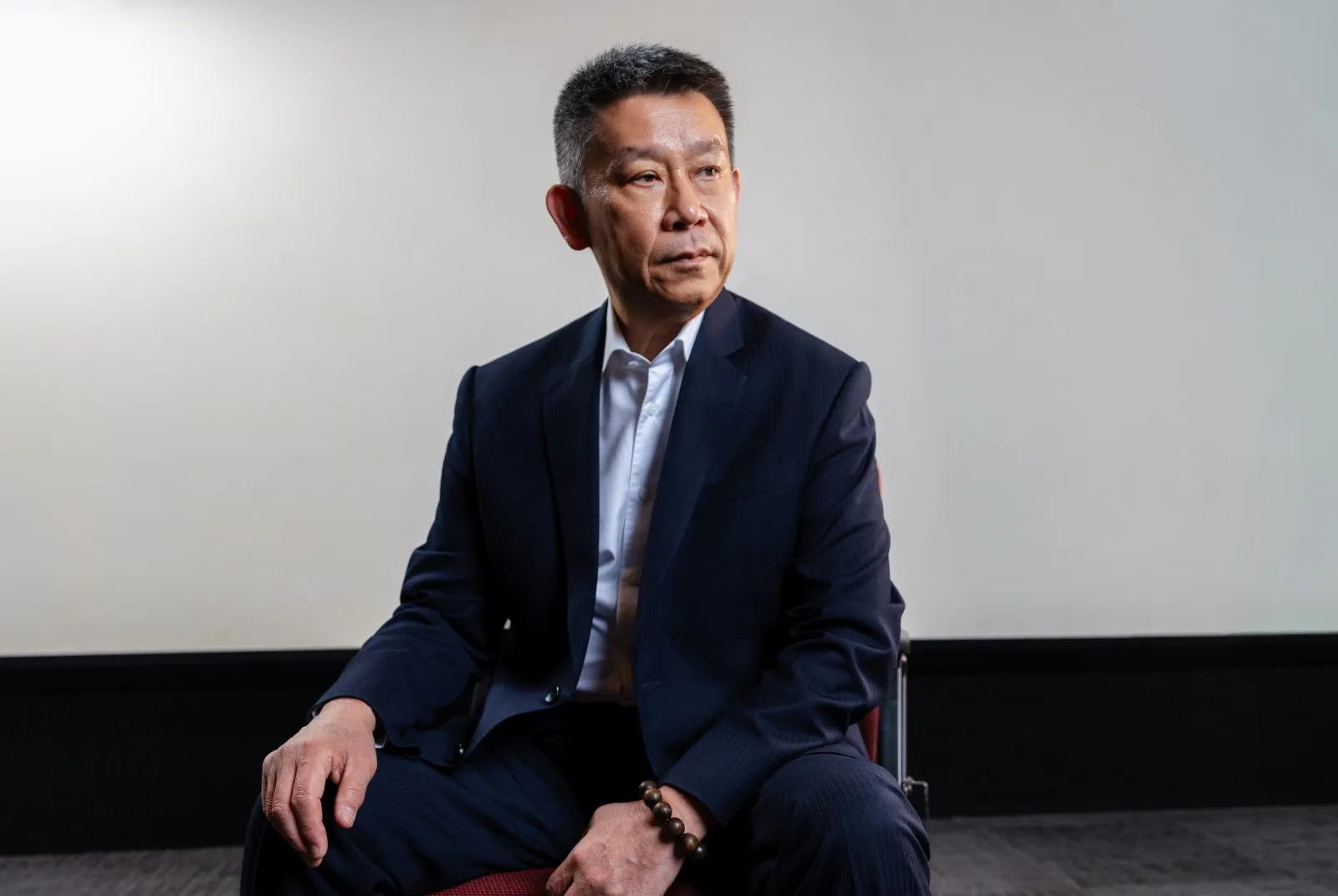
In an exclusive interview, Tan says Southeast Asia remains a high-growth market, but Taiwan holds its own appeal: a familiar high-density urban landscape, first-quarter GDP growth of 13.7% this year, and a market riding the AI wave. "We beat Uber once before," he says. "We believe we can do it again."
Industry observers see the Taiwan deal as Grab's first expansion beyond Southeast Asia since its founding — a test case that could determine whether the company can go truly global.
Grab's defining trait is hyper-localization. Entering a new market, its senior executives spend extended time on the ground conducting in-depth interviews with drivers; Tan himself relocated his family to Indonesia early on to experience daily life there. The top executives in Indonesia, the Philippines, and Malaysia are all local hires.
Services are tailored to local habits: modified pickup trucks ("songthaew") in Chiang Mai, tuk-tuks in Cambodia, and motorcycle-taxi service GrabBike in Indonesia and Vietnam.
Before launching GrabPay in 2016, Grab already let drivers accept cash — complicating reconciliation, but opening the service to lower-income users. Cash still accounts for a third of transactions today.
Tan considers Grab's real moat to be its self-built mapping system, detailed enough to cover unnamed streets in Cambodia and to number individual benches along Da Nang's beaches in Vietnam. Amazon and Microsoft both buy map data from Grab.
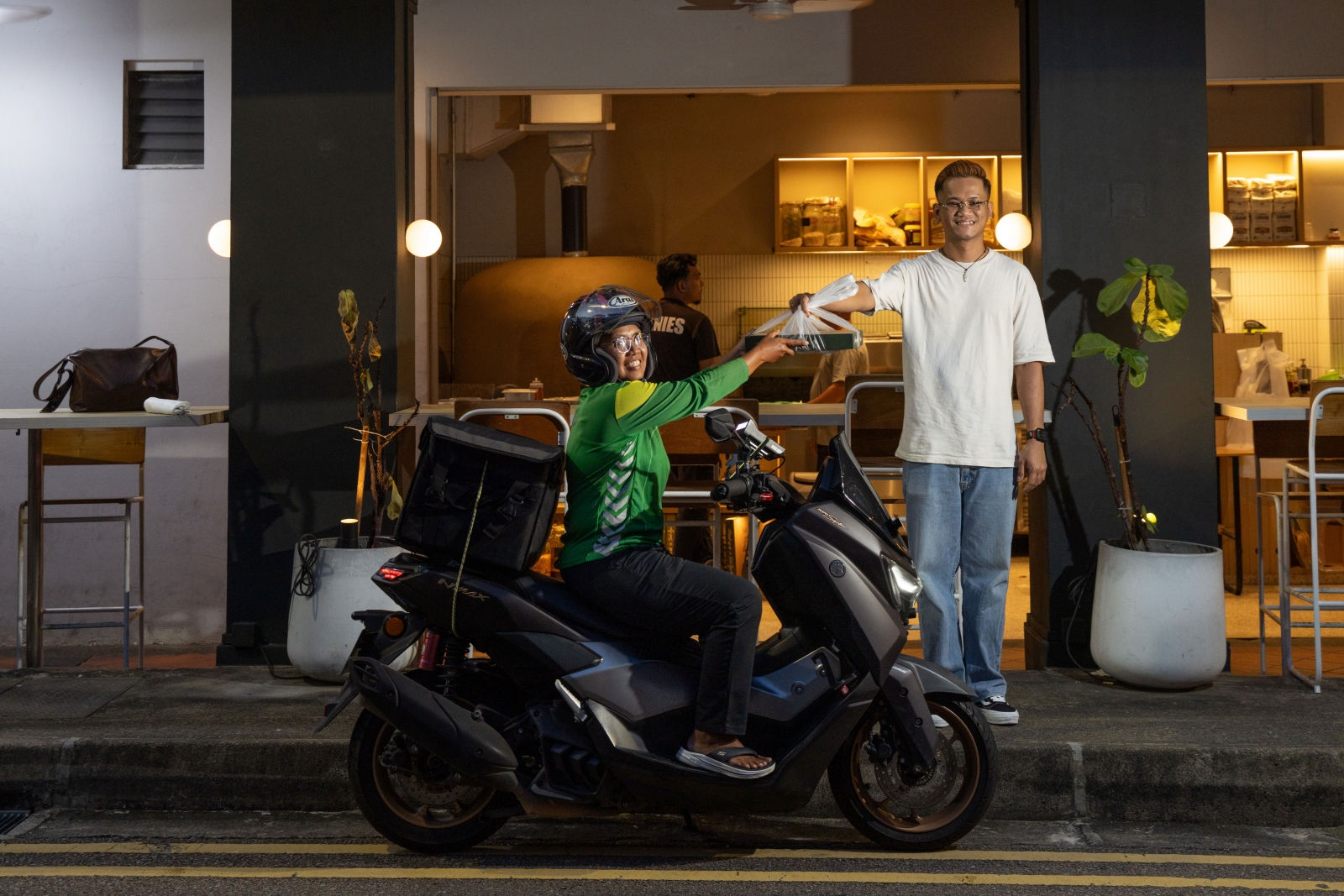 Beyond food delivery, Grab also offers Chope reservations and Dine Out in-store discounts, making it the broadest marketing channel for merchants. (Photo: Chien-Tong Wang)
That hyper-localized approach also led Uber, in 2018, to sell its Southeast Asian operations to Grab in exchange for a 27.5% stake — handing Grab both ride-hailing and delivery businesses and marking the starting point for its delivery arm. The combined entity's market share approached 80%, prompting Singapore regulators to fine both companies roughly S$13 million and bar Grab from requiring exclusive contracts with taxi drivers.
When ride-hailing demand collapsed during the pandemic, GrabFood and GrabMart grew explosively, revealing what Grab calls its flywheel effect: high-frequency delivery orders generate user and transaction data that feed into credit scoring, allowing street vendors and drivers unreachable by banks to borrow money — with Grab recouping loans through daily deductions from their delivery earnings.
Once it reached sufficient scale, Grab partnered with Singtel to launch digital banks in Singapore and Malaysia. President and COO Alex Hungate said financial services is Grab's fastest-growing business and is expected to turn profitable in the second half of this year. Delivery remains Grab's largest business by user volume but its lowest in terms of margin, and so it is now the company's most concentrated area of innovation — including 750 smart delivery lockers in Singapore and a pilot delivery robot, Carri, designed to save couriers time on pickup and last-mile delivery.
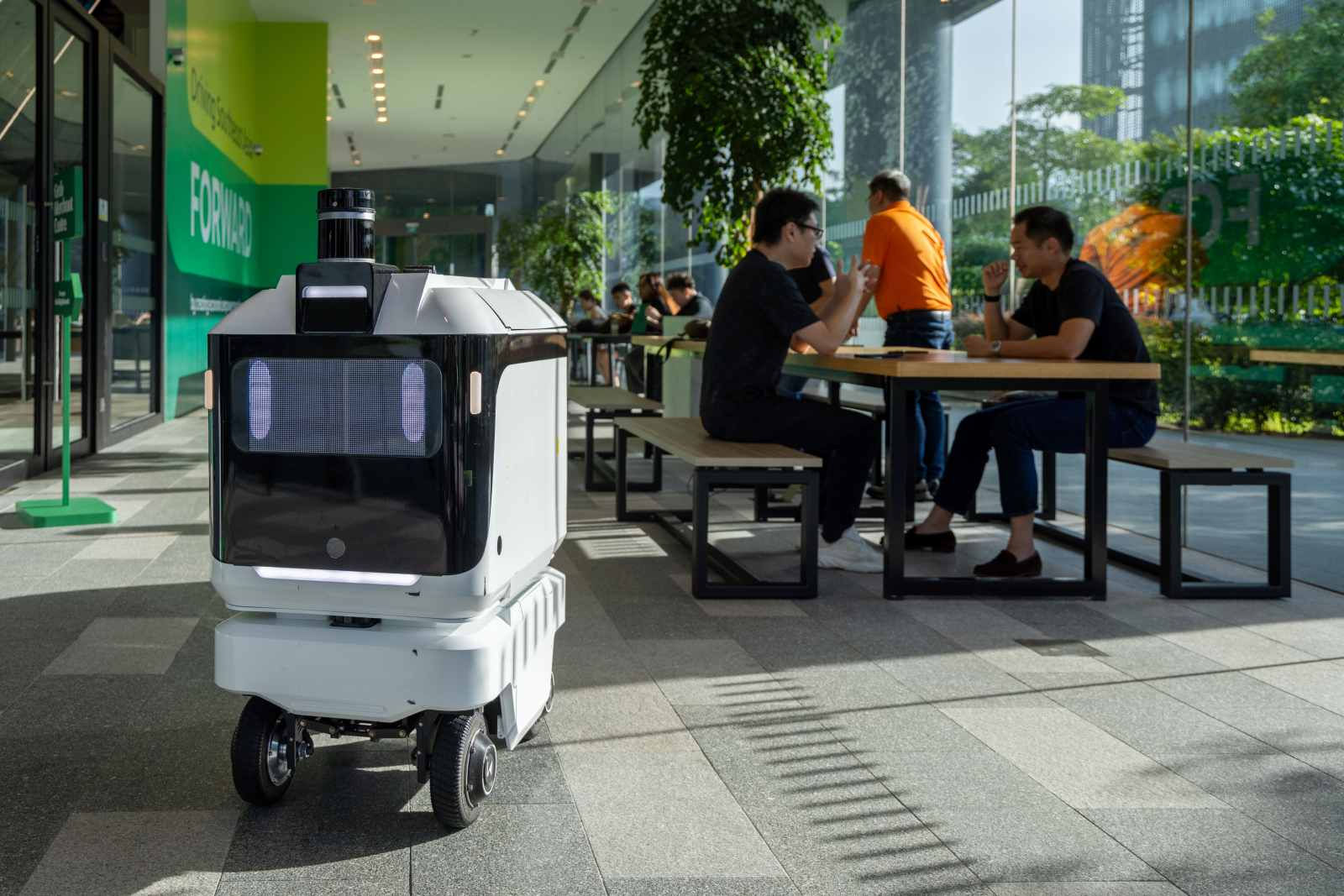 Pilot delivery robot, Carri. (Photo: Chien-Tong Wang)
Grab's corporate culture rests on four values, the “4Hs” — Heart, Hunger, Honor, and Humility — meant to unite its cross-border workforce. Its "Grab Benefits 2.0" program invests roughly S$4 million a year to provide delivery workers and drivers with medical insurance, income protection, and equipment subsidies; new recruits are paired with experienced "captains", and GrabAcademy helps workers transition to new roles. All employees, including engineers and finance staff, must complete a full day of delivery work upon joining, repeated every two years.
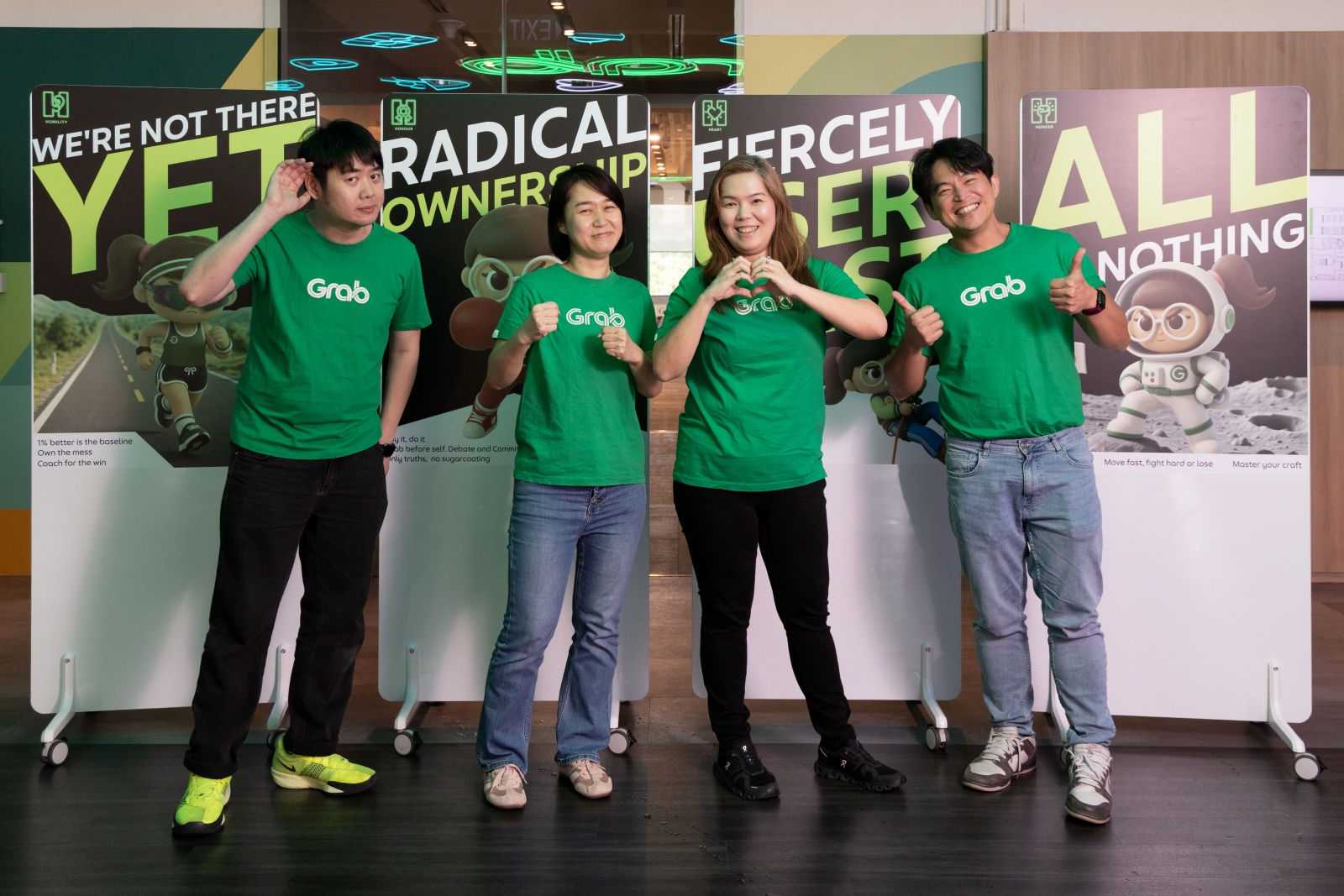 Grab employees creatively showcase the company's 4H culture: Humility, Hunger, Heart, and Honor. (Photo: Chien-Tung Wang)
In the face of the AI wave, Tan says Grab needs more than incremental improvement — it needs a wholesale transformation. In April, at its annual meeting in Jakarta, Grab unveiled the "Grab Intelligence Layer", rolling out 13 AI features at once, covering fare-splitting, free shipping across merchants, route optimization for rides, delivery dispatch, and loan risk assessment.
CTO Suthen Thomas Paradatheth says more than 90% of decisions in most markets are now made by AI without human intervention. Over the past five years, AI-driven dispatch has raised drivers' hourly earnings by 29% while cutting the price riders pay by 16%. To push the transformation company-wide, Grab paused routine operations for nine weeks, dedicating 9,000 employees to generative AI training and experimentation; a follow-up survey found the share of employees worried about AI replacing their jobs fell from roughly 80% to 70%.
Albert Chang, McKinsey's Southeast Asia managing partner, says Grab is shifting from an operating platform to an AI-driven technology and data company — and that its deeply localized, data-integrated ecosystem built on grassroots trust will be difficult to replicate.
Asked about future expansion, Tan reveals he's less focused on entering a hundred more countries than on making Grab a leader in AI: "If we can do that, we'll be the toughest competitor to beat, no matter which country we're in."
Have you read?
- Grab CEO Anthony Tan's Unlikely Path: Rejecting a Car Empire to Build Southeast Asia's Super-App
- Exclusive: Changpeng Zhao on Binance, His Prison Sentence, and Crypto's Next Chapter
- Joy Is Her Calling: How Lee A-Young Made Cheerleading a Career in Taiwan
Edited by Susanne Ganz
Uploaded by Ian Huang
Views

Subscribe to CWE Newsletter (every Thursday)
Stay abreast of what's happening in Taiwan with our weekly digest.
Keywords: